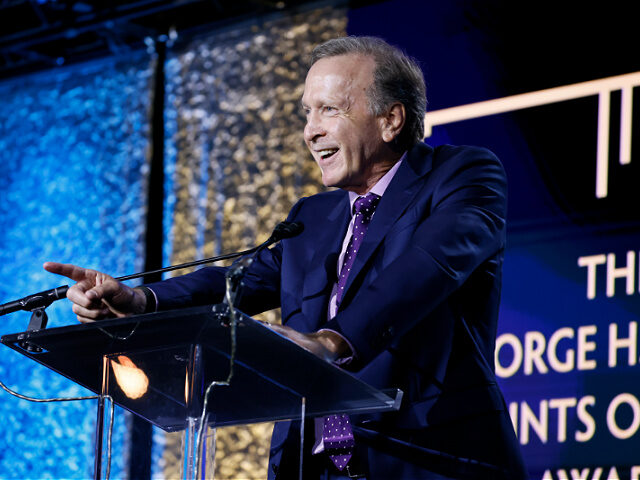
Neil Bush, son of former President George H.W. Bush and chairman of the Bush China Foundation, advocated for expanded cooperation with China during an appearance at the U.S.-China Hong Kong Forum, an event organized by the China-United States Exchange Foundation (CUSEF), which U.S. government agencies have identified as part of the Chinese Communist Party’s foreign influence network.
The remarks were highlighted in a video posted by Steve Bannon’s War Room co-host and White House correspondent Natalie Winters, who also published a detailed report outlining the forum’s links to CCP influence operations.
In his speech, Bush emphasized the need for increased interaction between U.S. and Chinese officials, stating, “The more they meet, the more they’ll have better understandings, the lower the tension will get, and hopefully the more normalized the relationship will look and the less fearful Americans will be of China.” He argued for a broad expansion of engagements — “We need more minister to minister. We need more student exchanges. We need more exchanges on all fronts, cultural and all fronts, including business.”
Bush also offered an example of U.S.-China collaboration in the renewable energy sector. He described working with an American company that brought in a Chinese investor to help scale a gravity-based energy storage technology, which is now being implemented in Rudong, China. He said, “They’ve spent over $100 million building this gravity-based storage solution … So it’s a great example of an area where there’s fewer barriers to collaboration.” He described climate, food security, aging, and health as areas ripe for further bilateral cooperation, stating, “There need to be more collaborations and those walls need to be broken down.”
In her accompanying article, Winters reported that the event was hosted by the China-United States Exchange Foundation (CUSEF), which is identified by the U.S.-China Economic and Security Review Commission as a CCP-aligned influence platform. According to the Commission, CUSEF is part of a broader United Front system that aims to “co-opt and neutralize challenges to the CCP’s political authority” and “guide, buy, or coerce overseas actors into serving Beijing’s political objectives.”
CUSEF has funded the Bush China Foundation with $5 million, distributed in one-million-dollar annual installments. In some years, this support has accounted for over 80 percent of the foundation’s operating budget, based on newly reviewed documents referenced in Winters’s report. The funding relationship and the foundation’s ongoing collaboration with CUSEF were prominently reflected at the forum, where Bush expressed pride in his partnership and support for continued engagement.
Chinese media drew attention to Bush’s public comments, with TVB citing him as a U.S. voice calling for de-escalation and partnership. In an interview with the outlet, Bush criticized U.S. trade policy: “To weaponize tariffs against China and Canada and Mexico, and friends all over the world, it’s a misinformed policy direction.”
Winters reported that the forum was “not an academic gathering, nor a neutral diplomatic dialogue,” but rather “the execution of a long-standing influence strategy” orchestrated through the United Front system. She noted earlier in her report that the event provided an ideal setting for CCP-linked organizers to “deliver exactly the type of legitimacy Beijing seeks from U.S. elites,” and argued that the inclusion of well-known U.S. names — from the Bush and Nixon families to institutional leaders — served Beijing’s aim to legitimize its narratives in Western discourse.
The Bush family’s historic ties to China were previously reported by Breitbart News and investigative works such as Peter Schweizer’s Red-Handed, including Neil Bush’s business deals with Chinese state-linked firms and George H.W. Bush’s diplomatic role in Beijing during the 1970s. Neil Bush received $400,000 annually from Grace Semiconductor, a company co-founded by the son of former Chinese President Jiang Zemin, the CCP leader who defended the Tiananmen Square massacre and maintained close ties with the Bush family.
Further ties have included public support for trade normalization — such as George W. Bush’s support for China’s 2001 entry into the World Trade Organization — and opposition to punitive policies following human rights violations, including George H.W. Bush’s refusal to impose meaningful sanctions after the Tiananmen Square massacre and Prescott Bush’s public opposition to restrictions on China. President George W. Bush also attended the 2008 Beijing Olympics despite widespread calls for a boycott, a moment later used by Chinese state media during the 2022 Olympics to discourage criticism of the CCP’s human rights record.
CUSEF’s leadership features high-ranking CCP-linked figures, including its founder and chairman, former Hong Kong Chief Executive Tung Chee-Hwa, who also serves as a vice-chairman of the Chinese People’s Political Consultative Conference (CPPCC) — a key advisory body in Beijing’s united front influence system. The group’s activities have also been publicly denounced by members of Congress, including Reps. Henry Cuellar and Mike McCaul, who warned universities that CUSEF aims to “spread China’s political agenda, suppress academic debate, and steal vital academic research.” These activities, often framed as cultural or educational exchange, are part of a long-term strategy to shape American public opinion and elite narratives in favor of the CCP’s governance model.
COMMENTS
Please let us know if you're having issues with commenting.