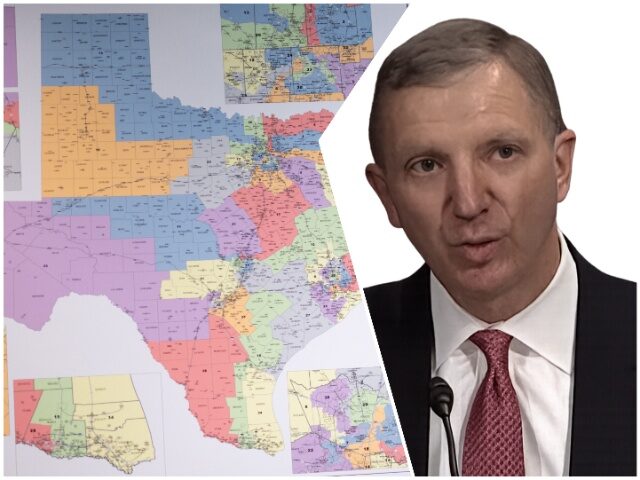

Federal Judge Jerry Edwin Smith delivered a blistering dissent against fellow jurist Jeffrey Vincent Brown, condemning Brown’s 160‑page injunction blocking Texas’s 2025 redistricting map as “a Nobel Prize for Fiction” and “the most outrageous conduct” he has seen in nearly four decades on the bench. Smith’s rebuke came as the Supreme Court stepped in with an administrative stay, halting Brown’s ruling that found Texas racially gerrymandered its new congressional districts.
The 2025 map would give Republicans five additional seats in Texas, thereby directly affecting control of the U.S. House of Representatives. The Supreme Court has not yet ruled on the merits of the case, and oral arguments are expected in the coming months.
The case is LULAC v. Abbott, No. 3:21-cv-00259-DCG-JES-JVB, in the Western District of Texas. The Supreme Court ordered that a response to Texas’s application be filed on or before Monday, November 24, 2025, by 5 p.m. (EST).
In his dissent, Smith, a 1987 Ronald Reagan appointee, concluded, “The main winners…are George Soros and Gavin Newsom,” and “The obvious losers are the People of Texas and the Rule of Law.”
In deciding to prevent Texas from using the 2025 Map, Judge Brown, a 2019 Trump appointee, opined, “Substantial evidence shows that Texas racially gerrymandered the 2025 Map.” His injunction temporarily blocked Republicans from expanding their congressional majority through redistricting and complicated President Trump’s efforts to secure a more substantial GOP House majority in the 2026 midterm elections. Brown concluded that race was the predominant factor in the drawing of these districts and that the map violated the Equal Protection Clause because race was used for partisan advantage.
Brown justified the extraordinary action of issuing a preliminary injunction by finding the harm to minority voters was immediate and irreparable. Texas Governor Greg Abbott and the State of Texas immediately filed an emergency petition with the Supreme Court to appeal.
Judge Smith blasted Brown, writing, “What’s the difference between God and a federal district judge? Answer: God doesn’t think he’s a federal judge. … Only this time, it isn’t funny.”
The senior judge accused Brown of “the most outrageous conduct” he’s seen in nearly four decades on the bench. Judge Smith lambasted Brown for rushing to publish a 160-page injunction without allowing time to deliberate with the senior judge and diminishing the impact of any dissent by publishing only the majority opinion on the docket.
“In summary, Judge Brown has issued a 160‑page opinion without giving me any reasonable opportunity to respond,” Smith explained. “Judge Brown was announcing that he would issue an opinion three days later—an opinion that I hadn’t even seen and might not be furnished before its issuance. That is unthinkable, but it occurred—and not accidentally.”
“Judges in the majority don’t get to tell a dissenting judge or judges that they can’t participate,” the dissenting judge continued.
The four-decade jurist warned that the ruling “sets a horrendous precedent that ‘might makes right’ and the end justifies the means.” He noted, “This isn’t my first rodeo.”
Judge Brown’s preliminary injunction, joined by Judge David C. Guaderrama (a Barack Obama appointee), triggered fierce backlash from Texas state leaders and Republicans who once supported Brown.
The three-judge panel was convened under federal law that requires multi-judge panels for statewide redistricting cases. Judge Jennifer Walker Elrod, Chief Judge of the Fifth Circuit, appointed Brown to the panel.
At the heart of Judge Smith’s dissent is the idea that gaining political advantage is not racial discrimination. Smith wrote, “The question for this three-judge district panel is whether the Texas Legislature did its mid-decade congressional redistricting to gain political advantage or, instead, because the main goal of Texas’s Republican legislators is to slash the voting rights of persons of color.”
The Reagan appointee charged that Brown rushed to publish the ruling to block Texas’s redistricting map and undermined the Texas legislature, silenced voters, and ignored the rule of law to hand Democrats a partisan victory. Smith wrote that LULAC’s legal theory in the lawsuit was “perverse and bizarre.”
California and other states have redrawn maps mid-cycle. The Texas case is seen as a test that could influence redistricting battles nationwide and frustrate President Trump’s efforts to secure a stronger GOP House majority.
Lana Shadwick is a contributing writer and legal analyst for Breitbart Texas. She is a trial and appellate lawyer specializing in family law and criminal defense in East Texas. Previously, she served as a prosecutor and family court associate judge in Harris County, Texas.
LULAC v Greg Abbott – Dissenting Opinion
COMMENTS
Please let us know if you're having issues with commenting.