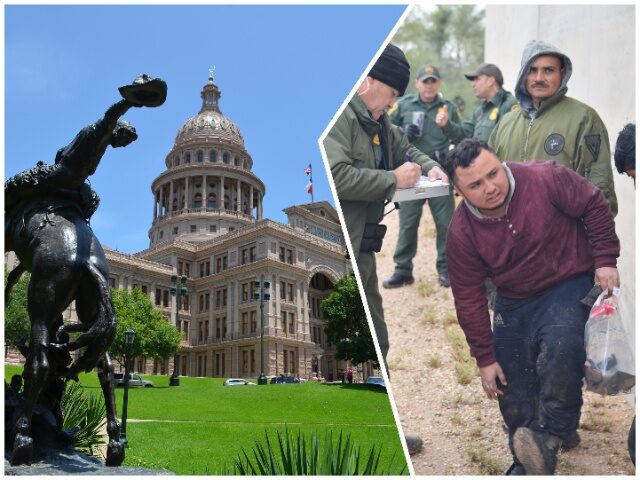

A Texas Democrat filed a bill this week in the State Senate to give $1,500 to every household in the Lone Star State. The one-time payment from the Texas Rainy Day Fund would fulfill a campaign promise by Governor-Elect Gina Hinojosa and would include payments to illegal aliens.
Texas State Senator Roland Gutierrez (D-San Antonio) filed the bill (SB 297) this week, calling for “one-time emergency household economic relief payments in response to a statewide affordability emergency” of $1,500 to be paid to every household in Texas. The bill includes no exceptions based on citizenship or immigration status. The only qualification is that the household must be established in the state on or before January 1, 2027.
The bill appropriates $17 billion directly out of the Economic Stabilization Fund (ESF / Rainy Day Fund). With the fund sitting at roughly $27 billion, this single measure wipes out more than 60 percent of Texas’s emergency savings in one stroke.
On her campaign website, Governor-Elect Hinojosa promised a $1,500 Corruption Tax Refund. She stated:
Greg Abbott has hoarded $27 billion in taxpayer money into the Rainy Day Fund – money that belongs to Texans – while families struggle to pay their bills. No Texas politician has ever hoarded taxpayer dollars like this – and it’s time Texans get that money back. It is fiscally irresponsible for the government – that money should be working in our economy.
The Rainy Day fund needs about a $10 billion balance to be fiscally responsible according to experts, so Gina will direct the legislature to return the other $17 billion to Texas families in the form of a $1,500 refund – because Gina knows your money should work for you, not sit idle in Austin.
This pledge is listed at the top of her gubernatorial priorities page.
RELATED CONTENT:
- OPINION: The Next Border Crisis — What Happens Along the Rio Grande Under Texas Democrat Leadership
- Democrat Takeover of Texas Threatens Biden-Style Migrant Flood
- Blue Tsunami Hits Texas: Massive Urban Turnout Enables Democrats Sweep of Statewide Executive Offices, State House; Senate Remains Red
- Up to 500 Migrants Cross into Mexico Headed to U.S. Border After Democrat Victories
LEGAL CHALLENGE
If the bill passes and is signed into law by then-Governor Hinojosa, it would likely face a court challenge. The Texas ESF was created to buffer the state budget against severe oil and gas revenue collapses, major natural disasters (like hurricanes), or multi-year state revenue shortfalls. There is no provision for a one-time universal cash distribution to address a manufactured affordability crisis.
The Texas Constitution, Article III, Section 51, explicitly prohibits the Legislature from making grants of public money to individuals. While there is an exception for “aid in case of public calamity,” the bill attempts to distort this exception by declaring a general, ongoing consumer inflation and utility cost-of-living crisis as a “public calamity.” Traditionally, a public calamity relates to relief from catastrophic floods, pestilence, or war.
The Texas Supreme Court maintains a strict three-prong standard for state expenditures:
- They must serve a clear public purpose,
- Retain government control over funds, and
- Ensure the state receives a return benefit.
SB 297 attempts to bypass this by declaring general inflation a “public calamity,” a definition courts have historically restricted to physical disasters (storms, pestilence, floods) or immediate wartime destruction. Challengers can push back that treating macroeconomic cost-of-living fluctuations as a “public calamity” effectively erases the constitutional limit on state welfare spending.
If it became law, SB 297 could also face a federal court challenge from the Department of Justice. Under the Personal Responsibility and Work Opportunity Reconciliation Act of 1996, illegal aliens are generally ineligible for state or local public benefits. This creates a preemption conflict by providing direct cash payments to “qualified households” without requiring proof of legal status or a Social Security number.
LACK OF CITIZENSHIP AND IMMIGRATION STATUS LEADING TO BORDER SECURITY CONCERNS
The bill would subsidize illegal alien households because it contains no requirement for a check on U.S. citizenship, proof of legal status, or a Social Security number. The bill simplifies the qualification process by allowing a utility bill, school record, or even a “sworn declaration” that the household meets the January 1, 2027, eligibility requirement.
Critics can highlight that Texas taxpayers would be funding $1,500 in direct cash checks to illegal aliens residing in the state. The funding provides a new magnet to attract illegal immigration into the U.S. and the State of Texas.
UNIVERSAL HANDOUT WITH NO WORK OR MEANS TESTING
SB 297 will subsidize wealthy Texans as much as it will subsidize the poor. Sec. 405A.003(c) explicitly bans any income cap, homeownership test, or tax-liability requirement. A billionaire in River Oaks or the Highland Park elite would receive the exact same $1,500 check as an hourly worker struggling to buy groceries.
Sec. 405A.003(c) forbids conditioning payments on employment, property-tax payments, or whether an individual has ever filed a federal or state tax return. It sends state dollars to non-taxpayers and able-bodied non-workers without any reciprocal obligation.
FRAUD AND ADMINISTRATIVE EXPANSION
SB 297 is ripe for exploitation. Section 405A.004(b) bars the Comptroller from denying payments simply because an applicant does not exist in any current government database. Requiring the state to issue checks based on vague documents or sworn affidavits creates a high risk of identity theft and duplicate claims—reminiscent of pandemic-era unemployment and stimulus fraud.
The bill also requires creating a new welfare bureaucracy. The bill carves out 1% of the $17 billion (up to $170 million) strictly for administrative overhead (Sec. 2(c)). Texas lacks a direct consumer disbursement infrastructure. This would force the Comptroller of Public Accounts, newly elected Democrat Sarah Eckhardt, to build a massive, expensive administrative apparatus from scratch.
INFLATIONARY POLICY, GOVERNMENT DEPENDENCY VS. STRUCTURAL TAX RELIEF
The sudden influx of more than $17 billion into the Texas economy could fuel the very inflation the bill claims to fight. The “relief checks” would drive up short-term consumer demand, further increasing the cost of goods, rent, and services.
Much of the so-called “affordability crisis” was created by the Biden-era Inflation Reduction Act (IRA). Breitbart News reported extensively on the inflationary impact of the hundreds of billions of federal dollars pumped into the economy.
The core conservative critique of the IRA was that it was branded as “inflation reduction” while serving primarily as a massive climate, energy, and healthcare subsidy and spending package. Nonpartisan models like the Penn Wharton Budget Model concluded that its 10-year impact on consumer prices was statistically indistinguishable from zero.
S.B. 297 labels a $17 billion cash disbursement as “household affordability relief.” Conservatives can argue this follows the exact same playbook: using the public’s real pain over high living costs to market legislation that fundamentally contradicts its stated objective.
Rather than a one-time government stimulus check that is quickly spent, conservative policy advocates returning surplus funds through permanent property tax cuts, lowering local school maintenance and operations (M&O) tax rates, or reducing the state sales tax burden, providing ongoing economic relief without expanding state government dependence.
IN CONCLUSION
Compounding the serious constitutional vulnerabilities, potential federal preemption hurdles, and inflationary risks is an inescapable arithmetic flaw at the heart of the legislation. With roughly 11.6 million households across Texas, cutting a universal $1,500 check demands at least $17.4 billion—leaving the bill mathematically underfunded out of the gate by at least $400 million before administrative overhead is even factored in.
The author’s own draft quietly anticipates this deficit: Section 2(d) explicitly mandates that the Comptroller must report shortfalls to state leadership once the $17 billion proves insufficient. Far from offering sound, sustainable economic relief, the measure guarantees an immediate fiscal crunch that will force state leaders to either shortchange hundreds of thousands of Texas families or initiate a second raid on the state’s greatly diminished Rainy Day Fund.
Beyond its fiscal shortfalls and legal hurdles, the bill establishes a sweeping entitlement framework that strips away standard taxpayer safeguards and invites massive exploitation. Because the proposal lacks any citizenship requirement or lawful-presence verification, Texas taxpayers would ultimately fund $1,500 checks for undocumented households—turning state reserves into a direct incentive for illegal immigration.
At the same time, the measure completely ignores financial need: by prohibiting income limits or tax-filing conditions, wealthy residents in luxury enclaves would receive the exact same government payout as low-income families struggling with essential costs.
Compounding both issues, the bill bars the Comptroller from denying claims simply because an applicant does not appear in existing government databases, allowing residency to be established through self-attested affidavits. This lack of rigorous identity verification invites rampant fraud and duplicate filings, mirroring the administrative vulnerabilities that compromised billions of dollars in pandemic-era cash programs.
As of press time, no companion bill has been filed in the Texas House of Representatives. As the Texas Senate remains under a Republican majority, it is unlikely to pass, but the bill is a bellwether indicator of the direction Texas Democrats seek to pursue.
Bob Price is the Breitbart Texas-Border team’s associate editor and senior news contributor. He is an original member of the Breitbart Texas team, established in January 2014. Price is a regular panelist on Fox 26 Houston’s What’s Your Point? Sunday morning talk show. He also serves as president of Blue Wonder Gun Care Products.
COMMENTS
Please let us know if you're having issues with commenting.