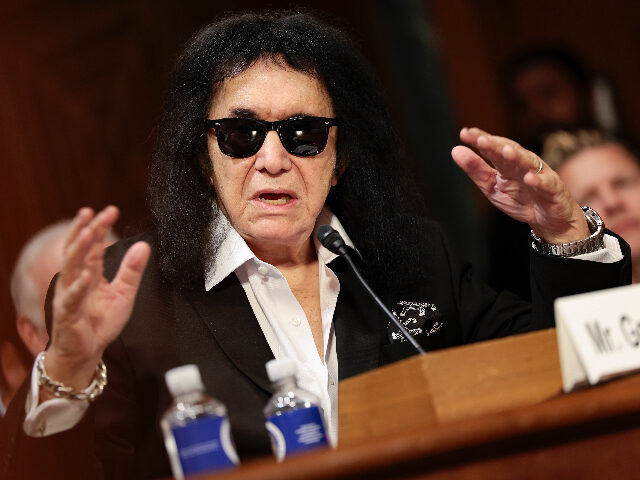
Dec. 9 (UPI) — KISS co-founder Gene Simmons and others testified for and against the proposed American Music Fairness Act during a Senate Judiciary subcommittee hearing Tuesday in Washington.
Simmons told the Senate Judiciary Intellectual Property Subcommittee that he supports the bill that would force AM/FM radio stations to pay royalties to the copyright holders of respective works played, according to Roll Call.
“It looks like a small issue [when] there are wars going on and everything,” Simmons said. “But our emissaries to the world are Elvis and Frank Sinatra.”
He said artists such as Elvis, Sinatra and Bing Crosby are treated “worse than slaves” by radio broadcasters.
“Slaves get food and water,” Simmons said. “Elvis and Bing Crosby and Sinatra got nothing for their performance.”
Also testifying in support of the proposed act was Michael Huppe, president and chief executive officer of SoundExchange, which helps music creators to collect royalties whenever their music is played internationally.
He said radio corporations made $250 billion in ad revenue over the past 16 years, while recording artists “were paid exactly zero.”
Broadcasters are using “other people’s property” to make money without paying them, and the United States is the only country that does not pay performers when they music is played on radio, Huppe said, adding that “even Russia and China pay.”
He said online streaming services pay recording artists, but not AM/FM stations.
Broadcasters once argued that radio promoted artists and new music, Huppe explained, but that no longer is the case.
He said most people now are exposed to new music online and via social platforms, such as TikTok and YouTube.
“The days of hearing a song on the radio and going out and buying a CD or an album at a store are long gone,” Huppe told the subcommittee.
Because the United States does not require royalty payments when songs are played on AM/FM radio, foreign governments do not pay royalties to U.S.-based artists.
Instead, he said nations like France collect royalties on U.S.-made music from French broadcasters and give them to French musical artists.
All other music delivery platforms pay artists, but AM/FM does not despite making nearly $14 billion in advertising last year from playing music, Huppe explained.
Broadcast radio stations pay DJs, talk show radio hosts and artists when the same programming is paid online, but not when they are played on analog broadcasts and AM/FM radio.
“No legitimate business or policy reason can justify that difference,” he said.
Opposing the proposed American Music Fairness Act, Henry Hinton, president of Inner Banks Media and longtime talk radio host in North Carolina, said the nation’s more than 5,100 free radio stations would suffer harm if it became law.
“I know firsthand the value and collaborative partnership of our stations and what we have with recording artists,” Hinton said, “but make no mistake: I also know firsthand that a new performance royalty imposed on local radio will create harm for stations, listeners and these very same artists.”
He called broadcast radio a “uniquely free service” that serves local communities “in a way that no other media can.”
Examples include hosting radiothons to raise money for local causes and providing “entertainment, inspiration and information,” including during emergencies and natural disasters.
Radio stations inform people of approaching danger and stay on the air, which at times is the only means of communication between emergency services personnel and the general public.
The Senate Judiciary subcommittee hearing lasted about 1.5 hours.
COMMENTS
Please let us know if you're having issues with commenting.