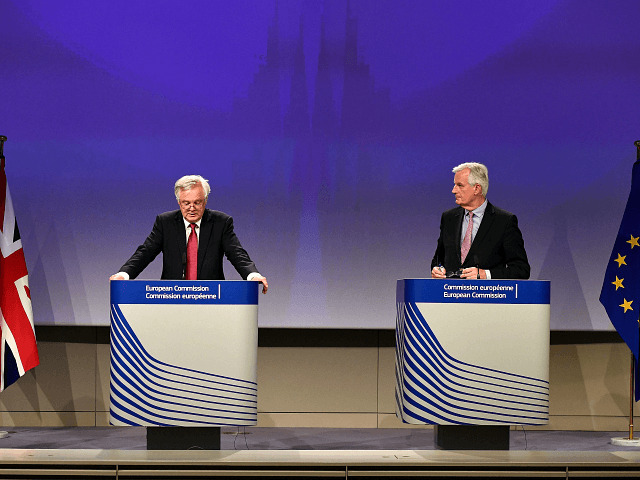
Brexit Secretary David Davis has issued an 11-page position paper proposing that EU goods entering the market prior to Brexit should remain on sale in the UK without restrictions, in hopes of speeding up trade talks.
“The UK believes that all goods lawfully placed on the market before exit should continue to circulate [between the EU and the UK] freely, without additional requirements or restrictions,” the paper states — but hints that this may be contingent on Brussels droppings its opposition to discussing a post-exit trade deal.
“The UK’s ambition is to work towards a comprehensive future agreement with the EU, which includes securing the freest and most frictionless trade possible in goods and services, to the benefit of all,” it continues.
“The UK enters these discussions with this in mind, and is seeking to avoid any unnecessary disruption during the move to the future partnership.”
David Davis described the paper as “[Helping] give businesses and consumers certainty and confidence in the UK’s status as an economic powerhouse after we have left the EU.
“They also show that as we enter the third round of negotiations, it is clear that our separation from the EU and future relationship are inextricably linked.
“We have already begun to set out what we would like to see from a future relationship on issues such as customs and are ready to begin a formal dialogue on this and other issues.”
Despite the Brexit Secretary’s apparent willingness to make concessions on customs, migration, trade and a lengthy transition period after Brexit — reportedly at the behest of Chancellor of the Exchequer ‘Remainer Phil’ Hammond — the EU itself remains intransigent.
Responding to today’s position paper, European Commission spokesman Alexander Winterstein appeared to rule out any deviation from the current negotiating framework in order to sketch out a future trade deal.
“There is a very clear structure in place, set by the EU27, about how these talks should be sequenced and that is exactly what we think should be happening now,” he said.
“So the fact that these papers are coming out is, as such, welcome because we see this as a positive step towards now really starting the process of negotiations.
“But as Michel Barnier has said time and again, we have to have sufficient progress first on the three areas of citizens’ rights, financial settlement and Ireland, and only then can we move forwards to discussing the future relationship.”
“Hopefully we can make fast progress on the three areas I have mentioned because once we have reached sufficient progress there, we can move on to the second stage,” he concluded.
https://twitter.com/JackBMontgomery/status/884026550835924992
A spokesman for Prime Minister Theresa May offered only a cautious reply, saying: “Both sides need to adopt a flexible approach.”
He added: We are working at pace. We are confident we will make sufficient progress. David Davis has said we want to move to the next stage in October.”
Meanwhile, the partly EU-funded Confederation of British Industry (CBI) took the opportunity to press for a “interim arrangements” which would see Britain “stay in the Single Market and a Customs Union until a comprehensive new deal is in force”.
Norway, Iceland and Liechtenstein entered into a similar arrangement — the European Economic Area (EEA) Agreement — in anticipation of their joining the EU in the middle of the 1990s.
When full membership was rejected in public referendums, however, the Agreement remained in place, and the three countries remain locked into the EEA until the present day.
COMMENTS
Please let us know if you're having issues with commenting.