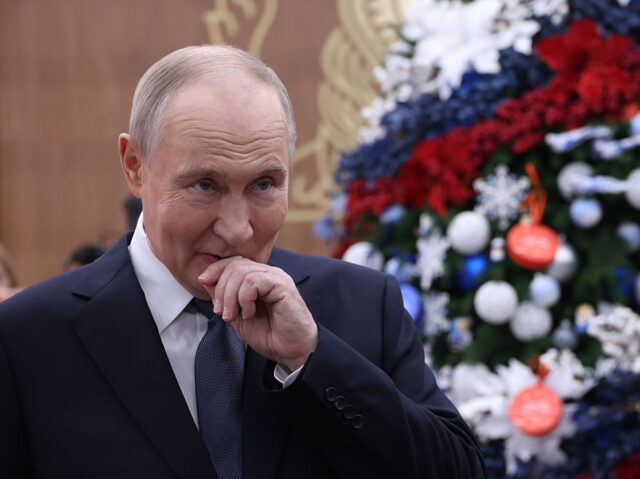
Tuesday night’s Ukraine peace talks prove Russia’s President Vladimir Putin has no intention of stopping fighting and he is merely stringing Western leaders alone to get more time to achieve his own battlefield ends, European political leaders blasted as the marathon meeting broke with no progress.
European nations spoke to common purpose on Wednesday to condemn Russia and the Federation’s President Vladimir Putin for both another unproductive peace summit, and for what they called his belligerent rhetoric on the possibility of a wider European war.
As is usual in Europe, the countries closest to Russia feel most under threat and tend to be the most voluble on Moscow aggression. Among the first to speak was Estonian foreign minister Margus Tsahkna, whose country borders Russia, and who said ahead of an EU summit on using seized Russian cash to fund Ukraine’s war effort: “What we see is that Putin has not changed any course.
“He’s pushing more aggressively on the battlefield… It’s pretty obvious that he doesn’t want to have any kind of peace… we must put more pressure on Russia”.
Finland, which has a considerable land border with Russia, saw its foreign minister Elina Valtonen hit similar notes, adding: “So far we haven’t seen any concessions from the side of the aggressor”. He called for a “full ceasefire” to build Western confidence that Russia is serious about peace. Finland’s President Alexander Stubb struck a somewhat pessimistic tone, saying he foresaw the war continuing without end: “all the conditions for a just peace that we have talked about so much over the past four years are unlikely to be met”.
Germany, although initially slow to involve itself in the Ukraine war but now an engine for European aid to Kyiv also spoke out on Wednesday to call on Putin to end the conflict. Their foreign minister Johann Wadepul said the diplomatic channels “are buzzing with activity” to gain peace, but nevertheless the “uncomfortable truth” remains; “Putin started the war in Ukraine – and he can end it at any time. He has yet to show any real willingness to negotiate.”
Ukraine’s foreign minister Andrii Sybiha said “Russia must stop wasting the world’s time”. A Kremlin spokesman, for their part, claimed “no, it would not be correct” to claim that Russia was rejecting peace.
In addition to Tuesday’s talks, Russia’s President Putin also made public remarks attempting to downplay his own country’s responsibility for conflict, and blaming Europe for artificially extending the Ukraine War by sending aid to Kyiv. President Putin insisted that Russia did not want war with Russia and asserted that should one come, it would be totally Europe’s fault.
This also drew European reaction today. The United Kingdom was particularly active in refuting these claims, with a spokesman for Prime Minister Sir Keir Starmer decrying these remarks as “dangerous” and “yet more Kremlin claptrap”. Other remarks from the British government called Putin’s comments “bluster”, “the same old sabre rattling”, and called out “the the irony of President Putin talking about warmongering”.
On the table in Brussels on Wednesday was whether the bloc would use £140 billion in frozen Russian cash held in European banks to fund further military support to Ukraine. The bloc already uses interest from frozen Russian assets for Ukraine, but this would involve making a loan of actual Russian money to Ukraine, which EU boss Ursula von der Leyen said Ukraine would pay back in future “if and when Russia is paying reparations”.
Because “we are in for the long haul with Ukraine” and Russia is “not willing” to negotiate for peace, it is up to the European Union to “increase the costs of war for Putin’s aggression” she said. Emphasising that “to be very, very clear: we want peace”, von der Leyen said the message she wanted to send to Moscow is “that the prolongation of the war on their side comes with a high cost for them”.
The cash confiscation plan has broad support among the EU’s member states but is opposed by Belgium, where much of the frozen funds being eyed up for the scheme are held. Belgium says it has concerns about the legality of the move and the risk of Russian retaliation in future.
COMMENTS
Please let us know if you're having issues with commenting.