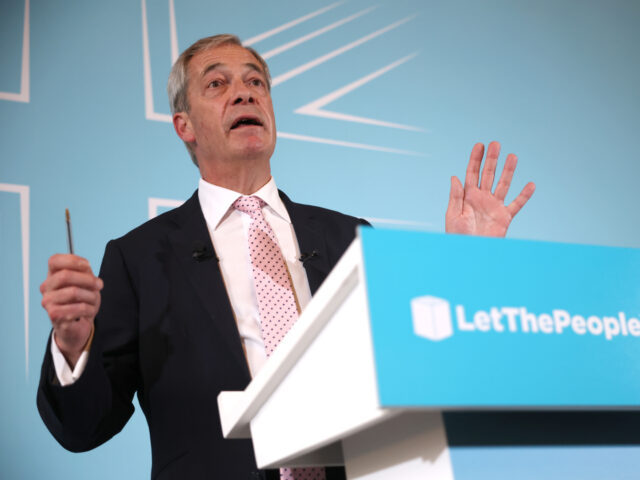

Reform UK leader Nigel Farage has warned of a looming “Brexit betrayal” as Prime Minister Sir Keir Starmer has tasked his MPs to craft legislation to outsource British sovereignty on regulations and standards to the European Union.
As a part of his so-called “reset” with Brussels, Prime Minister Starmer and his left-wing, anti-Brexit Labour Party are writing a “major” bill to realign the British economy with that of the EU, despite the PM having campaigned last year on upholding Brexit.
According to the Times of London, the bill could be introduced as soon as next month. Government ministers have argued that because many UK-based businesses supply both the British and European markets, imposing EU standards and regulations would save companies time and money in the form of lengthy paperwork currently demanded by the bloc.
However, this will likely mean that disputes would be decided at the EU level, such as by the European Court of Justice, rather than being decided in the supposedly independent UK. Yet, unlike before Brexit, the UK will have no vote in Brussels on how such standards and rules are made.
The BBC reported that the government will seek alignment in three main areas: farm and food exports, electricity, and emissions trading.
In an interview on Sunday with the BBC’s Laura Kuenssberg, Starmer said he believes it is in the “national interest” to align more closely with the European Union’s single market. However, he said that London will seek to make deals on an “issue-by-issue, sector-by-sector basis”, rather than admitting to rejoining the EU economic zone as a whole.
It comes on top of Downing Street striking a deal with Brussels to rejoin the Erasmus+ student exchange programme, allowing for UK and EU university students to spend a year studying abroad. While the government has said that it will pay £570m for a one-year membership in 2027, estimates from the Daily Telegraph have predicted that it may cost the British taxpayer £8.75 billion over the following seven years if the UK remains in the scheme.
Responding to the push for closer alignment with the European Union, Brexit boss Nigel Farage quipped that he does not believe that Prime Minister Starmer actually believes in the “national interest” of Britain, saying: “He just believes in Brussels. He believes in globalism. He believes in international law and all of those things.”
The Reform UK leader lamented that while Britain will be forced to follow EU rules, it will “have no say whatsoever over any of those rules that are made that affect pretty much every business in this country,” adding: “That is a full-on Brexit betrayal.”
Mr Farage highlighted the reported plans to align with the European Union’s internal energy and electricity market, which he warned would be worse for the British economy, businesses, and consumers than the far-left Net Zero green agenda imposed by the Westminster establishment on the country.
“We will now have to follow European Union rules on Net Zero. It will further damage British manufacturing. It’ll make it impossible for us to have data centres, AI, crypto, all the things that we’re going to need in the 21st century. It is an absolute sellout of British business and of British consumers with no benefit whatsoever,” he said.
Farage further argued that being trapped by EU market rules, such as those mandating tariffs on countries with high emissions, will squander the economic freedom and opportunities provided by Brexit to benefit from emerging markets around the world. He therefore pledged to fight against the Brexit betrayal, starting at the upcoming local elections.
In a statement on Monday, Starmer’s spokesman said that the deals with Europe will provide “huge benefits” to taxpayers and businesses, claiming that they will add nearly £9 billion to the UK economy by 2040.
“We’ve always been clear that some of this work will involve trade-offs, but as a sovereign nation, we’ll make the sensible, pragmatic choices that are in the national interest and stand to benefit the UK public.”
COMMENTS
Please let us know if you're having issues with commenting.