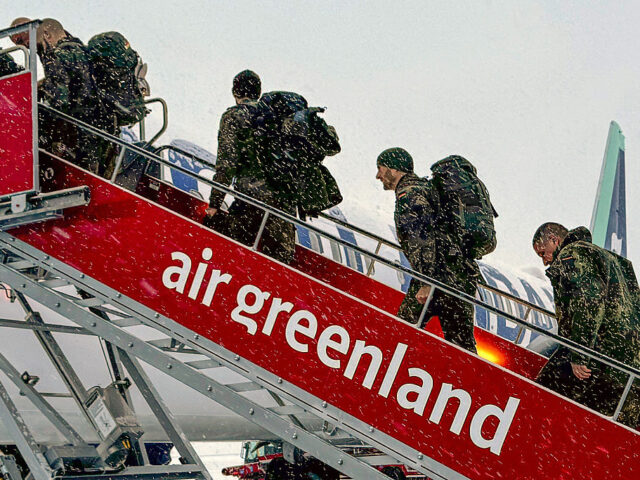

The Danish and Greenlandic governments poured cold water on the idea of a potential U.S. sovereign base on Greenland amid speculation over what the NATO-negotiated deal might involve, as Copenhagen and Nuuk insisted on “territorial integrity”.
U.S. President Donald Trump hailed a “framework” agreement with NATO leader Mark Rutte on Wednesday afternoon, the foundation for a potential future deal on enhancing American confidence in Arctic security, but Greenland and Denmark quickly moved against the speculated contents of the agreement. Greenland is a former Danish colony and presently a self-governing overseas territory.
Both Denmark and Greenland said while their concerns and “red lines” had been conveyed to NATO Secretary General Rutte, the alliance boss wasn’t authorised to negotiate on their behalf and they hadn’t been present at talks. Denmark’s left-wing Social Democrat Prime Minister Mette Frederiksen said her country was open to negotiations on a variety of matters, but said “we cannot negotiate our sovereignty”.
Frederiksen said on Thursday, as reports emerged that the compromise deal that could assuage American fears about strategic Greenland could involve the U.S. gaining permanent sovereign territory on the Arctic island, meaning its military bases there would operate on parcels of legally American land, rather than on borrowed Greenlandic territory, that:
The Kingdom of Denmark wishes to continue to engage in a constructive dialogue with allies on how we can strengthen security in the Arctic, including the United States’ Golden Dome, provided that this is done with respect for our territorial integrity.
A similar line emerged from Greenland itself, with its relatively new-in-office centre-right Prime Minister Jens-Frederik Nielsen who said he wanted to talk to the United States, including about basing President Trump’s Golden Dome missile defence system on the island, but he strongly implied there could be no transfer of territory. Danish media Nyheder reports he said: “we are ready to discuss a lot of things. We are ready to negotiate a better deal… But sovereignty is a red line. Our integrity and borders are definitely a red line that no one must cross”.
Nielsen said he wanted “respectful and good dialogue” and that “We are part of NATO. We are willing to discuss and do more. Let’s talk about it through the right channels… We want to strengthen security in the Arctic through important initiatives – including a more permanent NATO mission in Greenland and increased military presence and exercise activities”. The Guardian quoted Greenlandic deputy Prime Minister Múte Egede, who was said to be more blunt: “It is unacceptable to attempt to hand our land to others.”
Somewhat ironically, while proudly proclaiming the sovereignty of Greenland, Nielsen said the Greenlandic people had chosen the path of “the EU”, which the country isn’t a member of, and joining involves a certain degree of surrendering of national sovereignty.
Both Frederiksen and Nielsen said they didn’t actually know what had been discussed between Trump and Rutte and what was in the “framework” agreement that President Trump had said “gets us everything we needed to get… it’s a deal that everybody is very happy with”.
Greenland is a small democracy in a very large country; it has only 40,000 eligible voters and Nielsen won the 2025 general election with just 8,500 votes. The country itself is practically uninhabited, with the vast majority of inhabitants living in just a handful of coastal towns. Yet if the United States could negotiate for just one per cent of Greenland, it would have a parcel of land the size of the state of Maryland for the development of national and hemispheric defence, and Arctic security.
There has been a run on stores in Greenland in recent days as people try to buy bottled water, food, generators amid uncertainty over what the future holds. Per Nyheder, this may have been somewhat prompted by the Greenlandic government itself, which it said had sent instructions to every home in the country on how to create a “home emergency kit” to survive a five-day crisis.
COMMENTS
Please let us know if you're having issues with commenting.