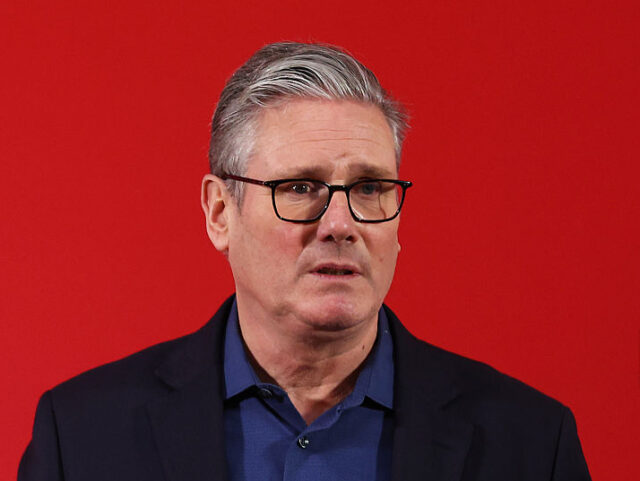
Prime Minister Sir Keir Starmer apologised to the public over Lord Mandelson’s relationship with Jeffrey Epstein but also issued a veiled threat to his political faction to stand behind him or risk a Nigel Farage government.
Britain is reeling from what has been called “the biggest scandal in British politics for over one century” and the Prime Minister, who is heavily implicated along with his top allies, is trying to cling on to power.
The walls are evidently closing in on Sir Keir Starmer, who attempted to show contrition in a speech on Thursday morning where the usually compliant legacy media broke containment to heckle the Prime Minister and, in some cases, tell him to his face that he had failed. Starmer’s speaking time was mostly used for planned remarks on his vision of a multicultural Britain where, ironically enough, he both criticised others for saying integration had failed while also saying himself that integration needed more government support to succeed. Attention, however, was all on his teetering relationship.
Following the astonishing admission in Parliament on Wednesday that he had known that Labour grandee Peter Mandelson had a relationship with American paedophile financier Jeffrey Epstein when he decided to appoint ‘Petey’ to the prestigious ambassadorial role to Washington, Starmer today attempted to portray himself as a victim in the affair. The top lawyer, who reached the top of his profession to become Director of Public Prosecutions before making the leap to politics, claimed that he had innocently accepted the reassurances of the veteran political operative known in the UK as “the prince of darkness” that he had no inappropriate contact with Epstein.
The Security Services also came in for flak from Starmer, although gently delivered, as he tried to cover his own gullibility for trusting repeatedly scandal-hit Mandelson by noting they, too, had failed to know the truth about Mandelson by allowing him to pass vetting prior to appointment.
Trying to position himself on the side of public outrage rather than the focus of it, Starmer repeatedly told his audience he shared “the anger and frustration” and stated “I was lied to, I was lied to.”
The Prime Minister said: “I regret making the decision to have appointed him in the first place. Had I known at the time what I know now, or I knew in September, I’d have never done it.”
Starmer also moved to draw a line under the scandal, widely discussed in British media this week as the worst in UK politics since the Profumo Affair, which was partially ‘resolved’ with resignations and suicide in 1963. When asked what his future as Prime Minister looked like, Starmer responded, “we’re moving forward as a country,” and he made a veiled warning to his party to think twice before deposing him in favour of a new leader.
Implying a choice existed between Keir Starmer as Prime Minister and Reform UK leader Nigel Farage, the Prime Minister said: “every minute we spend talking about anything other than the cost of living, Pride in Place, how we stabilise our economy … that we must unite this country, understand that to be British is to be tolerant, reasonable, compassionate and diverse, and fight for it against the toxic division of Reform, every minute we spend not talking and focusing on that is an absolute minute wasted.”
The journalists present for the speech evidently tasted blood in the water and, in contrast to regular convention, interrupted the Prime Minister several times to demand clarifications, even after their microphones had been turned off. ITV journalist Robert Peston told the Prime Minister in the course of his question asking whether Starmer would attempt to fight a leadership challenge or not, “You failed miserably, and there is no one to blame except yourself.”
Yet even as Starmer was speaking, back in London, leadership talk continued to rumble. The Guardian, Britain’s newspaper of the left and certainly the publication closest to Labour’s parliamentarians, continued to state call after call by party insiders for Starmer to go.
They cited Labour MP Karl Turner, who this morning said the mood in the party was the worst he had seen it in 16 years and that Starmer had to make a choice between power or clinging on to his all-powerful chief of staff Morgan McSweeney, who it is claimed pushed his ally Mandelson towards that ambassadorial job. Turner is reported to have said:
If the prime minister decides that he has to be surrounded by advisers who give him shoddy advice, I think the reality of that will end in the prime minister having to be making a decision about his future at some point soon.
I don’t want to be telling the PM who he’s entitled to have an as adviser … If McSweeney continues in No 10 Downing Street, I think the PM is up against it in a way that he doesn’t need to be.
Others quickly rejected Starmer’s bid to portray himself as a remorseful victim of Mandelson, including Farage himself, who underlined the magnitude of the scandal. He said during a press conference on Thursday:
Yesterday the Prime Minister admitted, because he had to, that despite the fact he’d known that Mandelson had continued his relationship with Jeffrey Epstein, even after he’d been sent to prison for underage prostitution, despite the fact the Prime Minister knew that he still appointed Mandelson to be our ambassador in Washington. But don’t think this scandal is just another scandal. It isn’t just some sort of Partygate but a bit bigger.
This involves sex, it involves money, it involves the royal family. It involves the leaking of market sensitive, confidential information. I suspect its pretty close, in many ways, to breaching the Official Secrets Act. This is far bigger than the Profumo Scandal of 60 years ago. This is the biggest scandal in British politics for over one century. And I would predict pretty comfortably… that Morgan McSweeney, the chief advisor, will be gone pretty quickly.
Mr Farage went on to joke that he hopes Starmer himself stays in power, for now, implying that his unpopularity benefits Farage’s own polling.
Tory leader Kemi Badenoch also responded to Starmer. She said today:
What he should apologise for is ignoring security advice and vetting that showed him Mandelson should never have been appointed in the first place. But, ladies and gentlemen, you will notice he cannot bring himself to do that because his self-righteousness is his greatest weakness.
COMMENTS
Please let us know if you're having issues with commenting.