
Britain’s Secretary of State for Defence subjected radio listeners to dead air on Thursday morning, as well as obfuscatory non-answers, when asked simple questions about the state of the nation, including how many warships it has.
Secretary of State for Defence John Healey, a trade unionist with no military service experience, spoke to several broadcasters on Thursday morning to field questions on the national defence at a time where public interest in the military is unusually high. Yet despite the importance of the brief amid a new war in the Middle East and intense public scrutiny of the questionable readiness of Britain’s Armed Forces, Healey seemed unready to answer several questions.
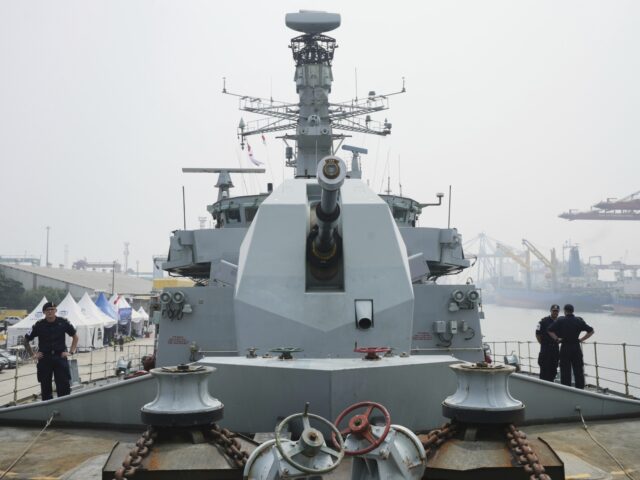
Speaking to London region radio station LBC, Healey was quizzed on the parlous state of the Royal Navy, the traditional first line of defence for British life and liberty, and asked “How many frigates do we have in the fleet?”. Healey responded: “we have, we have, we have, we have, ah… we have 17 frigates and destroyers”.
The answer was incorrect. Already perilously low after decades of swingeing cuts, 17 is the number of escort ships it was envisioned the Royal Navy would end up having at the time of the 2021 Defence White Paper. What has actually happened is two frigates have since been retired early as they were found to be worn out beyond economical repair, and the replacements for the outgoing 1980s-built Type 23 frigates have been delayed, meaning the actual number of commissioned escorts has plummeted to 13.
And of those commissioned escorts — destroyers and frigates, the mainstay of a modern navy — only a handful can be said to be active. One destroyer, HMS Dragon, has been deployed to the Eastern Mediterranean to act as guard ship for Britain’s bases on Cyprus, and the remainder are in refit or maintenance. Astonishingly, one of Britain’s six destroyers has been inactive for nearly nine years, and isn’t expected to be back in front line service from its present mammoth refit until late 2026.
Of Britain’s few frigates, one is deployed hunting for Russian submarines in the Atlantic and two are active on England’s southern coast. The remainder are in maintenance and refit.
When asked why Britain’s availability of warships is so low, Healey stated this was normal for any military. The Defence Secretary also spoke to Sky News on Thursday, where there was an attempt made to grill the minister on the danger of Iran’s newly revealed theoretical ability to strike distances with missiles at much longer range, which could put European cities including London under threat.
Rather than making any direct response to the assertion, Healey fended off three questions on whether Iran can bomb London or not by instead talking about whether the government had intelligence on whether Iran intended to, or not. While the UK mainland has precious little in the way of missile defences, Healey did note “Our defence of Britain is part of the layers of defence of nations”, an oblique reference to missile defence systems stationed in European NATO ally states over which, presumably, any Iranian missile would have to fly before reaching Britain.
The discussion of Iranian missiles and European cities came after Tehran, surprisingly, launched an attempted strike against the joint British-American base at Diego Garcia in the Indian Ocean. Thousands of miles away from Iran, the attack failed but tore up the narrative that Iran had no intermediate-range ballistic missiles. Actually how many of these missiles Tehran may have, whether this unlikely attack was attempted by Iran cannibalising its space programme for a last-chance Hail Mary strike, and whether it could ever have succeeded, all remain to be answered.
COMMENTS
Please let us know if you're having issues with commenting.