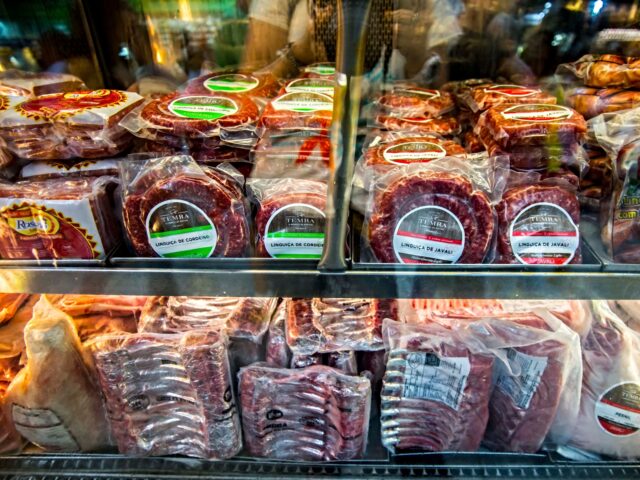

The European Union (E.U.) is set to ban Brazilian meat imports on September 3 over the use of antibiotics to stimulate growth unless producers show compliance with safety regulations before the deadline — an announcement that comes roughly two weeks after the E.U. provisionally kicked off its controversial free trade deal with Mercosur.
An E.U. committee group unanimously voted on Tuesday to remove Brazil from the list of countries authorized to export animal products intended for human consumption. The decision reportedly makes Brazil the first country to be removed from the list of states that complies with E.U. restrictions on antibiotic use in animals.
“The Commission confirms that Brazil is not included in the list, meaning that it can no longer export to the EU commodities (both food producing live animals and derived products) such as bovine, equine, poultry, eggs, aquaculture, honey and casings, with effect as from 3 September 2026,” Eava Hrncirova, the European Commission’s spokesperson for health, told Euractiv.
E.U. food safety regulations stipulate that antibiotics cannot be used on animals to promote growth, a provision that applies to both E.U. producers and imports. As such, Hrncirova noted, Brazil must ensure compliance with E.U. regulations “for the entire lifetime of the animals.”
Earlier this year, the E.U. and the Latin American trade bloc Mercosur signed a free trade agreement after both sides spent roughly 25 years in back and forth negotiations. Brazil, as a founding member of Mercosur, is among the countries that benefits from the trade deal’s ease of barriers and export provisions into European markets. The European Commission greenlit the agreement in January despite the fierce rejection from European farmers who protested the deal over concerns that the deal creates unfair Latin American competition that gravely jeopardizes their livelihood.
The deal went into provisional effect on May 1, 2026, pending a legal challenge presented before the E.U. Court of Justice in Luxembourg. The court, however, could take around two years to rule on the matter. The agreement also faces a new legal challenge presented by the Polish government this month. The upcoming ban, if it materializes, marks a new point of contention for the already convoluted EU-Mercosur trade deal, as the EU was reportedly the third top destination for Brazilian beef exports in 2025 after the United States and China.
“Trade agreements do not change our rules,” Hrncirova detailed to Euronews, and added, “The Commission establishes the Union’s mandatory sanitary and phytosanitary standards, and both our farmers and exporters from third countries have to comply with them.”
The Brazilian government expressed their “surprise” over the impending ban through an official joint statement from its Foreign, Agriculture, and Development Ministries in which the government affirmed its intention to take “all necessary measures” to reverse the decision and sure that Brazil can continue exporting its beef products to Europe. The government noted that such exports presently remain active before the impending September 3 ban.
The head of Brazil’s diplomatic delegation to the E.U. is slated to meet with health authorities on Wednesday to address the subject.
“With a robust health system of internationally recognized quality, Brazil is the world’s largest exporter of animal proteins and the main supplier of agricultural products to the European market,” the Brazilian government’s statement concluded.
The Irish Farmers’ association (IFA), one of the groups that has been at the forefront in opposing the E.U.-Mercosur trade deal, celebrated the vote against Brazil by affirming the E.U. Commission is “finally waking up” to Brazil’s use of antibiotics in its beef production. IFA President Francie Gorman recounted that, in November, the group participated in an independent investigation in Brazil over the “startling” use of antibiotics in beef farms. The group forwarded its report to the E.U. at the time.
Mercosur was founded in 1991 by Argentina, Brazil, Paraguay, and Uruguay, with several other regional countries forming part of the bloc as associate members. Venezuela was granted a full membership seat in 2012, but was suspended from the bloc in 2016 over the Venezuelan socialist regime’s numerous violations of human rights committed against its own people and violations of the bloc’s trade rules under the rule of now-deposed socialist dictator Nicolás Maduro.
COMMENTS
Please let us know if you're having issues with commenting.