

Existing Chinese vehicle manufacturing plants in Spain have turned the country into a “gateway” for Chinese vehicles into Europe, local outlets stated.
The growing arrival and continued penetration of Chinese automakers in European Union markets is a now years-long phenomenon across the regional bloc. It is reportedly estimated Chinese brands represent a majority of the 27 new vehicle brands on sale in Spain and in other European countries, with Chinese vehicles accounting for nearly ten percent of all sales in Europe.
Although the E.U. imposed protective tariffs on Chinese Electric Vehicles (EVs) in recent years, Chinese carmakers are able to completely circumvent the tariffs by manufacturing its cars in European factories instead.
While several Chinese carmakers have signed deals to establish manufacturing plants in European countries — as such as Chinese auto giant BYD in Hungary — Spain notably stands as the European country with the most amount of Beijing-based investment. Presently, there are five different Chinese vehicle manufacturing with a manufacturing presence in the entire country, or in plans to start manufacturing soon.
The Spanish outlet Ok Diario stressed on Friday that this has turned Spain into a “Haven of the Chinese automotive industry” and a gateway for Chinese vehicles into Europe, as China’s Chery, BAIC, Leapmotor, and others are now manufacturing their vehicles in Spanish territory.
Most recently, on Thursday, Chinese carmaker Geely announced that it will build two electric SUV models at Ford’s plant in Valencia, Spain through joint venture signed by both companies. Speaking during the announcement event, pro-China socialist Prime Minister Pedro Sánchez affirmed that the deal evidence Spain’s “capacity to attack investments.”
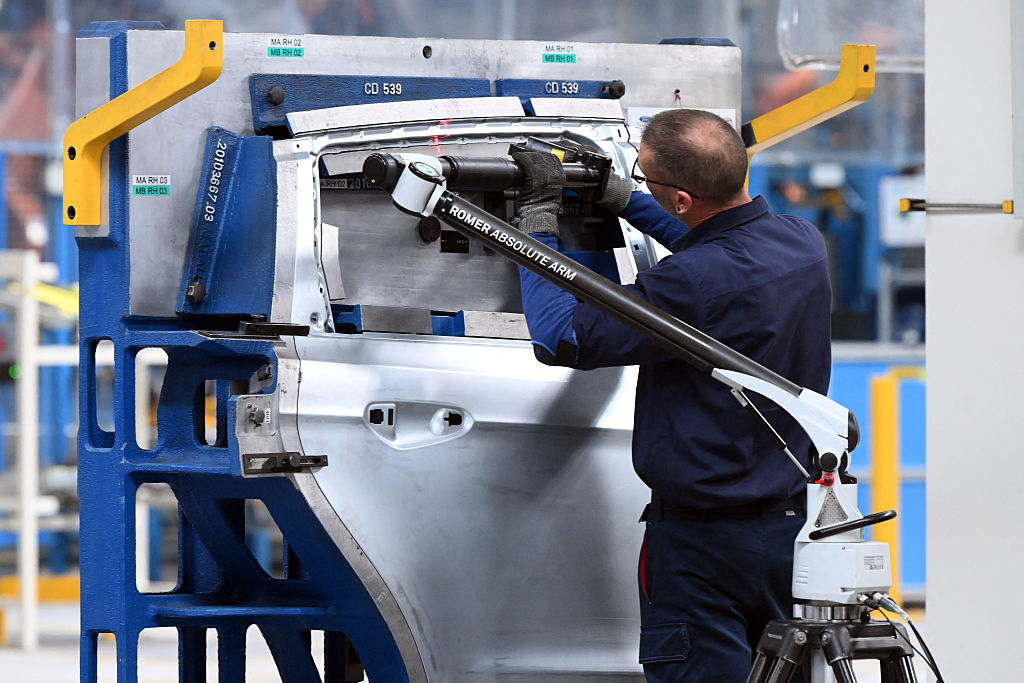
An employee works at the Ford factory in Almussafes, near Valencia on July 23, 2026. US automaker Ford announced plans to create a joint venture with Chinese group Geely at its struggling Spanish plant in Valencia, which will produce four additional models for both companies. (Photo by JOSE JORDAN / AFP via Getty Images)
The Spanish economy outlet El Economista, citing information from the Spanish Association of Automobile and Truck Manufacturers, reports that Chinese manufacturers are choosing Spain because it boasts one of the “most efficient logistic chains” in all of Europe. Local labor conditions, and “competitive” renewable energy prices is reportedly listed as other reasons for Chinese carmakers choosing Spain as their manufacturing hub destination.
China’s news agency Xinhua claimed on Friday that Chinese vehicles’ growth in Spain is supported by “growing consumer acceptable and rising demand for electric and electrified vehicles.”
“MG, BYD and Omoda & Jaecoo accounted for most of the registrations, while other Chinese brands, including Geely and Changan, continued to expand their presence in the Spanish market,” Xinhua wrote.
According to Xinhua, Chinese brands registered 75,024 new vehicles in Spain during the first half of 2026 — accounting for 12.3 percent of the market, and marking a 50.9 percent year-on-year increase.
Some of the Chinese companies, rather than build new facilities in Spain, have opted to install themselves in pre-existing locations that have been bought from their previous owners.
One such case is Chery, which signed a deal with Barcelona’s local government to occupy a shutdown plant previously operated by Japan’s Nissan. The Chinese carmaker reportedly plants to produce 200,000 vehicles in that plant by 2029.
As Breitbart News reported last week, the flood of Chinese vehicles is pushing European carmakers into downsizing, with Germany’s Volkswagen on the verge of shutting down several plants and firing 100,000 employees — nearly a seventh of its entire workforce.
While the E.U. applied tariffs to Chinese EVs it did not apply similar tariffs to hybrid vehicles. As a result, China was able to dump unsold inventory in E.U. markets, further exacerbating the prevalence of Chinese-made vehicles in the region.
COMMENTS
Please let us know if you're having issues with commenting.