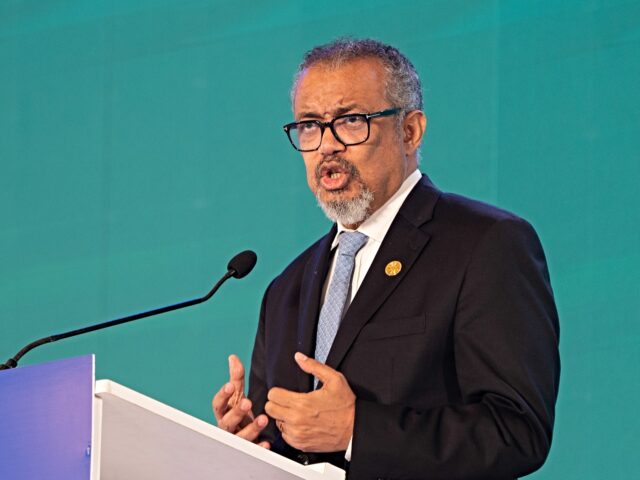
World Health Organization Director-General Tedros Adhanom Ghebreyesus suggested in remarks on Tuesday to African and European leaders that “sudden and unplanned” spending cuts following President Donald Trump’s decision to withdraw from the U.N. agency were an “opportunity” for poorer countries to pursue sovereignty.
Rather than relying on international aid from wealthier countries, Tedros recommended seeking alternative sources of funding and prioritizing the building of reliable public health institutions. Among the solutions he proposed were taxes on health-damaging goods such as alcohol and sugary drinks.
Tedros was in South Africa on the sidelines of the G20 Summit, meeting with world leaders. According to messages Tedros published on social media, he used meetings with world leaders to update them on a “prioritization and realignment process” within the W.H.O. that became necessary after it lost millions in American taxpayers’ dollars under Trump.
“Sudden and unplanned cuts to global aid are causing widespread disruption to health systems and services in many African countries,” Tedros explained on Tuesday in remarks at the African Union-European Union summit, not naming Trump directly as the reason for the cuts. “These cuts have exposed and amplified long-standing vulnerabilities, including soaring debt burdens and shrinking fiscal space.”
“I have said many times that in this crisis lies an opportunity—an opportunity to leave behind the era of aid dependency, and embrace a new era of sovereignty, self-reliance, and solidarity,” he suggested.
“In the short-term, WHO is supporting countries to develop affordable essential health benefit packages; To introduce or increase health taxes on tobacco, alcohol and sugary drinks;” Tedros continued.
The W.H.O. chief added that, in conversations with African leaders, he felt optimistic that they were “ready to take that opportunity and push for self-reliance.”
“Africa does not want charity; Africa wants fair terms,” he asserted.
In meetings with heads of government at the G20, Tedros shared on social media, he updated them on the W.H.O.’s attempts to cut its prodigious spending to align with expected income flows now that the United States is no longer a member. Tedros referred to this as a “prioritization and realignment process.” In his meeting with Canadian Prime Minister Mark Carney, Tedros assured him that the W.H.O. was working to “right-size” itself, a tacit acknowledgment that the bureaucracy had been suffering from some bloat.
President Donald Trump withdrew the United States from the W.H.O. on the first day of his second term as president, January 20.
“So, we paid $500 million to [the] World Health Organization when I was here, and I terminated it,” Trump explained at the time. “China, with 1.4 billion people, we have 350 … nobody knows what we have because so many people came in illegally. But, let’s say we have 325, they have 1.4 billion, they were paying $39 million, we were paying $500 million.”
In his executive order formalizing the move, the president shared a long list of failures by the U.N. agency prompting his exit, including “the organization’s mishandling of the COVID-19 pandemic that arose out of Wuhan, China, and other global health crises, its failure to adopt urgently needed reforms, and its inability to demonstrate independence from the inappropriate political influence of WHO member states.”
“In addition, the WHO continues to demand unfairly onerous payments from the United States, far out of proportion with other countries’ assessed payments,” the text of the order continued. “China, with a population of 1.4 billion, has 300 percent of the population of the United States, yet contributes nearly 90 percent less to the WHO.”
At the time, reports indicated that the United States was investing nearly $1 billion a year on the agency. The Trump administration remains an active United Nations member outside of the W.H.O., however, and has enthusiastically called for the organization to reduce unnecessary spending. In his capacity as American ambassador to the United Nations, Mike Waltz launched a new initiative this week calling for a 25-percent reduction in spending on the controversial U.N. peacekeeper program and firing 2,600 bureaucrats in New York, among other reforms.
Tedros and his officials initially responded to the announcement of the United States leaving the W.H.O. with condemnation and panic, suggesting that the organization would have to cut life-saving aid. America, Tedros conceded in March, “has been extremely generous over many years, and of course, it’s within its rights to decide what it supports and to what extent.”
He urged, however, that Washington uphold an alleged “responsibility to ensure that if it withdraws direct funding for countries, it is done in an orderly and humane way, with alternative sources of funding.”
COMMENTS
Please let us know if you're having issues with commenting.