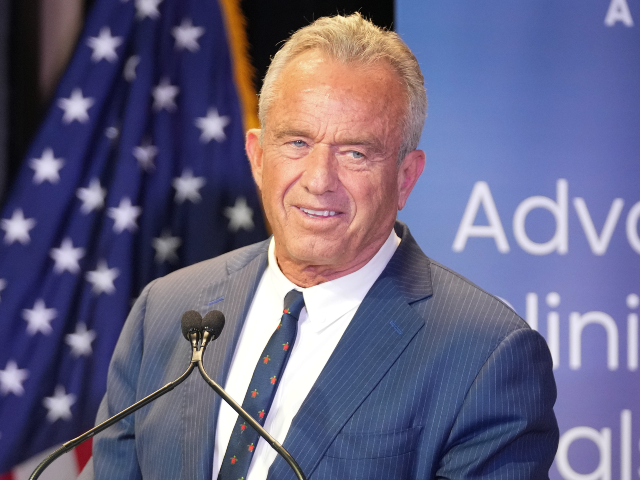

A dramatic reduction in opioid prescriptions and addiction and overdose deaths is being accomplished during the Trump administration, according to new analysis announced this week by Health and Human Services (HHS) Secretary Robert F. Kennedy Jr.
However, while U.S. opioid addiction and fatalities from drugs like oxycontin and fentanyl have been one of the top news stories in the U.S. for the past two decades, the latest positive development announced on Tuesday has been universally ignored by the legacy media, a Google search revealed.
“They never write about our accomplishments,” Kennedy told Breitbart News in an exclusive interview. “They did the same thing over the border, saying for years the president had no control, yet this administration closed it tight. When we lowered our drug prices, the highest in the world to the lowest, we got it done when no administration previously could — and nobody covered that, either.”
Kennedy added, “It’s like if a tree falls in a forest and nobody hears it, you wonder if it really happened.”
The HHS secretary announced the new opioid findings at a roundtable with local officials at the Detroit Wayne Integrated Health Network, which provides crisis and behavioral health services for metropolitan Detroit.
“President Trump has attacked the opioid crisis from every direction — rightsizing opioid prescribing, disrupting the fentanyl supply chain, and expanding treatment and recovery,” Kennedy also said in a statement released to dozens of news outlets. “Those actions are saving lives and driving opioid deaths to the lowest in nearly a decade.”
The new analysis came from the Office of the Assistant Secretary for Planning and Evaluation (ASPE) which examined America’s record-low overall age-adjusted death rate in 2025.
At its peak from 2021 until 2024 under the Biden administration, overdose deaths were averaging more than 100,000 a year, approximately twice the number of American troops killed in the entire Vietnam War, according to the Centers for Disease Control and Prevention (CDC).
That number dropped below 70,000 in a one year period ending in December of 2025 and as of May of 2026 was down to approximately 65,000.
Titled “U.S. Age-Adjusted Death Rate Reached a Record Low in 2025: What Drove the Decline?” the analysis examined the CDC’s provisional finding that the overall age-adjusted death rate reached 689.2 deaths per 100,000 people in 2025.
That is the lowest rate ever reported, according to HHS.
An accompanying analysis, “Two Opioid Policy Trends Are Moving in the Right Direction: Sustaining a Decade of Progress,” examines pharmacy dispensing from March 2015 through March 2026. Using population-adjusted measures, researchers found:
- Opioid prescriptions dispensed fell to 45.3 percent of their March 2015 level.
- Total opioid dosage dispensed fell to 35.2 percent of the baseline.
- The number of patients receiving prescription opioids through retail pharmacies fell to 49.6 percent of the baseline.
- The number of patients filling retail prescriptions for buprenorphine or naltrexone, medications used to treat substance use disorders, rose to 218 percent of the baseline.
The opioid crisis developed in three waves, according to HHS’s National Capital Poison Center.
The first began in 1991 with deaths following the sharp increase in prescribing pain killers, particularly oxycontin, with false assurances from drug companies that the rate of addiction was low.
The second wave started in 2010 with fatalities associated with heroin abuse. As early efforts to decrease opioid prescribing began to take effect, making prescription opioids harder to obtain, the focus turned to heroin, a cheap, widely available substitute.
The third wave of the epidemic began in 2013 with an increase in deaths related to synthetic opioids like fentanyl. The sharpest rise in drug-related deaths occurred in 2016 with over 20,000 deaths from fentanyl and related drugs.
Trump’s efforts to attack the opioid crisis actually began in his first term when he signed the SUPPORT for Patients and Communities Act in 2018, a landmark law that marshaled a series of prevention, treatment, and recovery measures to address the problem. Trump reauthorized the law in 2025.
On the law enforcement front, the Drug Enforcement Agency (DEA) intensified efforts to disrupt the global fentanyl supply chain and launched its Fentanyl Free America initiative, the HHS said in a statement.
In January 2026, President Trump also established the Great American Recovery to better align federal programs and integrate prevention, treatment, recovery support, and reentry across systems, according to HHS officials.
Kennedy’s appearance in Detroit, where he also announced that city would be receiving a $12 million grant to combat its homelessness and addiction problems, received some local coverage.
However, another report by a local outlet focused on remarks he made at a get-out-the-vote rally in Grand Rapids where he blamed radical Muslims for “destroying” that culture’s tradition of scientific discovery.
Critics from Muslim groups called his remarks Islamophobic and “white supremacist,” with one local outlet tying the remarks into others made against Democratic senate candidate Abdul El-Sayed.
The negative coverage, however, cannot negate the newly analyzed findings.
“For families living with addiction, saving a life means another birthday, another holiday together, another chance to come home — that is what President Trump’s commitment to this fight is about,” said HHS Senior Advisor Kathryn Burgum and co-chair of the recovery effort.
“Through the President’s Great American Recovery, we will keep our focus on the people behind the numbers and the families counting on the Trump Administration to save more American lives.”
Kennedy added, “We will keep pressing forward until every American struggling with addiction has a real path to recovery and a chance to rebuild a healthy life.”
Breitbart contributor Lowell Cauffiel is the author of the New York Times true crime best seller House of Secrets and nine other crime novels and nonfiction titles. He is also the cofounder of Primary Purpose Productions, which made short films that inspire drug addicts and alcoholics to seek recovery. See lowellcauffiel.com for more.
COMMENTS
Please let us know if you're having issues with commenting.