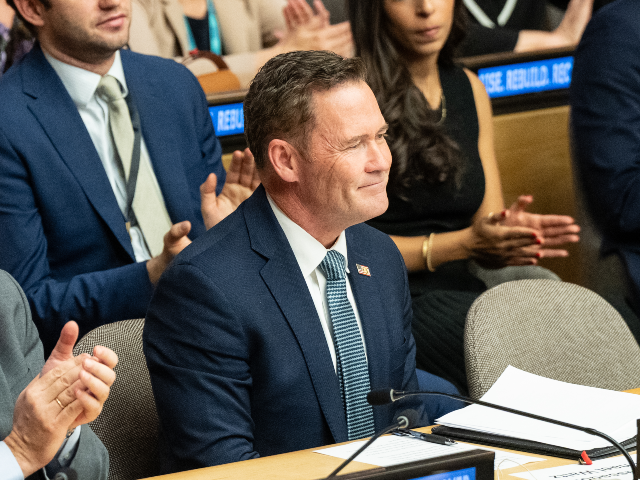

The United Nations passed a symbolic resolution on Wednesday condemning the alleged American “embargo” on Cuba with the lowest number of positive votes since the tradition began in the 1990s, suggesting a dramatic turn against the communist state at the international body.
Every year, the United Nations General Assembly schedules a vote for countries to pass a resolution that calls for America to trade openly with the bloodthirsty communist Castro regime. It has passed each year, often with only America and Israel voting against it. The “embargo” is a U.S. policy that limits commerce with Cuba to prevent American money from funding the Castro regime. It does not limit Cuba’s access to the global market and includes exceptions for food and medicine, which has made America one of the largest providers of basic food goods to the island nation.
Despite this, the Castro regime blames the “embargo” for the state of abject poverty that engulfs most in the nation, with the notable exception of the Castro family. Leftist regime allies around the world regularly echo this talking point, which defies the reality of communist authoritarianism having impoverished what was once Latin America’s wealthiest country.
Last year, 165 countries voted to condemn the alleged “embargo,” itself a significant improvement over the 2024 vote where 187 countries voted in favor and only America and Israel voted against the resolution. On Wednesday, only 130 countries supported Cuba’s resolution demanding free economic relations with the American “empire,” which it presumably wants to distance itself from.
Three times the number of countries chose to vote against the resolution, abstain, or not show up to the vote at all compared to 2025. A group of 14 countries voted against the resolution, largely represented by Latin America and Eastern Europe. Among the opponents of the anti-American resolution were Argentina, Colombia, and Paraguay, now all led by conservative leaders; Ukraine, which is currently being invaded by Cuban soldiers supporting Russia; and the United Arab Emirates (UAE) and Morocco, representing opposition to the Castro regime in the Muslim world.
The list of abstentions also included some notable countries such as Albania, led by a nominally socialist government; a host of European countries supporting Ukraine in the Russia invasion including Germany, Italy, Poland, and the Netherlands; South Korea, run by a left-wing government; and some small island nations such as the Solomon Islands and Palau.
On the list of absences were former Cuba allies such as Venezuela and Syria and a variety of international member states such as Jordan, Tajikistan, and Somalia.
The independent outlet Cubanet observed that four countries — Colombia, UAE, Slovenia, and Trinidad and Tobago — moved from supporting last year’s anti-American resolution to voting against it this year. Another 17 countries abstained this year when they had voted in favor of it in 2025. Six countries voted against the resolution that had abstained last year: Bosnia and Herzegovina, Czechia, Costa Rica, Ecuador, Lithuania y Morocco.
Only two nations, Cubanet observed — Madagascar and Nauru — voted in favor of the resolution this year and not last year. Both had abstained a year ago.
“Today nearly triple the number of nations voted no, abstained, or just chose not to vote — turning their back on Havana’s sham resolution at the UN,” American ambassador to the United Nations Mike Waltz wrote in a statement following the vote. “More work to do, but the world is starting to push back on Cuban regime propaganda as their corruption and oppression is exposed. Cuba Libre!”
Ambassador Waltz accompanied his message with a photo alongside two guests to the vote: Orlando Gutiérrez-Boronat, the organizer of the Assembly for the Cuban Resistance and longtime Cuban freedom activist, and José Daniel Ferrer, the leader of the Patriotic Union of Cuba (UNPACU), believed to be the country’s largest dissident organization.
Waltz has spent much of the past month at the United Nations making the case that the Cuban Castro regime is a blight on the world and encouraging other countries to support human rights activists in the country. This week, Waltz offered extensive evidence before the General Assembly showing the exorbitant wealth of the Castro family and the tiny Communist Party elite inner circle, demonstrating that the true cause of Cubans’ poverty was widespread theft. Among the evidence was the status of Nave Pilar, the Castro family’s private luxury island, and Fidel Castro’s personal Rolex collection, which remains in the family.
The presentation outraged Cuba’s so-called diplomatic representatives, who organized a mob scene to shout over Ambassador Waltz’s presentation. Cuban Foreign Minister Bruno Rodríguez was among the disruptors, attempting to make it impossible for Waltz to continue speak. In the ensuing chaos, a Cuban “diplomat” allegedly attacked Waltz spokesman J.P. Freire, attempting to steal his phone.
Ambassador Waltz later confirmed that “Secretary [Marco] Rubio signed the paperwork to eject the diplomat” who confronted Freire.
Last week, also in anticipation of this vote, Ambassador Waltz held an event on the sidelines of the U.N. titled “Cuba Libre: The Oppression that Havana Hides,” in which several victims of the Castro regime testified of the atrocities the Cuban government regularly commits. A Ukrainian diplomat also attended the event, detailing how Russia uses Cuban nationals as “cannon fodder” with the regime’s blessing to sustain their invasion.
A horde of Cuban regime “diplomats” also attacked that event, attempting to stage an “act of repudiation,” its traditional mob attacks on dissidents, shouting “long live the revolution!” at attendees of the event.
COMMENTS
Please let us know if you're having issues with commenting.