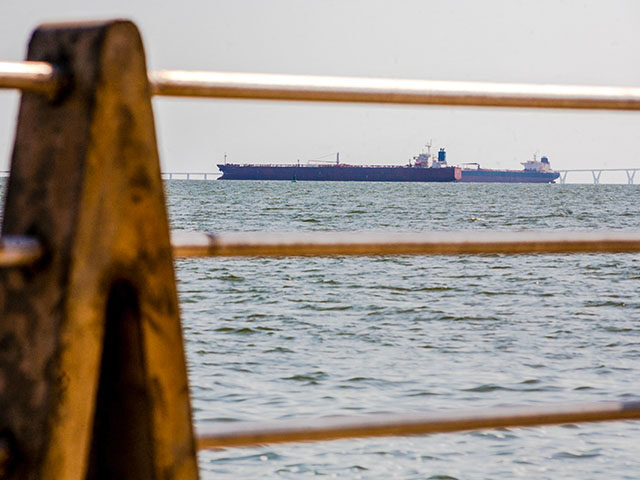

Ship tracking services detected around a dozen ships identified as loaded oil tankers departing from Venezuela in the first week of 2026, all of them targeted by U.S. sanctions.
Several of the tankers allegedly sailed in “dark mode,” presumably with the blessing of Venezuelan officials, meaning their satellite tracking devices were switched off to conceal their movements.
The first week of 2026 culminated with the surprising arrest of Venezuelan dictator Nicolás Maduro in a bold and flawlessly executed raid by the U.S. military. A few weeks before that, President Donald Trump ordered a “blockade” of all sanctioned oil tankers bound for Venezuela.
WATCH — President Trump: I Told Maduro “You’ve Got to Surrender”:
Trump and Secretary of State Marco Rubio said over the weekend that Maduro’s arrest did not mean the blockade was canceled.
“We have a quarantine on their oil. That means their economy will not be able to move forward until the conditions that are in the national interest of the United States and the interests of the Venezuelan people are met,” Rubio said on Sunday.
“As far as what our legal authority is on the quarantine, very simple: We have court orders. These are sanctioned boats, and we get orders from courts to go after and seize these sanctions,” he added.
Reuters noted it was not immediately clear if the reported rash of tanker departures was an effort to break Trump’s blockade, or if the U.S. government signed off on some of the departures.
The ships allegedly carried an estimated 12 million barrels of oil between them. About half of those ships were “supertankers that typically carry Venezuelan crude to China,” according to ship tracking data and documents from Venezuela’s nationalized oil company, Petróleos de Venezuela (PDVSA). President Trump said on Saturday that China would continue receiving the oil it was owed by Venezuela.
WATCH — Trump: “We’re in Charge” in Venezuela:
“Venezuelan exports had ground to a halt last week due to the blockade, forcing PDVSA to begin cutting output at the weekend. PDVSA had almost nowhere to store the oil after filling onshore storage and loading ships with crude,” Reuters reported.
The New York Times (NYT), which defended its columnist Maduro on Saturday, on Monday spoke to ship tracking experts who said at least 16 vessels were involved in what looked like a major effort to violate the U.S. blockade of sanctioned oil tankers. Their departure was quite abrupt, as many of them were seen docked at Venezuelan ports for weeks in satellite photos – but all of them were gone within hours of the raid that captured Maduro.
In addition to running in “dark mode,” the NYT’s experts claimed some of the vessels were “spoofing,” or broadcasting fake names and navigational data.
“The only real way for oil-laden tankers to break through a naval blockade is to overwhelm it with outbound vessels,” observed Samir Madani, co-founder of the TankerTrackers website.
Four of the ships reportedly left port without permission from the “interim” government headed by Maduro’s vice president Delcy Rodriguez, possibly in an effort to defy the authority of her regime.
All four of those ships were under contract to oil traders Alex Saab and Ramon Carretero, who are both under sanctions as business partners of Nicolás Maduro.
Saab, a native of Colombia, was imprisoned in the U.S. on money laundering charges for about two years but was traded by the Biden administration in 2023 for several Americans held prisoner in Venezuela. A year later, Maduro named him as minister of industry.
COMMENTS
Please let us know if you're having issues with commenting.