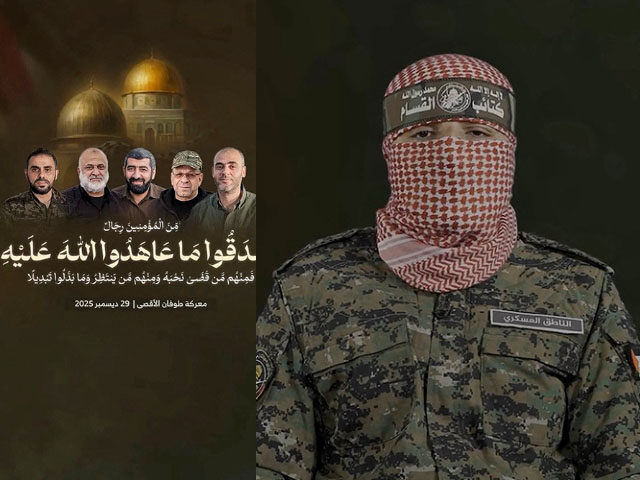
The Palestinian terrorist organization Hamas released a statement on Monday confirming that five of its senior leaders were killed during the Gaza war, including “masked spokesman” Abu Obeida and Mohammed al-Sinwar, the brother of former top leader Yahya al-Sinwar.
The statement on Monday was delivered by the new masked spokesman for the terrorist gang, who said he has “inherited” the name of Abu Obeida from his deceased predecessor.
Abu Obeida is a pseudonym that means “father of the worshippers.” The real name of the previous spokesman was Huthayfa Samir Abdallah al-Kahlout. He was killed by an Israeli airstrike on Gaza City on August 31.
Israeli officials have identified Kahlout in the past and published photos of the face he kept hidden beneath a red keffiyeh scarf, but Monday was the first time Hamas has published images of him.
“Abu Obeida” is technically the spokesman for the Izzadin al-Qassam Brigades, the “armed wing” of Hamas. The Qassam Brigades are often very slow to admit that high-ranking members have been killed. The casualties officially acknowledged in the statement on Monday were all confirmed by Israeli military and intelligence officials months ago.
Mohammad al-Sinwar, for example, was eliminated by an Israel Defense Forces (IDF) strike in May. His death was mentioned in public by Israeli Prime Minister Benjamin Netanyahu a few days later.
Israeli media soon reported that Sinwar was killed while hiding underneath the European Hospital in Gaza, in what the IDF described as an underground command bunker. Hamas denied it was hiding under the hospital, and refused to admit Sinwar was dead.
Sinwar was the commander of the Izzadin al-Qassam Brigades at the time of his death. Also killed in the bunker was Mohammed Shabana, commander of the Rafah Brigade, a unit of the Izzadin al-Qassam Brigades.
The fourth death acknowledged on Monday was Hakam al-Issa, chief of staff for the armed wing of Hamas and a founder of the organization. Israeli officials said he was one of the architects of the October 7, 2023, attack on Israeli civilians that began the Gaza war.
“Issa served as head of combat support, advancing terror plans from the air and sea against Israeli civilians and IDF troops operating in the Gaza Strip,” the IDF said when announcing Issa’s death in June.
“In the past, Issa led Hamas’s force build-up efforts in the Gaza Strip, was one of the founders of the military wing’s operations division, served as head of the training division, and was a member of Hamas’s general military council,” the IDF said.
WATCH — President Trump & Israeli PM Benjamin Netanyahu Deliver Remarks:
The fifth high-ranking casualty acknowledged by Hamas was Ra’ad Sa’ad, a senior member of the Izzadin al-Qassam Brigades who managed to hide in the terror tunnels beneath Gaza City until December 13, when he reportedly emerged and attempted to escape in a vehicle. The IDF, which had been tracking Sa’ad’s movements through the tunnels, destroyed the vehicle with a precision strike.
Sa’ad was the most recent of the five deaths confirmed in Monday’s statement, and he was the only one Hamas acknowledged before now, because Hamas complained that Israel committed a “criminal breach of the cease-fire agreement” by killing Sa’ad and the other three people traveling in his vehicle.
Writing at the Jerusalem Post on Tuesday, Institute for National Security Studies researcher Kobi Michael argued that Hamas was making a “calculated move” by admitting the five deaths of senior officials in a single consolidated statement long after the fact:
By postponing the announcement, Hamas sought to prevent demoralization among its operatives and to maintain its standing in the eyes of the local population. The organization aimed to project resilience and stability, despite the significant blow to its leadership.
The remaining leadership needed time to regroup, rehabilitate, and appoint successors. Now, with Hamas having reestablished control over western Gaza, its confidence has grown, and it has managed to fill key positions–even if not all appointments have been made public
Hamas held off on admitting the loss of its leaders for as long as possible to cast doubt on Israel’s claims they had been killed, even though those claims have been retroactively proven accurate, and to preserve morale among Hamas members and supporters. Now that the senior positions have been filled, including a new “masked spokesman” working under the same alias, it was safe to confirm the deaths, presenting them as evidence that Hamas can survive the loss of its high-level leaders.
“The timing seems linked to the upcoming meeting between President Trump and Prime Minister Netanyahu, and the pressure on Israel to advance the second phase of Trump’s 20-point plan,” Michael added.
COMMENTS
Please let us know if you're having issues with commenting.