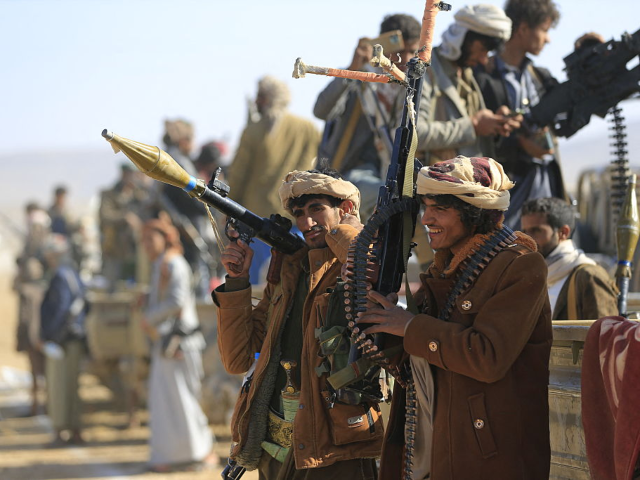
The Southern Transitional Council (STC), a secessionist group in Yemen, has seized control of the oil-rich provinces of Hadramout and Mahra, threatening to re-ignite the stalemated Yemeni civil war and potentially destabilize the region.
The civil war in Yemen has three major factions: the internationally-recognized elected government, known as the Presidential Leadership Council (PLC); the Iran-backed Houthi insurgents; and the STC secessionists, whose strength is concentrated in southern Yemen.
The Houthis kicked off the grueling Yemeni civil war in 2014 by capturing the national capital of Sanaa, forcing the elected government to relocate to the port city of Aden. In 2015, a coalition of Gulf states led by Saudi Arabia intervened on behalf of the Aden government with a campaign of airstrikes against the Houthis, but could do little more than force a stalemate.
The STC draws much less international media attention than the other big players, but they have been an active armed force in southern Yemen since the beginning of the civil war. They are usually aligned with the PLC government — on paper, they are part of it — and are strongly opposed to the Houthis.
The STC wants to “reinstate the Southern State,” the independent nation of South Yemen that existed before the country was unified about 40 years ago. The STC has its own army, stitched together from paramilitary units and militias, known as the “Southern Armed Forces.”
STC leaders often denounce their nominal allies in the PLC government as corrupt or incompetent, declaring autonomy in the areas they control. The STC has never compromised on its long-term goal of seceding and making southern Yemen independent, but for years they have allied with the PLC government against the Houthis.
One of the many confusing details of the Yemeni civil war is that Saudi Arabia’s coalition in support of the PLC includes the United Arab Emirates (UAE), but the UAE also strongly supports the STC.
The UAE established a paramilitary unit of highly trained tribal fighters called the Hadrami Elite Forces (HEF) in 2016 that is explicitly aligned with the STC. The HEF was nominally created to fight al-Qaeda in the Arabian Peninsula (AQAP), which had taken control of some important areas in Yemen, but it grew into a direct challenge to Saudi Arabia’s influence in the oil-rich Hadramout region.
The United Nations negotiated a shaky ceasefire in Yemen in 2022, freezing the territory controlled by the Houthis, the PLC, and the STC in place — until a few weeks ago, when the STC and HEF began seizing control of more territory in southern Yemen.
On Monday, the STC declared it was in control of Hadramout and Mahra provinces, including their valuable oil facilities. The STC also claimed it had taken control of Aden, the seat of the PLC government for the past decade. Several high-ranking members of the PLC have reportedly fled the city since the STC takeover.
The STC said its aggressive actions were “necessary to ensure stability and security in the South; to counter extremist groups like AQAP, and to cut the smuggling routes that strengthen the Houthis.”
“We are concentrating on unifying the operational theatre of our armed forces to enhance coordination and readiness to reinforce stability and security in the south, as well as combatting the Houthis should there be a willingness to head in this direction,” STC spokesman Amr al-Bidh said on Monday.
According to Al-Bidh, STC and HEF fighters encountered only “limited resistance” as Saudi-backed PLC forces fell back before their advance, but some violent clashes were reported.
PLC leader Rasad al-Alimi said the STC’s moves were a “blatant violation” of the agreement holding their alliance together. According to the STC, al-Alimi and the PLC’s prime minister, Salem Saleh bin Braik, have both fled to Riyadh, Saudi Arabia.
Saudi Arabia and the UAE were both curiously quiet about the sudden shift of power in southern Yemen. The Saudis modestly announced they were “repositioning” their troops out of Aden, and dispatched a diplomatic delegation to southern Yemen to reduce tensions.
On Wednesday, the president of the STC, Aidarous al-Zubaidi, said his group’s maneuvers in southern Yemen were the “cornerstone” of a drive to “liberate” northern Yemen from Houthi control.
“Security and military stability achieved in the south is not an end in itself but the essential foundation for a serious campaign to free the north,” he said.
Zubaidi ambitiously declared “the era of side battles is over,” and it was time for the main event, now that supply lines to the Houthis from southern Yemen have been severed. He said the STC’s next target was Sanaa, which would be secured “through peace or war.”
Contrary to appearances, Zubaidi stressed that his forces seizing control of southern Yemen’s oil fields and the alternate capital of Aden were not acts of aggression against the PLC or the Saudi-led coalition that supports it.
Instead, he said he was seizing the initiative to act against the Houthis because his forces were “more loyal, stronger, and better prepared” to become “the spearhead of the Arab effort to cut Iran’s influence and end Houthi threats to international shipping and neighboring states.”
COMMENTS
Please let us know if you're having issues with commenting.