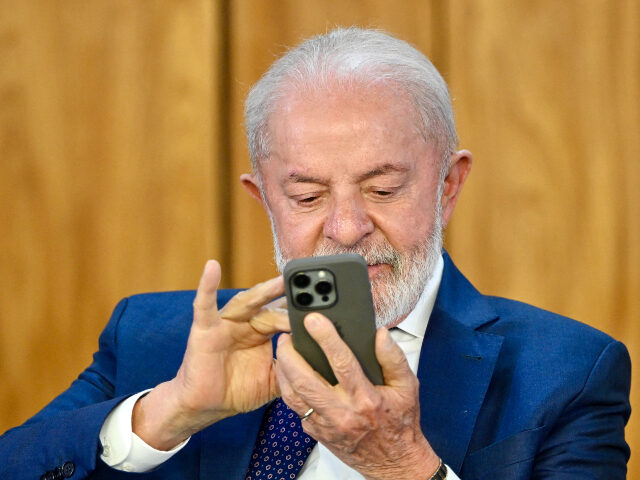

Socialist President of Brazil Luiz Inácio Lula da Silva held a friendly phone call on Friday with Chinese dictator Xi Jinping, presumably to increase bilateral cooperation but taking place in the context of both countries being invited to join President Donald Trump’s “Board of Peace.”
In an interview on Thursday with the Brazilian newspaper O Globo, top Lula foreign policy adviser Celso Amorim disparaged the Board of Peace as “confusing” and too expansive. Amorim protested that, while the Board of Peace is a proposal primarily to help structure the reconstruction of Gaza following the war between Hamas and Israel, it has the potential to be a productive vehicle to help resolve conflicts around the world, which he viewed negatively. China, which was also invited to join the project, has not yet rejected the invite but has used its state propaganda arms to condemn Trump for the idea.
The Chinese government readout of the Xi-Lula call did not identify the Board of Peace as a topic of conversation between the two leftist rulers, both members of the anti-American coalition BRICS. Instead, the Foreign Ministry claimed that Xi discussed how “China’s high-quality development via high-level opening-up” could benefit Brazil.
“Amid the current turbulent international situation, China and Brazil — both important countries in the Global South — are a constructive force in safeguarding global peace and stability and improving global governance,” Xi allegedly asserted. Xi pressured Lula to “stand on the right side of history,” meaning to support all of China’s political goals internationally, and to “jointly safeguard the central role of the United Nations, as well as international fairness and justice” – possible a subtle dig at the Board of Peace.
According to the Chinese government, Lula used the call to promise he would “uphold the authority of the United Nations, and strengthen cooperation among BRICS countries so as to safeguard peace and stability in the region and beyond.”
Trump officially inaugurated the Board of Peace this week at the World Economic Forum (WEF) in Davos, Switzerland. Describing the initiative, Secretary of State Marco Rubio explained that the need for such a vehicle arose from the failure of bodies such as the United Nations Security Council to take any meaningful action in the face of wars, massacres, and other atrocities.
“A lot of times, people like to give speeches. I’ve been to many of these forums, and they’re not useless, and … they have utility in many cases,” Rubio explained on Thursday, “but oftentimes in international affairs, we often find ourselves at events where people are reading these scripted statements, these strongly worded letters that they put out, but no action. Nothing happens. This is a group of leaders that are about action.”
Rubio added that the Board of Peace will help propel a prosperous vision for Gaza, “but I also think it will serve as an example of what’s possible in other parts of the world. Without losing focus on what’s before us now, this is what’s possible for other places and other conflicts that seem impossible to solve right now.”
At press time, 25 countries have accepted invitations to participate in the Board of Peace, including three BRICS countries: Egypt, Indonesia, and the United Arab Emirates (UAE). Other participating nations include Turkey, Argentina, Paraguay, and Kosovo. The four largest BRICS countries – Brazil, Russia, India, and China – were invited but have not at press time accepted or rejected the offer.
Amorim, the Lula foreign policy adviser, lamented to O Globo that the Board of Peace could have use beyond Gaza.
“The letter [invitation to the Board of Peace] is confusing because it starts to talk about one thing and then it starts lengthening the appendix document,” Amorim explained. “It represents, in practice, a revocation of the UN, over all in the area of peace and security. This part, certainly, I don’t see how to accept.”
“The word ‘Gaza’ does not appear in this statute. It refers to any conflict,” he continued. “That is clearly stated. I don’t think that it is extending to other topics, like economic or commercial questions, but yes to any conflict. It would be like a Security Council, only with a practically permanent president.”
Amorim also complained that the White House did not open a discussion on the parameters of the Board of Peace, instead sharing a “take-it-or-leave-it contract” to join.
The Brazilian government’s concerns that the Board of Peace could undermine the Security Council, where Russia and China regularly use their veto power to prevent any meaningful action on global conflicts, echoes the complaints in the Chinese state-run newspaper Global Times.
“If peace seats can be bought and major powers can arbitrarily establish their own systems outside the existing international order, the fairness of the postwar international order will be undermined,” the Times stated in a column complaining about the Board of Peace. “This ‘club governance’ model reduces international law to a private contract among major powers, forcing the world back into the law of the jungle.”
COMMENTS
Please let us know if you're having issues with commenting.