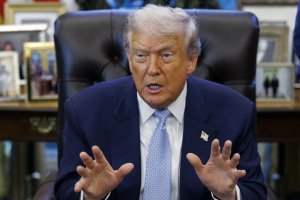
Dec. 1 (UPI) — President Donald Trump has again threatened a television network over its coverage, this time in relation to the unreleased Jeffrey Epstein files.
The president has no direct role in broadcast licensing but he does have influence through the FCC. Even absent action, a president’s threats can have a coercive effect, sparking networks to preemptively curb speech the president does not like out of fear of retaliation, former FCC Chairman Tom Wheeler who served under President Barack Obama, told UPI.
“Contrary to the First Amendment and established FCC precedent, the president keeps calling on the chairman of the FCC to take action that can only be considered to be retribution and intimidation and it’s unprecedented, unlawful and tragic,” Wheeler told UPI.
In recent weeks Trump aired out his desires to see television hosts like Jimmy Kimmel and Seth Meyers removed, while Federal Communications Commission Chairman Brendan Carr made overtures about retaliating over content, which has free speech advocates on alert.
“I think the license should be taken away from ABC because your news is so fake and wrong,” Trump told ABC News reporter Mary Bruce after she asked why he was waiting to release the Epstein files.
The FCC is unlikely to take any action against ABC’s broadcast license, according to Eugene Volokh, law professor at UCLA Law, told UPI. However, there are other levers the agency can pull to influence broadcasters.
“As a practical matter there’s relatively little to those threats,” Volokh said. “At the same time the government does have authority that may be relevant to broadcasters, broadcast mergers and antitrust enforcement. One danger with this is it’s sending the signal that ‘We’re coming after you. Even if it’s pretty clear we aren’t going to pull your license, there are lots of other ways we can retaliate against you.'”
Kimmel, on his late night show Jimmy Kimmel Live!, has often used Trump as fodder for his monologues. Trump has responded in kind, saying his show should be cancelled due to ratings.
It was not comments about the president that briefly saw Kimmel pulled from the air in September. It was remarks he made about the killing of conservative commentator Charlie Kirk, saying Trump supporters were “desperately trying to characterize the kid who murdered Charlie Kirk as anything other than one of them.”
The FCC did not take action but Carr threatened ABC on social media, saying the agency may take regulatory action if networks do not change their conduct.
“We can do this the easy way or the hard way,” Carr said.
Volokh explained that Trump’s threats can be viewed simply as political rhetoric or as something more, making it difficult to discern theater from actual free speech violations.
When it comes to television broadcasters, the federal government has more influence than with other mediums, such as print newspapers or online publications.
The FCC has standards meant to prohibit broadcasters from distorting news content and requiring them to serve in the interest of the public. Rarely has it had to act on these policies, at least over the last 40 years, Volokh said. When it has acted, its enforcement amounted to a reprimand and there was no threat to any network’s license.
“If the FCC did that, there would be a legal review process by the courts and the courts are highly unlikely to uphold that,” Volokh said of revoking broadcast licenses.
Volokh was on the legal team of the National Rifle Association in the case NRA vs. Maria Vullo in 2023. Vullo was the superintendent of the New York Department of Financial Services.
In that case, the NRA argued that the New York state government, under Democratic Gov. Andrew Cuomo at the time, threatened financial services companies with retaliatory enforcement, coercing them into cutting ties with the organization.
The U.S. Supreme Court ruled that the NRA made a plausible argument that its speech was being suppressed due to coercion by the state government. The state government, through its regulatory influence, affected the NRA’s ability to spread its message.
The case is relevant to Trump and the FCC’s influence over networks like ABC in that the government has direct oversight over not only the network’s ability to broadcast but also its business dealings.
The challenge lies in demonstrating a harm came directly as a result of the words or actions of the president or the FCC.
“A threat coupled with actual harm to the speaker may indeed violate the First Amendment,” Volokh said. “I do think it’s bad. I don’t go as far to say President Trump has violated the First Amendment with these statements. The problem is I think he’s trying to suppress speech through the threat of probably illegal and unconstitutional retaliation.”
The FCC was designed to operate independent of political influence to stop it from rewarding or punishing broadcasters based on their content and the political ideologies that might serve.
Within the agency, the federal workers that make up the FCC answer to the chairman alone, Wheeler said. Carr’s apparent allegiance to the president raise questions about how the agency will respond to Trump’s rhetoric.
“We’re living in an environment where the FCC, at the request of the president, tries to intimidate broadcasters, broadcast affiliates, and at the same time is promoting the idea that several Trump-favoring broadcast television networks should be able to merge in violation of existing law,” Wheeler said. “So they’ll change the law. It’s a clear message going out from the FCC which is, ‘We’ll take care of your economic interests if you’ll take care of our political interests.’ That is a dangerous brew.”
The economic interest Wheeler refers to are potential purchases and mergers in the broadcasting industry. Nexstar is prepared to purchase Tegna for $6.2 billion. The deal would give it access to 80% of U.S. households, violating the FCC’s 39% cap on how many households a single network group can reach.
Sinclair Broadcast Group submitted a bid Monday to purchase E.W. Scripps, a company licensed to 61 stations in 41 markets.
Trump opposes lifting the 39% cap if it would allow liberal-leaning networks to expand their reach, he said in a post on social media.
As the threats by the president and the FCC continue, Wheeler and Volokh believe FCC reform may be necessary.
“This uptick in attempts to leverage power over broadcasting into political control, coupled with the history that this has been done with past administrations is a reminder that it’s probably time to do away with the special treatment of broadcasting, at least in most instances,” Volokh said. “It’s too dangerous for the government to even have potentially the power to remove a license under some vague public interest standard that might be deployed in a political sense. Maybe we shouldn’t have the FCC have discretionary authority to approve mergers.”
Wheeler said such reforms have not been needed in the past because FCC has operated under “responsible leadership.”
“Of course it would be great to have more specificity and less leaving things to one person’s decision,” Wheeler said. “But the position we’ve been in before is the individuals entrusted with oversight responsibilities have acted in a more responsible manner,”
COMMENTS
Please let us know if you're having issues with commenting.