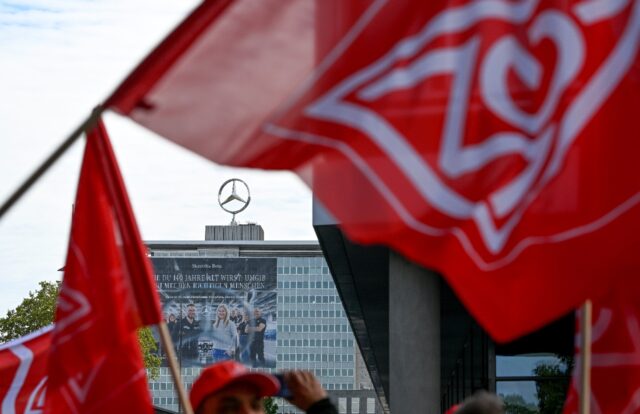

Struggling German carmaker Mercedes-Benz announced Thursday it will halt all investment in Germany and is mulling plant closures, underlining the woes facing the country’s automotive sector.
Like its German peers, Mercedes has been battered by Chinese competition and high costs, and last month became the third big German carmaker to cut its outlook for the year.
Its management has been locked in talks with staff representatives to find ways to reduce costs but, with little sign negotiations were making progress, the manufacturer signalled a harder line.
“The executive board has jointly decided to halt all further investments in German sites,” said board member Michael Schiebe in an interview posted on the company’s intranet and sent to AFP.
Management was unable to see any way forward on finding a deal with unions “despite numerous intensive discussions,” he said.
“We are now forced to carefully examine which German sites we would have to close if we cannot achieve a change in the cost structure.”
Schiebe stressed however that management still hoped for a breakthrough in talks and that “we want the next generations of vehicles to also be built at our German locations”.
There was nevertheless the possibility that “our new products will only be manufactured abroad,” he said.
‘Biggest crisis’
The powerful IG Metall union is currently demanding a pay rise of five percent in wage negotiations with the company.
In the same document published on Thursday, another board member Britta Seeger called the union’s demand “totally excessive”.
“Such an increase would further drive up labour costs, already high in Germany, when they are already far too high in international comparison,” she argued.
The company wants to implement a “productivity offensive” to drive down costs, including an increase in working hours for no extra pay, but here too there has been no agreement with the unions.
“These are uncomfortable topics but it is part of our job as the board to raise them, if we want to change things,” said Seeger.
Auto sector analyst Ferdinand Dudenhoeffer said that Thursday’s news was indicative of the fact that Germany’s car industry is in “its biggest crisis since its inception”.
Mercedes’ announcement was in itself “not a surprise”, Dudenhoeffer said, noting that the company had been “stressing for months how difficult the situation is at its German sites”.
“Without a fundamental realignment of the cost structure in Germany, the automotive industry here will simply die out,” he said.
Last month Mercedes-Benz revised its profit outlook down to 5.8 billion euros ($6.5 billion), on a par with 2025. It had previously foreseen an increase of at least 15 percent.
BMW and Volkswagen had both already cut their guidance for the year after sluggish demand combined with cut-throat competition from Chinese rivals such as BYD and Xiaomi ate into profits.
Volkswagen plans to have cut 120,000 jobs globally by the end of the decade in what is the largest restructuring in automotive history, eclipsing the 50,000 jobs lost after the bankruptcy of General Motors in 2009.
COMMENTS
Please let us know if you're having issues with commenting.