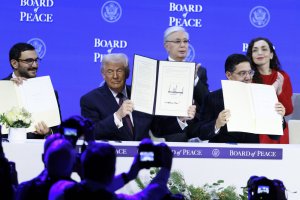
Jan. 29 (UPI) — President Donald Trump has officially formed the Board of Peace as he seeks to hold influence over resolving conflicts in Gaza and elsewhere.
The president ratified the charter of the Board of Peace in a ceremony at the World Economic Forum in Davos, Switzerland, last week. The charter states that the Board of Peace’s goal is to “promote stability, restore dependable and lawful governance” and secure “enduring peace in areas affected or threatened by conflict.”
Trump will serve as chairman of the Board of Peace, overseeing an end to hostilities and reconstruction in Gaza as well as its approach to other conflicts.
The formation of the Board of Peace is part of Trump’s “20-point plan” to end the war in Gaza.
In his statement on the plan, published by the White House, Trump said the board “will play an essential role in fulfilling all 20 points of the president’s plan, providing strategic oversight, mobilizing international resources and ensuring accountability as Gaza transitions from conflict to peace and development.”
The 20-point peace plan
The president unveiled the 20-point peace plan in the fall, saying it will lead to world peace starting with what the plan refers to as “New Gaza.” It is supposed to block Israel from occupying or annexing Gaza.
The plan calls for a release of all hostages in the conflict between Israel and Hamas. After the release of hostages. Israel is to release 1,700 Gazans who were detained after Oct. 7, 2023, including all the women and children that were detained and 250 prisoners who were given life sentences.
Gaza is to be a “deradicalized terror-free zone” and will be redeveloped to benefit people living there. After entering the agreement, full aid is to be sent to the Gaza Strip at least to the same level that it was sent on Jan. 19, 2025, the day before Trump was inaugurated.
Trump would lead the economic development plan to reconstruct Gaza and the Board of Peace would serve a key role in the “transitional” governance in the region. The board would work with a “technocratic, apolitical Palestinian committee” responsible for operating public services and municipalities.
Trump would also be the lead figure during this period of transitional governance.
Under the plan, Hamas is meant to agree that it will not have any role in governing Gaza in any capacity. A series of agreements with regional partners are to guarantee this.
The plan states that “no one” will be forced to leave Gaza but will be free to leave and return as they wish.
The United States would be involved in training and vetting Palestinian police forces in Gaza. It would partner with other nations in the Middle East and internationally to form the International Stabilization Force, a temporary entity to establish security in Gaza. Egypt and Israel would work with this entity to secure their border areas with Gaza.
Board of Peace membership
The Board of Peace is being supported by voluntary contributions, particularly from its participants. To be involved in the board, members must contribute at least $1 billion.
The board centralizes authority and influence, beginning with Trump and members of his inner circle. The executive board includes members of his administration, such as Secretary of State Marco Rubio and special envoy to the Middle East Steve Witkoff, as well as Trump’s son-in-law Jared Kushner.
Robert Gabriel, a political adviser to Trump, is also on the board.
The scope of the board’s membership is international, with Trump inviting representatives from dozens of countries around the world. Not all of those invited have accepted at the time of writing.
Also on the executive board are: former British Prime Minister Tony Blair; Ajay Banga, president of the World Bank; and Marc Rowan, chief executive officer of Apollo Global Management.
Nikkolay Mladenov, former Bulgarian minister of defense and U.N. special representative, will serve on the executive board as the high representative for Gaza. He is directed to work with the board and the National Committee for the Administration of Gaza which formed earlier this month.
Kushner, Blair, Witkoff, Mladenov and Rowan will also serve on the Gaza Executive Board. This board’s purpose is to “support effective governance and the delivery of best-in-class services” in Gaza.
Also serving on the Gaza Executive Board are: Hakan Fidan, Turkish minister of foreign affairs; Ali Al-Thawadi, a diplomat representing Qatar; Hassan Rashad, Egyptian general; Reem Al Hashimy, United Arab Emirates minister of state for international cooperation; Yakir Gabay, Israeli billionaire; and Sigrid Kaag, former deputy prime minister of the Netherlands.
More than a dozen more officials representing countries in Europe and Asia have recently added their names to the list of members. More may still join but are reviewing their invitations.
Britain does not plan to join the board, citing concerns over Trump extending an invitation to Russian President Vladimir Putin. Putin has not announced his decision about joining.
The U.N. Security Council signed off on the peace plan, including the formation of the Board of Peace during a meeting in November.
Board of Peace built in wake of U.S. breaking international agreements
While Trump was forming the Board of Peace, he has also spent the past year removing the United States from the international arena in various capacities.
From withdrawing from the Paris Agreement for a second time to pulling the United States from its role in delivering humanitarian aid, the president has been adamant about resetting America’s role on the world’s stage.
Trump withdrew the United States from the Paris Agreement on inauguration day last year. He also withdrew from the agreement in 2019 and President Joe Biden rejoined it when he took office.
Also on inauguration day, Trump directed the U.S. Ambassador to the U.N. to notify the secretary general of the U.N. of the United States’ withdrawal from any agreement made under the U.N. Framework Convention on Climate Change.
The president has pulled the United States out of several more international coalitions focused on the environment and combatting climate change.
Last week, the Trump administration formally completed its withdrawal from the World Health Organization. The United States was a founding member of the WHO.
The president cited the WHO’s “mishandling” of the COVID-19 pandemic and financial contributions from the United States as the main reasons for withdrawing from the organization.
The United States is no longer involved in dozens of United Nations entities after Trump announced a mass withdrawal from 66 international organizations and treaties earlier this month. Among the U.N. organizations Trump has withdrawn from are U.N. Women, the U.N. Democracy Fund and the U.N. Peacebuilding Commission.
Last summer, the president pulled the United States out of the United Nations Educational, Scientific and Cultural Organization. A press release from the State Department said involvement with UNESCO is “not in the national interest of the United States.”
COMMENTS
Please let us know if you're having issues with commenting.