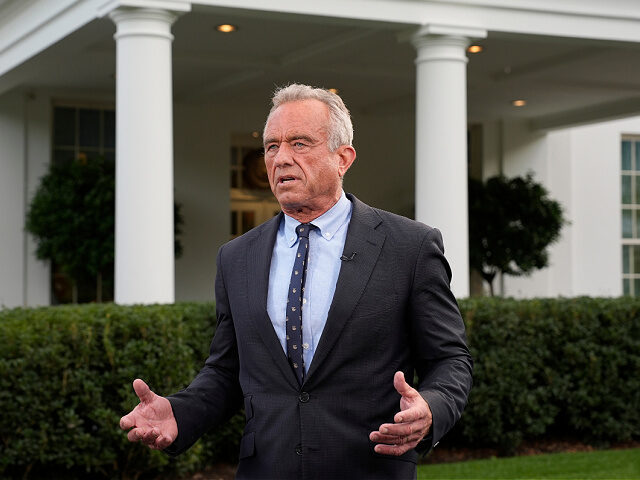

Department of Health and Human Services (HHS) Secretary Robert F. Kennedy Jr. spoke on Sunday evening about how Turning Point USA founder Charlie Kirk’s “overarching mission … was Jesus, and also free speech — and he saw it as intertwined.”
Kennedy spoke at the vigil in Washington, DC, for 31-year-old Kirk, who was assassinated while engaging in debate at Utah Valley University on Wednesday, September 10. Kennedy, whose father and uncle were also assassinated and whose brother David died of a drug overdose, spoke about how Americans must take on “the best virtues and character traits of the person that we lost.”
“When my brother David died, I had a conversation with my mother, who had been through more than her share of loss and tragedy,” Kennedy said. “I asked her … ‘Does the hole they leave in you when they die, does it ever get any smaller?’ And she said, ‘No, it never gets any smaller. But our job is to build ourselves bigger around the hole. We do that by taking the best virtues and character traits of the person that we lost, and using discipline and restraint and practice integrating those character traits into our own character. In doing that, we make ourselves larger, and the hole gets proportionally smaller. And we also give that person a kind of immortality because the best parts of them are now living on in us.'”
Kennedy noted that his daughter-in-law saw his 17-year-old niece pack a Bible in her suitcase to go to college. When asked about it, his niece replied, “I want to live like Charlie Kirk.”
“There are millions and millions of kids around the country who are inspired to live like Charlie Kirk, and that’s a great thing for our country,” he said. “…The overarching mission of Charlie Kirk was Jesus, and also free speech — and he saw it as intertwined. He saw a conversation as the only way we were going heal our country, and we had to learn to talk to each other without vitriol, without poison, without anger.” he continued.
Kennedy reflected on meeting Kirk for the first time on a podcast and both of them being apprehensive at first before ultimately ending their discussion “as soulmates — we were spiritual brothers, and we were friends.” He said they specifically spoke about the importance of the First Amendment in protecting all other rights and how the government violated Americans’ rights during the pandemic.
“We talked about the fact that our founders put freedom of speech in the First Amendment because all the other rights are dependent on it. A government that can silence its opponents has a license for any kind of atrocity,” he said.
“…Charlie, more than any figure in our country, led the resistance that has restored freedom of speech to this country. And he built this movement which is going to make sure that never, ever happens again,” he said.
He also reflected on a conversation he once had with Kirk “talking about the danger that we both faced from challenging entrenched interest.”
“And he asked me if I was scared to die. And I said to him, there’s a lot worse things than dying — the chief among them is is losing our constitutional rights and having our children raised in slavery,” he said.
“I said to him at the time, sometimes our only consolation is that we can die with our boots on. We can die fighting for these things,” he continued. “Charlie gave his life so that the rest of us would not have to suffer those fates worse than death. Now it’s our job. He’s no longer there to lead us. Rush in and fill the breach, and win this battle for our country, for God, and for our families.”
COMMENTS
Please let us know if you're having issues with commenting.