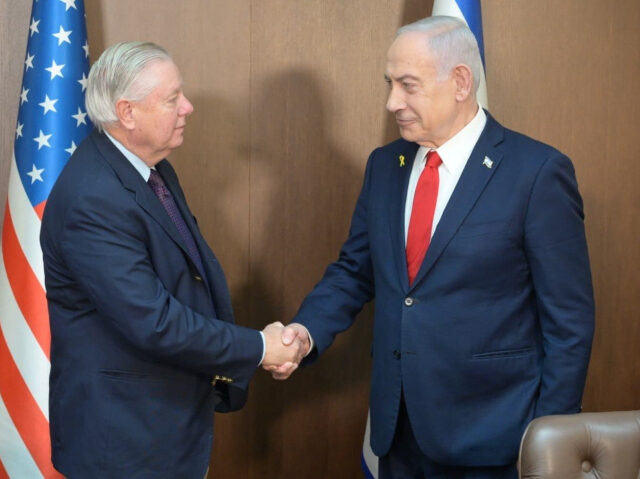
Sen. Lindsey Graham urged a formal U.S.–Israel defense pact, arguing that strong GOP support for Israel remains overwhelming, that U.S. aid delivers “tenfold” returns in intelligence, counterterrorism, and advanced technology, and that Israel’s security role provides capabilities the United States could not replicate on its own.
In remarks delivered Sunday to reporters in Israel following meetings with Israeli leaders, U.S. military officials, and intelligence briefers during a two-day visit — including talks with Prime Minister Benjamin Netanyahu and Foreign Minister Gideon Sa’ar — Graham framed Israel not as a burden on the United States, but as one of its most valuable strategic partners, militarily, economically, and morally.
No Republican Break With Israel
Graham dismissed suggestions that support for Israel is weakening within the Republican Party, calling such claims disconnected from political reality.
“There is no strong anti-Israel movement in the Republican Party,” he said, arguing that vocal critics represent a fringe rather than the base. “Loud voices do not represent the majority.”
Citing his home state, Graham noted that more than three-quarters of Republican voters in South Carolina strongly support the U.S.–Israel relationship, adding that national Republican politics reflect the same reality.
“In South Carolina, over 75% of Republicans cherish the U.S.–Israel relationship,” he said.
Underscoring that backing Israel remains a foundational position for GOP voters and leaders alike, Graham said that “support for Israel in the Republican Party is strong.”
Why U.S. Aid to Israel Benefits America
Graham argued that U.S. military and economic assistance to Israel delivers outsized returns to American security and global influence.
“Israel is a great deal for America,” he said. “The money we give Israel comes back tenfold in security, intelligence, and economic cooperation — especially in AI.”
Pointing specifically to intelligence cooperation, counterterrorism expertise, and advanced technology, including artificial intelligence, where Israeli innovation feeds directly into U.S. defense and economic strength, Graham added that “if Israeli intelligence disappeared tomorrow, America would be blind in the region,” noting that U.S. forces could not replicate the Israel Defense Forces’ counterterrorism capabilities.
Locking in the Alliance
Graham encouraged Israel to pursue a formal U.S.–Israel defense agreement to institutionalize cooperation beyond individual administrations.
“Israel should deepen its relationship with the United States, not pull away,” he insisted.
He said such a pact would reflect strategic reality rather than political symbolism.
“Israel does more to keep America safe than almost any other ally,” Graham said. “NATO matters, but no one is closer to the threat than Israel.”
The senator explained how the long-standing alliance is mutually reinforcing.
“It is in America’s interest that Israel survive, thrive, and remain militarily and economically strong,” he said. “The better Israel does, the better America does.”
Winning the War, Losing the Media
While praising Israel’s military effectiveness, Graham said the country continues to struggle in the information space.
“You are winning on the ground, but losing the media war,” he said, urging Israeli leaders to remain focused on achieving their military objectives rather than chasing international approval.
He also rejected accusations of genocide, contrasting Israel’s conduct with the stated goals of its enemies.
“If Israel wanted to kill all Palestinians, it could,” Graham said. “Hamas wants to kill all Israelis — but cannot.”
The Common Threat: Hamas, Hezbollah, and Iran
Graham grouped Hamas, Hezbollah, and Iran into a single strategic problem, describing them as interconnected components of a broader Iranian-led campaign against Israel and the United States.
He said Hamas has used the ceasefire not to disarm, but to rearm and consolidate power in Gaza, making long-term peace impossible. Hezbollah, he added, continues to destabilize Lebanon and has American blood on its hands, pointing to the Beirut barracks bombing that killed 241 U.S. service members, including 220 Marines, in 1983.
Iran, Graham said, remains the central driver.
“Without Iran, there is no Hamas or Hezbollah,” he said.
While acknowledging that Iranian nuclear facilities have been severely damaged, Graham warned that Tehran’s intentions remain unchanged.
“Iran’s capability has been reduced — but not its desire,” he said, calling for immediate military action if Iran resumes nuclear enrichment or expands ballistic missile production.
“Appeasement does not lead to peace,” Graham said, noting that the Iranian regime is “bent on destroying Israel and attacking America.”
“Nothing will change until the regime changes,” he added.
A Deadline for Terror Groups
Stating that the region cannot move forward unless armed terror groups are removed from political power, Graham called for Hamas to be placed on a defined timetable to disarm, warning that failure should trigger decisive Israeli military action with U.S. backing.
“Put Hamas on a time clock. Give them a defined period to disarm. If they fail, I would encourage President Trump to unleash Israel to finish off Hamas,” he stated.
Similarly, he said Hezbollah must either voluntarily surrender its heavy weapons or face coordinated military action involving Israel, the United States, and regional partners. Removing those threats, Graham argued, would dramatically improve prospects for regional normalization, including expanded peace agreements with Arab states.
Graham closed his remarks by honoring the victims of the October 7 massacre and expressing hope that decisive action now could reshape the region for the better.
Joshua Klein is a reporter for Breitbart News. Email him at jklein@breitbart.com. Follow him on Twitter @JoshuaKlein.
COMMENTS
Please let us know if you're having issues with commenting.