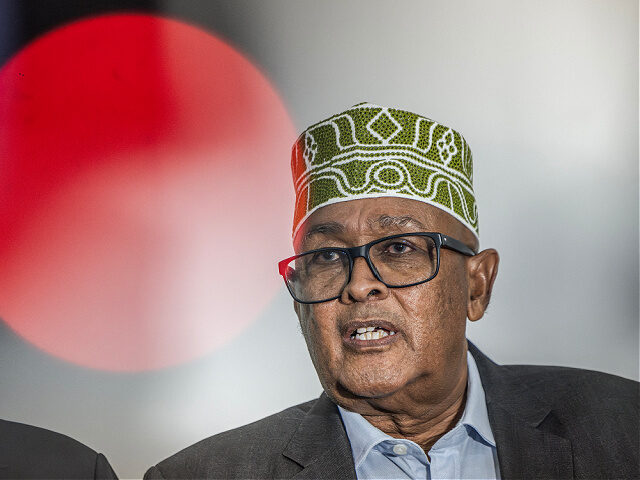
Somaliland President Abdirahman Mohamed Abdullahi said his nation is ready to enter into a full security and economic partnership with the United States, arguing that it occupies what he called “perhaps the most strategically positioned territory in the region” — positioned along a maritime corridor that carries 30 percent of global container traffic, with abundant critical minerals and a stable, pro-Western foothold in a volatile corner of the world.
Speaking in an exclusive interview with Breitbart News from Dubai following meetings at the World Government Summit, Abdullahi detailed how Somaliland’s secure coastline, untapped resource base, and more than three decades of internal stability match core U.S. priorities — from safeguarding maritime trade routes and deepening counterterrorism cooperation to diversifying critical mineral supply chains away from China’s dominance.
President Donald Trump, “A Great Leader and a Peacemaker”
Abdullahi began by praising President Donald Trump’s first year back in office, pointing to what he described as multiple successful conflict resolutions and renewed American global leadership.
“In my personal opinion, and in the opinion of my people, we see President Trump’s peace initiatives as the work of a great leader and a peacemaker who has now solved eight ongoing wars in the world,” he said, noting that he has previously proposed Trump for the Nobel Peace Prize.
He described Trump’s leadership as “a service to the world” and “a service to peace,” saying the president has restored the United States as a decisive force for stability.
Israel’s Recognition and a New Opening
Abdullahi’s push to deepen ties with Washington follows Israel’s historic recognition of Somaliland on December 26, 2025 — the first time a United Nations member state formally acknowledged the republic’s sovereignty.
Israel’s Prime Minister Benjamin Netanyahu described the move at the time as being made “in the spirit” of the Abraham Accords — the regional normalization agreements brokered during Trump’s first term between Israel and several Arab states, including the United Arab Emirates (UAE).
The UAE is also one of Somaliland’s most significant economic partners through its development of the strategic Port of Berbera, a deep-water facility along the Gulf of Aden.
Abdullahi said his government wants to build on the diplomatic opening and formalize expanded cooperation at the highest levels.
“We support the peace initiative of the President,” he said. “We support moving forward on that process. We have already shown our interest, and I hope to have the opportunity to sign such an agreement — both in Israel and in the Oval Office.”
Since recognition, Israeli and Somaliland officials have discussed expanded cooperation in agriculture, technology, health, trade, and security. Israeli Foreign Minister Gideon Sa’ar visited Somaliland in early January, marking the first official visit by a foreign minister from a country formally recognizing the republic.
The Bab el-Mandeb Chokepoint
At the center of Abdullahi’s case is geography.
Somaliland controls approximately 460 miles of coastline along the Gulf of Aden near the Bab el-Mandeb Strait — the chokepoint linking the Indian Ocean to the Red Sea and the Suez Canal. Roughly 30 percent of global container shipping passes through that corridor.
Abdullahi said Somaliland’s coast has remained secure — a point he contrasted with the piracy and instability long associated with waters off Somalia — and argued that the republic can serve as a dependable maritime partner for the United States and the West.
“We have secure, piracy-free waters,” he said. “We are strategically located in the Gulf of Aden. We are near Bab el-Mandeb.”
Recent attacks by Iran-backed Houthi forces targeting commercial vessels in the Red Sea have underscored the corridor’s vulnerability — and the value of reliable partners positioned along its shores.
“We can be an indispensable partner in maritime security,” Abdullahi said, adding that Somaliland stands ready to help ensure global trade “goes smoothly and freely.”
Minerals, Energy, and Livestock
Abdullahi also pointed to Somaliland’s resource base as a U.S. economic and industrial opportunity.
“We have a lot to offer the United States,” he said. “We have rare earth minerals, oil, gas, marine resources, livestock — many natural resources.”
Somaliland has identified lithium and other strategic minerals within its territory at a time when Washington is working to reduce reliance on China, which dominates rare earth mining and processing.
Earlier this month, President Trump announced “Project Vault,” a $12 billion strategic reserve initiative aimed at securing critical minerals and insulating American industry from supply disruptions.
Abdullahi said Somaliland can be part of that diversification effort, noting that American companies such as Chevron previously held exploration concessions in the territory prior to 1991.
“We are ready for business,” he said.
“We are not asking for aid. We are asking for partnership.”
Republicans Push Recognition and Strategic Alignment
Several Republican lawmakers have advanced the same basic strategic case in Washington — that Somaliland’s stability, location, and resources make it a natural partner for U.S. interests in the Horn of Africa.
Sen. Ted Cruz (R-TX), who has urged President Trump to consider formal recognition, wrote that recognizing Somaliland “isn’t charity — it’s strategy,” adding that it “aligns with America’s security interests and the America First doctrine” by strengthening an ally that “shares our values” in a region vital to global trade and counterterrorism.
“I thank Senator Ted Cruz. He is a brave man,” Abdullahi said. “I agree with him.”
In the House, Rep. Scott Perry (R-PA) — joined by Reps. Tom Tiffany (R-WI), Andy Ogles (R-TN), Pat Harrigan (R-NC), and others — introduced the Republic of Somaliland Independence Act, arguing Somaliland meets the criteria of statehood and that formal recognition would strengthen U.S. security and economic interests.
Separately, Rep. Chris Smith (R-NJ), chairman of the House Foreign Affairs Subcommittee on Africa, has pointed to Somaliland’s democratic record and the strategic value of the Berbera port as factors that bolster U.S. national security.
And Rep. John Moolenaar (R-MI), who chairs the House Select Committee on the Chinese Communist Party, has emphasized the need to diversify critical supply chains and distinguish Somaliland from Somalia in U.S. policy — including travel advisories — citing Somaliland’s stability and strategic value.
Somaliland vs. Somalia
Addressing critics who argue recognition would destabilize Somalia, Abdullahi drew a firm distinction between the two entities.
“Since reclaiming our sovereignty in 1991, we have lived in peace with our neighbors — Djibouti and Ethiopia — with more than 1,000 kilometers of border and not even a single major incident,” he said.
Somaliland has held seven elections, including peaceful transfers of power. It maintains its own currency, armed forces, police, and functioning governmental institutions.
Somalia, by contrast, Abdullahi noted, has required repeated international stabilization missions — including the United Nations Operation in Somalia (UNOSOM), the African Union Mission in Somalia (AMISOM), and its successor, the African Union Transition Mission in Somalia (ATMIS) — and still depends on foreign forces while continuing to battle the al-Qaeda-linked al-Shabaab terrorist organization.
“We built our institutions alone, without the help of anyone,” Abdullahi said.
A Voluntary Union — and Restored Sovereignty
Somaliland, originally a British protectorate, became an internationally recognized sovereign state on June 26, 1960. Five days later, it voluntarily united with the former Italian Somalia in an effort to consolidate Somali-speaking territories.
“We were two different countries,” Abdullahi said, explaining that Somaliland “voluntarily merged for one purpose — to unite all Somali-speaking territories,” a dream he said that was never realized.
Djibouti remained separate. Somali-inhabited regions in Ethiopia and Kenya did not join. After the collapse of the Somali state in 1991, Somaliland declared the restoration of its sovereignty.
“We became independent before Somalia became independent,” he said. “The world does not understand our history.”
Political unions have dissolved before without erasing the underlying sovereignty claims of the parties involved, including the United Arab Republic between Egypt and Syria (1958–1961) and the Senegambia Confederation between Senegal and Gambia, which collapsed in 1989.
Abdullahi argued Somaliland’s case fits that historical pattern.
“Ready to Fully Cooperate”
With President Trump and Israel’s Prime Minister Benjamin Netanyahu coordinating on countering Iran and regional terrorism, Abdullahi said Somaliland is prepared to contribute.
“We are ready to fully cooperate in counterterrorism in the region and worldwide,” he said. “We shall be a partner in counterterrorism and in securing safe passage for world trade.”
Positioned across the Gulf of Aden from Yemen and adjacent to one of the world’s most critical maritime chokepoints, Somaliland, he argued, can serve as a reliable anchor of stability.
“We are a peaceful democracy and a reliable partner to the world,” Abdullahi said. “Hopefully, the world will understand the difference between Somaliland and Somalia.”
Joshua Klein is a reporter for Breitbart News. Email him at jklein@breitbart.com. Follow him on Twitter @JoshuaKlein.
COMMENTS
Please let us know if you're having issues with commenting.