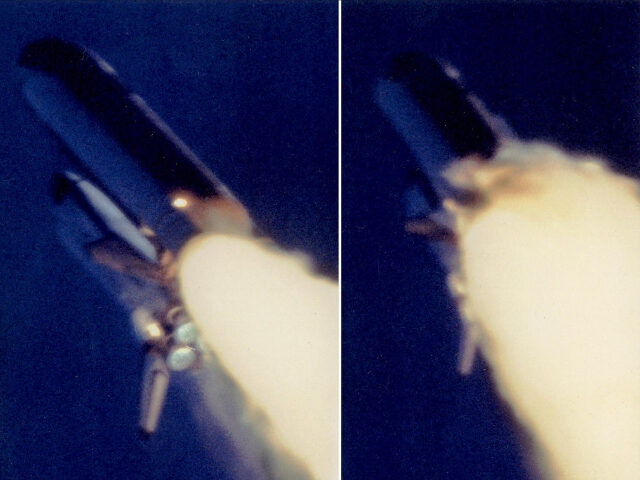
Forty years ago today, the world watched in horror as NASA’s Space Shuttle Challenger exploded in the sky, claiming the lives of all seven crew members aboard.
On January 28, 1986 — during the height of the United States’ spacecraft era, amid anticipation and excitement among the public to witness human advancement in space exploration — the Challenger disintegrated in midair just 73 seconds into its flight.
Watch Below:
The fiery demise of the space shuttle was first met with stunned silence from Mission Control, before an unidentified man could be heard announcing over an intercom: “We have a report from the flight dynamics officer that the vehicle has exploded flight.”
“Flight director confirms that,” the man adds. “We are looking at…checking with the recovery forces to see what can be done at this point.”
Due to debris that continued to rain from the sky, a search effort could not begin for some 15 minutes after the explosion, NBC Nightly News reported at the time.
“At 11:40 a.m. this morning, the Space Program experienced a national tragedy with the explosion of the Space Shuttle Challenger, approximately a minute and a half after launch,” Jesse Moore, then-director of Kennedy Space Center, announced at the time.
In 1981, a few years before the Challenger catastrophe, NASA had just conducted its first crewed flight since the Apollo missions ended in 1972, sparking renewed excitement and hope for continued advancement in space.
But those expectations were swiftly crushed as the Challenger’s fate went on to become one of the most infamous moments in modern history.
The incident, which was broadcast live on television and witnessed by billions worldwide, sent a shockwave around the globe that many remember as one of the defining moments of the 1980s.
The disaster was especially harrowing due to the immediate deaths of the seven crew members on board:
Francis Scobee — 46-year-old mission commander from Cle Elum, Washington, and Air Force test pilot
Michael Smith — 40-year-old pilot from Beaufort, North Carolina, and a U.S. Navy commander
Judith Resnik — 36-year-old mission specialist from Akron, Ohio, who was among the first six women selected for NASA’s astronaut program in 1978, and was the second American woman to fly in space
Ellison Onizuka — 39-year-old mission specialist from Hawaii who was on active duty with the Air Force until he was chosen as a NASA astronaut in 1978
Ronald McNair — 35-year-old mission specialist from Lake City, South Carolina, who had a doctorate in physics and became one of the first three black Americans selected as a NASA astronaut
Gregory Jarvis — 41-year-old payload specialist from Detroit, Michigan, who was not a NASA astronaut, but worked as an engineer at an aerospace company
Christa McAuliffe — a 37-year-old civilian from Boston, Massachusetts, who was chosen over 11,000 applicants by NASA to become the first teacher in space
The NASA Space Shuttle program’s Challenger mission, also known as STS-51-L, was intended to be a week-long orbital trip to observe Halley’s Comet over six days, release routine satellites into space, and launch NASA’s “Teacher in Space” initiative.
The Teacher in Space program had sought to send non-astronaut civilians — specifically educators — into orbit, so that they could use their experiences in space to teach their students, as well as the public. NASA immediately halted the program following the death of McAuliffe, its first participant, and officially canceled the initiative in 1990.
The Challenger explosion was triggered by a leak in one of the rocket boosters that allowed hot gases to escape, which ignited the shuttle’s main fuel tank, causing the tragic blast, according to a presidential commission report on the space shuttle’s fatal accident.
The investigation further determined that unusually low temperatures in Florida compromised the seals that were designed to prevent hot gases from leaking during the booster ignition.
Alana Mastrangelo is a reporter for Breitbart News. You can follow her on Facebook and X at @ARmastrangelo, and on Instagram.
COMMENTS
Please let us know if you're having issues with commenting.