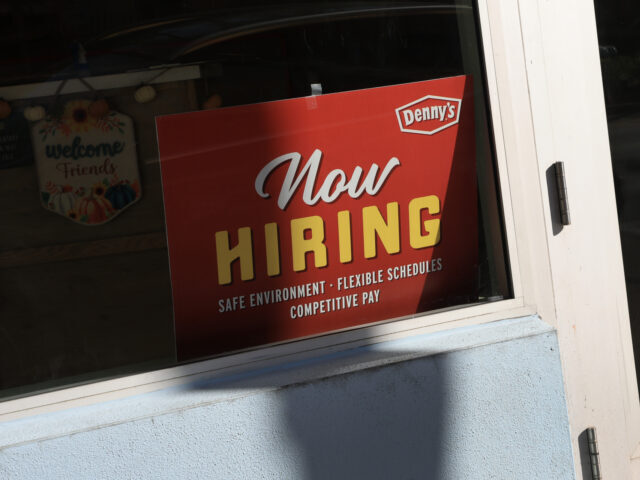
Private sector employment increased by just 22,000 jobs in January, falling short of economist expectations but landing closer to a rapidly declining break-even threshold for job creation, according to ADP’s National Employment Report released Wednesday.
The figure came in well below the consensus forecast of 45,000 jobs and marked a deceleration from December’s revised 37,000. However, recent research from the Federal Reserve Bank of Dallas suggests the benchmark for evaluating these numbers may have shifted dramatically.
The Dallas Fed estimates that the monthly job growth needed to keep the labor market in balance—known as the break-even rate—has collapsed from approximately 250,000 in mid-2023 to around 30,000 by mid-2025. This sharp decline stems from a reversal in immigration flows and cyclical shifts in labor force participation.
“Job creation took a step back in 2025, with private employers adding 398,000 jobs, down from 771,000 in 2024,” said Dr. Nela Richardson, chief economist at ADP. “While we’ve seen a continuous and dramatic slowdown in job creation for the past three years, wage growth has remained stable.”
While the 398,000 figure represents a significant decline from 2024, the break-even rate for maintaining labor market equilibrium fell even faster over the same period. The Dallas Fed’s analysis shows the goalposts moved substantially lower as demographic factors transformed the labor market landscape.
Annual pay growth held at 4.5 percent for workers who stayed in their jobs, while those who changed jobs saw pay increases of 6.4 percent, down slightly from 6.6 percent in December.
The education and health services sector led hiring with 74,000 jobs added, while professional and business services shed 57,000 positions, the largest decline since June. Education and health services are often regarded as “non-cyclical” parts of the labor market, where hiring is often driven by government budgeting rather the economic fundamentals. Professional and business services are highly cyclical.
Manufacturing lost 8,000 jobs, continuing a streak of monthly losses dating back to March 2024.
The Dallas Fed’s analysis found that about half the decline in break-even employment comes from slowing population growth—including an estimated net outflow of approximately 300,000 people in 2025—while the other half stems from declining labor force participation rates.
“A break-even rate of around 30,000 appears to be the new reality for the U.S. labor market,” Dallas Fed economist Anton Cheremukhin wrote in October. “This means modest payroll gains, which might have seemed alarming in 2023, are now indicative of a stable and balanced market.”
The gap between January’s 22,000 jobs and analyst expectations of 45,000 may reflect forecasters still calibrating their models to account for the lower break-even threshold. Many economic projections were built on assumptions of 100,000 or more monthly jobs being needed to maintain labor market equilibrium, a benchmark that applied during the 2022-2023 immigration surge but no longer holds.
Large employers with 500 or more workers shed 18,000 jobs in January, while medium-sized establishments added 41,000 positions. Small businesses saw no net change in employment.
Regionally, the South Atlantic region lost 76,000 jobs, while the West South Central region added 47,000 and the Midwest gained 25,000.
The ADP report, based on payroll data covering more than 26 million private sector employees, comes as the Bureau of Labor Statistics delayed its official January jobs report due to last weekend’s brief partial government shutdown. The BLS has not yet announced when that report will be released.
COMMENTS
Please let us know if you're having issues with commenting.