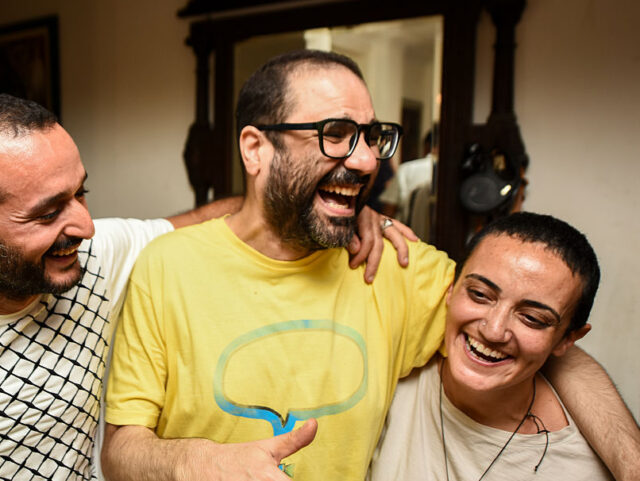
The UK Prime Minister hailed achieving a “top priority” for his government with the release of Alaa Abd El-Fattah from his native Egypt, prompting critics to highlight the activist’s extreme writings against Britain, white people, police officers, and “Zionists”.
Alaa Abd El-Fattah, unfailingly and uncritically referred to in legacy media reportage as an “Anglo-Egyptian activist” despite only recently having been given British citizenship by the previous Conservative government, has arrived in the United Kingdom after being released from prison in Egypt.
The British government has tirelessly advocated for El-Fattah for years, despite his opinion that Britons are “dogs and monkeys”.
British Prime Minister Sir Keir Starmer hailed the government’s achievement of having managed to negotiate the release of the Arab Spring revolutionary: “I’m delighted that Alaa Abd El-Fattah is back in the UK and has been reunited with his loved ones, who must be feeling profound relief… Alaa’s case has been a top priority for my government since we came to office. I’m grateful to President Sisi for his decision to grant the pardon.”
El-Fattah gained British citizenship in 2022 while in an Egyptian prison, under the British Nationality Act 1981 by the virtue of his grandmother having given birth to his mother while studying for a PhD in London in the 1950s. He comes from a family of hard-left, Communist-adjacent, and anti-Zionist activists and revolutionaries. He and several members of his close family were active in anti-government circles in their native Egypt during the Arab Spring-type Egyptian Revolution in 2011.
While “blogger” El-Fattah’s focus may be Egypt, the UK government’s celebration of having engineered his release to British soil has led to critics to point to his wider extremist writings. Robert Jenrick, who was not the UK’s immigration minister when El-Fattah was given British citizenship but took up the role several months later and who has since reinvented himself as a migration critic, highlighted one of El-Fattah’s writings in which he is alleged to have stated: “police are not human they don’t have human rights, we should just kill them all”.
Writing to the Prime Minister to demand answers, Jenrick said:
Only days ago you committed to “eradicating antisemitism in the UK”. Yesterday you said you were “delighted” that Alaa Abd El-Fattah is back in this country, described his case as a “top priority” for your Government, and thanked President Sisi for granting a pardon.
That was not quiet consular support. It was a personal, public endorsement from the Prime Minister. Given Mr Abd El-Fattah’s record of extremist statements about violence, Jews and the police, it was a serious error of judgment.
…Nor is this confined to Israel. In July 2011, Mr Abd El-Fattah wrote that “police are not human”, that they “don’t have rights”, and that “we should just kill them all”. In August 2011, amid disorder on London’s streets, he urged people to “go burn the city or Downing Street or hunt police”. That is not principled dissent. It is the language of violence against the police and against the heart of our democracy.
The timing could scarcely be worse. You chose to welcome him publicly just days after the terrorist attack at a Hanukkah celebration on Bondi Beach and weeks after the horrific attack at Heaton Park synagogue, when Jewish communities here and abroad are understandably deeply worried and looking to you for leadership on extremism.
Brexit leader Nigel Farage highlighted further writings, including El-Fattah allegedly stating “I consider killing colonialists and specifically Zionists heroic, we need to kill more of them” and “sounds like [you] need more fear. Random shooting of white males should convince them racism costs live”.
Mr Farage reflected that the “government just gets worse” and noted none of these writings were cited in the legacy media’s uncritical reportage of the government having engineered El-Fattah’s release. Conservative activist and broadcaster Adam Wren shared further snippets allegedly speaking approvingly of suicide bombing and stating “fucking hate white people… a blight on the earth they are. Good thing they stopped breeding”.
It is not as if these extreme remarks were secret or obscure until now. In 2014, El-Fattah had been nominated for a prestigious European Union Humanitarian award, the Sakharov Prize. Named for famed anti-Soviet dissident Dr. Andrei Sakharov and worth €50,000 to a winner, Laureates include Nelson Mandela and Kofi Annan.
Shortly after his nomination, El-Fattah’s writings were brought to the attention of the European parliamentarians who had selected him, causing them to withdraw the nomination, reported The Times of Israel. They said in a statement then: “It emerges that one of the bloggers we proposed, Alaa Abdel Fatah who was a victim of repression in Egypt and jailed several times, called for the murder ‘of a critical number of Israelis’ in a tweet in 2012. We did not avail of this information when we put forward his candidacy”.
El-Fattah railed against the withdrawal, claiming an Israeli and Neocon conspiracy against him and writings taken out of context. He said in October 2014: “A horde of political talk show hosts on supposedly independent TV stations discusses old and out-of-context tweets, twisting my words and assigning sinister implications to them… I was not surprised when a new tarnish campaign was launched in reaction against my nomination.”
A call to kill Israelis was part of a private conversation between friends — conducted using public messages on the then-Twitter platform — that the wider public couldn’t hope to understand because only the direct participants had “enough [knowledge] about each others` views to make it unnecessary to clarify and elaborate,” he claimed.
In any case, he said, it was hypocritical to deny him a chance at the honour when it had already been awarded to Nelson Mandela when he and the ANC were “considered terrorists by many democratic governments”.
Five years later the withdrawal of the scandal and nomination seems to have been forgiven. A glowing profile of “One of Egypt’s most renowned political activists and bloggers” in The New York Times in 2019 approvingly notes El-Fatah was nominated for a prestigious European Union human rights prize but failed to mention what came next.
COMMENTS
Please let us know if you're having issues with commenting.