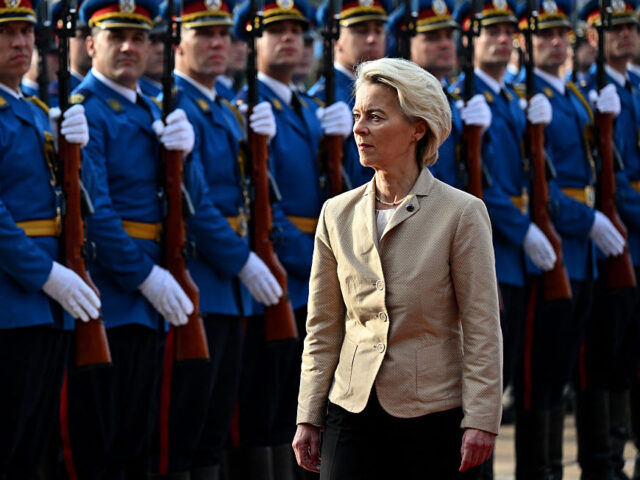

The European Union should have its own parallel NATO-like defence structures — albeit one without America — Commission President Ursula von der Leyen said in her State of the Union address.
The European Union chief addressed the bloc on Wednesday, giving a speech on the future of its security that clearly envisioned a move to divorce the continent from American defence. Remarkably, Ursula von der Leyen’s speech began by placing the Russian invasion of Ukraine and America’s exploration of acquiring Greenland on a level moral footing, while claiming that “standing up” for both non-member states was an example of how the EU protects its own.
As well as inviting Canada to become the first European Union “associate member”, perhaps the key announcement in the marathon hour-plus address, was yet another attempt to create a European Security Council, and a move towards common European defence.
A single EU Army, and the infrastructure which goes along with it, has been an ambition of Eurocrat federalism-extremists for decades, but has always stumbled because European states themselves — many of which have experienced being militarily occupied in living memory — simply don’t want to surrender the single greatest guarantor of their sovereignty, their armed forces. Concerns about creating a parallel defence union — weakening the crucial military but non-political NATO alliance — have also abounded.
Nevertheless, because “as the threat level climbs, so must Europe’s preparedness”, it is time to put these concerns aside and build a parallel military structure, Von der Leyen said. She told the chamber of European lawmakers:
…we already have many tools and we are strengthening our work with NATO, but our doctrine, our institutions, and our decision-making have not kept pace with the new reality. Our systems are made for a different world, they are driven by well-intentioned attempts at consensus and compromise.
But we need to consider whether they are still fit for purpose. For instance, Europe needs its own counter-hybrid playbook. We urgently need a consensus on how to respond to certain incidents. Those that fall below armed aggression, but which clearly threaten our national security. In other words, a mechanism to flank NATO’s Article 4, and I believe it is time for Europe’s own Article 4 and an emergency security protocol.
Article Four is a NATO mechanism laid out by the alliance’s founding treaty that states if triggered by a member state, all others are obliged to meet immediately and discuss the incident. It has been triggered by European states in recent months after Russian attack drones have become “lost” from the Ukraine war and crashed in NATO territory, and is used to commence a NATO response without a full Article Five declaration, which means full-out war.
Von der Leyen said that, in addition to building Europe’s own Article Four, there should also be a “European Security Council” that would involve EU member states and like-minded allies, including Canada, Ukraine, the United Kingdom, and Norway. Again, while the United States was excluded from this envisaged parallel NATO, it was not explicitly named, but was abundantly implied.
Another area where this bid to get away from the U.S. defence umbrella was evident was the list of military technologies that Von der Leyen said the European Union desperately needs to develop to be credible. Since the end of the Cold War, it has emerged as the de facto NATO position that while European militaries provided basic capabilities — such as infantry and armour, and jet fighter interception — a handful of big-ticket strategic capabilities were basically American competencies, and it was all these areas the EU boss said now needed to be developed domestically.
She said “strategic enablers” included “critical support assets and force multipliers that any credible defence relies on. From air and missile defence, to strategic transport, to air-to-air refuelling, to space, to cyber. These systems are essential and we need more of them”.
“This is not a partnership against anyone else, but for our common strength… fully aligned with NATO, of course”, she said.
The enormous reliance of Europe on these areas has been repeatedly laid bare in recent years, with the Patriot air interception missile system in short supply as Ukraine consumed limited stores, and missile strikes by Ukraine against Russia, even when using European-made long-range missiles, limited to what targets Washington was willing to provide intelligence on.
Yet this latest European Union counter-signalling of the United States on President Trump continues a now years-long trend of the American leader calling on his NATO allies to do more to provide for their own defence and be better members of the alliance, followed by those European states essentially doing as they are told but dressing up compliance as defiance towards President Trump. The NATO Secretary General, Mark Rutte, has repeatedly noted that the pattern appears to be that President Trump’s critiques push fellow members to increase their defence spending, as he demanded in the first place.
COMMENTS
Please let us know if you're having issues with commenting.