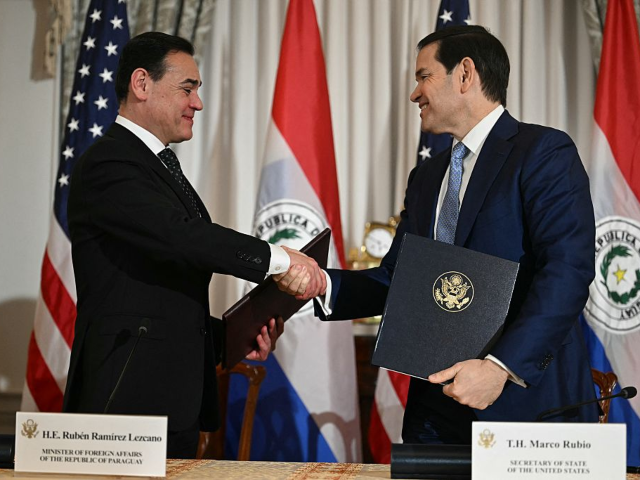
The United States and Paraguay on Monday signed a historic Status of Forces Agreement (SOFA) allowing the presence and activities of U.S. military and Department of War civilian personnel in Paraguay.
U.S. Secretary of State Marco Rubio and Paraguayan Foreign Minister Rubén Ramírez Lezcano signed the agreement in Washington as part of the Paraguayan top diplomat’s official visit.
The Paraguayan Foreign Ministry detailed that both Rubio and Ramírez Lezcano ratified the joint fight against transnational crime and drug trafficking with both countries agreeing to work together over the coming months and years.
The Status of Forces Agreement signed with Paraguay, the U.S. Department of State detailed, establishes a framework for U.S. military presence in the South American nation for bilateral and multinational training, humanitarian assistance, disaster response, and other shared security interests. Sec. Rubio pointed out that the agreement “opens new doors for our collective efforts to advance security and stability in our hemisphere.”
“Secretary Rubio emphasized that the SOFA reflects the United States’ commitment to coordinate closely with Paraguay on regional security and Paraguay’s growing importance as a regional leader and champion for security in our Hemisphere,” the State Department’s statement read in part.
“The agreement strengthens a longstanding partnership and supports our shared priorities. Both officials expressed confidence that the agreement will strengthen both countries’ sovereignty and enhance our cooperation for greater stability and prosperity in the region,” the statement concluded.
At the signing ceremony, Sec. Rubio described Paraguay as one of America’s strongest allies in the world and in the region. Rubio said that the United States wants to continue to find concrete ways to work together, stressing that it “extends beyond the security realms.”
Rubio explained:
This is not just a security matter. This agreement is about security, but we also want to extend and expand our cooperation on the economic front. There’s a lot of good things, positive things happening in Paraguay, a tremendous potential to make Paraguay a richer country and do so in partnership with American economic interests in a way that further binds our two countries together and makes us stronger. So we’re very grateful for that.
Rubio, speaking in both English and Spanish, detailed that transnational terrorist organizations are the most serious problem in the hemisphere, which are not just ideologically terrorists, but also financial and economic as well, threatening the stability and security of the region.
“It’s a problem we see in multiple places, and we need strong partners to confront them. We need strong partners in the region that understand that that’s the biggest threat in our hemisphere and are committed to working with us to confronting it,” Sec. Rubio said. “And we can do it in a way that also respects the sovereignty of our partner nations.”
Rubio noted that the agreement allows the United States to formalize the already existing partnership with Paraguay which America wants to build upon, authorizing both countries to train and expedite the transfer of security equipment, share intelligence in real time, and operate together when needed, “and in the case of any contingencies, by the way.”
Paraguayan Foreign Minister Ramírez Lezcano, for his part, highlighted Paraguay and United States’ 160 year-old friendly diplomatic relations, and expressed his nation’s clear commitment to fight against terrorism and transnational criminal organizations.
“We are very committed to the freedom, to the human rights, to the rule of law, and obviously with the freedom,” he said. “The freedom is one of the most important steps in which we are working, because fighting against the terrorism is allowing our people to be — to have a better life and freedom.”
“This is an agreement that it will strengthen our relation not only on security, as you well express, dear Marco. It’s going to allow us to work very close to building capacities, our force — security forces, and will allow us as well to be closer on our relation, on our strategy, on development of security,” he concluded.
The Paraguayan Foreign Ministry detailed that Rubio and Ramírez Lezcano discussed the delivery of radars to cover national airspace, reviewed the Safe Third Country Agreement signed earlier this year between both countries, and committed to continue working together.
The Ministry also detailed that Ramírez Lezcano was accompanied by Defense Minister Óscar González in a meeting with U.S. Deputy Assistant Secretary of War Joseph Humire where both countries listed the challenges facing the region, highlighting how President Donald Trump’s recently-released National Security Strategy proposes closer cooperation in the Americas to address shared interests.
Christian K. Caruzo is a Venezuelan writer and documents life under socialism. You can follow him on Twitter here.
COMMENTS
Please let us know if you're having issues with commenting.