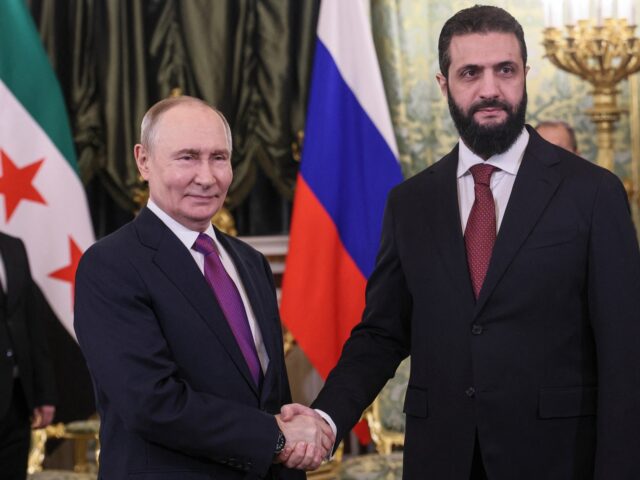
Syrian President Ahmed al-Sharaa, the head of the al-Qaeda offshoot Hayat Tahrir al-Sham (HTS), held a phone call on Tuesday with President Donald Trump shortly before his departure to Moscow to meet with Russian strongman Vladimir Putin.
The phone call with Trump was the second of its kind in as many weeks, as Washington has been offering support to Damascus during the process to dismantle the Syrian Democratic Forces (SDF), the U.S.-allied, Kurdish-led force primarily responsible for the liberation of “caliphate” capital Raqqa from the Islamic State. Sharaa’s visit to Moscow will also be his second since taking over Syria in December 2024, when longtime dictator Bashar Assad fled the country and received political asylum in the Russian capital. The Russian government aided Assad during the Syrian Civil War, often engaging in combat with HTS and other rebel groups. Sharaa has not let this deter the establishment of diplomatic channels between his government and Russia in the year of his tenure.
Russia’s main priority in Syria currently is believed to be the maintaining of its military bases, established under the Assad regime, and ensuring its long-term political influence in the Middle East. Sharaa’s biggest political challenge at the moment is the integration of the Kurdish fighting forces. The SDF and the Sharaa regime signed an agreement this month that would integrate the militia into the reconstructed Syrian armed forces and mandate the recognition of the government of Damascus as sovereign over Syrian Kurdistan, or Rojava.
In exchange, the Syrian government agreed to recognize the Kurdish ethnic group as part of the social fabric of the country and allow the teaching of the Kurdish language in Kurdish region schools, among other promises.
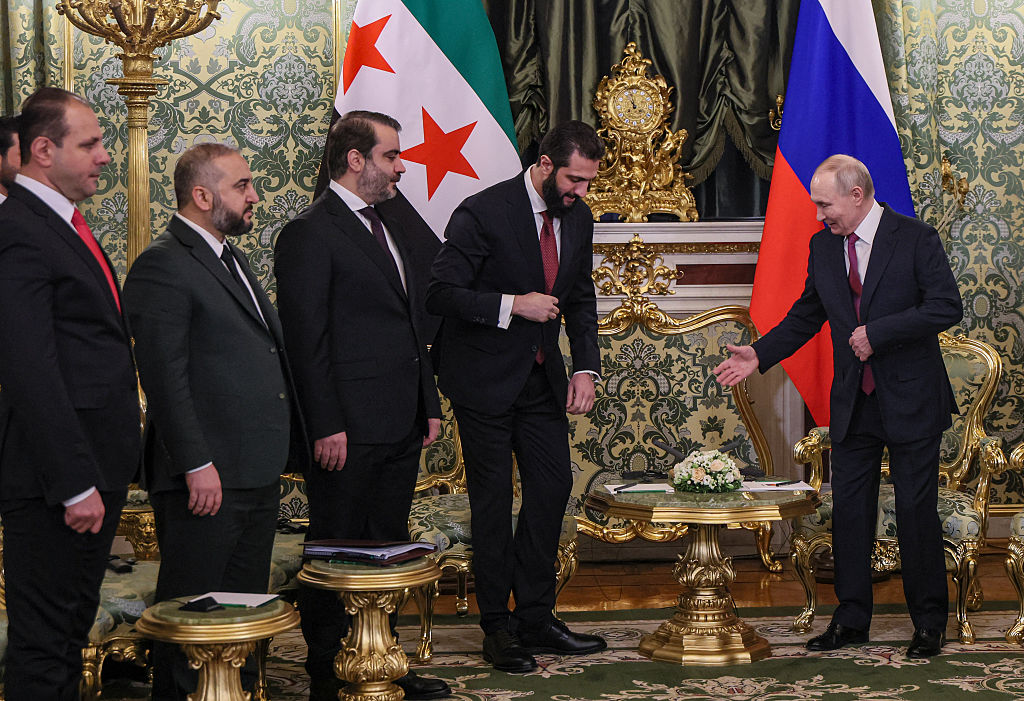
Russian President Vladimir Putin meets with Syria’s President Ahmed al-Sharaa at the Kremlin in Moscow on January 28, 2026. (Photo by MAXIM SHIPENKOV / POOL / AFP via Getty Images)
The signing of the deal was immediately followed by widespread reports of regime-affiliated terrorists slaughtering Kurds, including several beheadings and other horrific crimes. Videos of jihadists believed to be associated with Sharaa terrorizing Kurdish communities – and one in particular showing an alleged jihadi showing off a braid cut off the head of a dead Kurdish female fighter – caused international alarm and triggered demands from the U.S.-allied Kurds for support from Washington. Kurdish groups also reported that regime-affiliated jihadists attacked prisons housing hundreds of Islamic State terrorists, many of them captured during the liberation of Raqqa. The attacks resulted in potentially hundreds of fugitive Islamic State terrorists now on the run in the country.
President Trump has not commented in any detail on the atrocities against the Kurds of Rojava. During his phone call with Sharaa, he allegedly praised the ongoing negotiations to integrate the Kurds into the new, jihadist-led Syrian government.
According to the Syrian Arab News Agency (SANA), Sharaa’s state-run press outlet, Trump told Sharaa that the process to bring the SDF under Sharaa’s control was “a pivotal step toward ending the conflict” between Damascus and the Kurds. Trump allegedly “commended the understandings related to the integration of military forces, including the Syrian Democratic Forces (SDF), into official institutions.”
SANA added that Trump “reiterated his country’s support for the aspirations of the Syrian people to build a unified and strong state” and offered support for the rebuilding of Syria following the war. The civil war resulted in the near-complete leveling of some of Syria’s largest cities and, relatedly, a migrant crisis creating a diaspora of an estimated 4.4 million people, according to the United Nations.
Sharaa, according to his news agency, offered Trump his commitment to eradicate the Islamic State. Sharaa joined the international coalition to fight ISIS during his visit to the White House last year, an initiative that Assad, a close ally of the Iranian regime’s, had not entertained.
“He and the U.S. President agreed on the necessity of prioritizing dialogue as a means to resolve regional disputes,” Sharaa shared, “with President Al-Sharaa stressing that “active diplomacy” is the only path to overcoming the region’s protracted crises.”
Trump confirmed the phone call during remarks to reporters on Tuesday, but offered few details.
“I had a great conversation with the highly respected president of Syria,” Trump said, describing the situation in Syria as “working out very, very well.”
“We are very happy about it,” he offered.
Neither the American nor the Syrian side mentioned Putin or Russia in discussing the Trump-Sharaa phone call, though the Syrian strongman’s visit to Moscow is likely to have come up as a topic. The Kremlin confirmed Sharaa’s visit on Tuesday and gave reporters few details on the topics of conversation expected between Sharaa and Putin.
“They plan to discuss the state and prospects of bilateral relations in various areas, as well as the current situation in the Middle East,” a Kremlin press statement read.
SANA also reported the visit, citing Sharaa’s office, which said that the two would “discuss aspects of developing bilateral relations between the two countries, in addition to discussing developments in the Middle East region.”
The issue of Russia’s military bases is likely to be high on the list of priorities. Russia has managed to retain some military presence in the country since the fall of Assad but exited its naval base at Tartus following the end of the Assad regime. According to the Kurdish news outlet Rudaw, Russian forces were moving “troops and equipment” out of the Qamishli airbase this week, where they have had a presence since 2019.
COMMENTS
Please let us know if you're having issues with commenting.