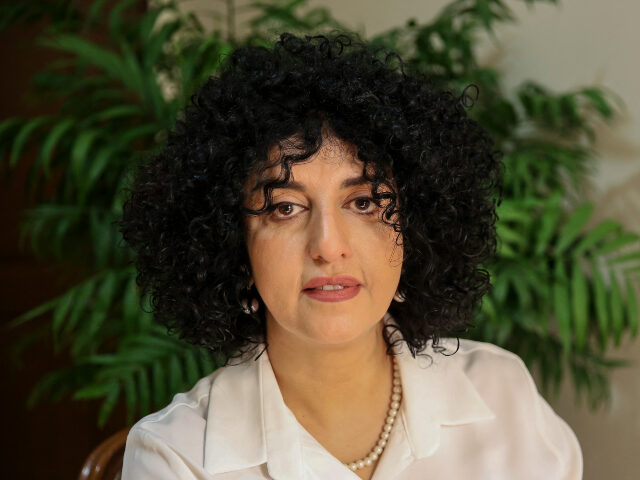
The lawyer for imprisoned Iranian human rights activist Narges Mohammadi said the regime added another seven years and a half to her prison sentence on Saturday as part of its crackdown against dissidents in the wake of last month’s massive nationwide protests.
“She has been sentenced to six years in prison for ‘gathering and collusion’ and one and a half years for propaganda and two-year travel ban,” lawyer Mostafa Nili said on social media.
According to Nili, Mohammadi was also punished with two years of “internal exile” that would prevent her from leaving the city of Khosf after she eventually gets out of prison.
Mohammadi, 53, received the Nobel Peace Prize in 2023 for her “fight against the oppression of women in Iran, and her fight to promote human rights and freedom for all.”
Mohammadi had been arrested 13 times by that point and was imprisoned in Iran’s infamous Evin dungeon when her Nobel Prize was awarded. In a bitter twist of fate, she had been jailed in 2021 for “spreading propaganda against the state,” and one piece of “evidence” introduced against her by regime prosecutors was her nomination for the Nobel Peace Prize in 2021. She did not get the award for 2021, but she finally did become a Peace Prize laureate two years later.
Even though she was in prison, Mohammadi was an intellectual leader of the “Women, Life, Freedom” uprising that began in 2022 with the death of a young Kurdish woman named Mahsa Amini at the hands of Iran’s infamous “morality police.” Amini’s “crime” was not wearing her mandatory headscarf properly.
In December 2024, she was given a three-week medical furlough, which the Nobel Committee and other human rights activists wanted to make permanent, due to the “severe” health conditions she developed in Evin prison. Among other ailments, the Nobel Committee said she “most likely” had developed bone cancer. She also suffered several heart attacks during emergency surgery in 2022.
Cheerfully defiant as ever, she walked through the gates of Evin singing the anthem from the “Women, Life, Freedom” protests.
Mohammadi’s freedom lasted longer than three weeks, but she was rearrested in December 2025 while attending a memorial service for human rights lawyer Khosro Alikordi. According to a France-based advocacy group that supports her, the Narges Foundation, she was swarmed by “plain-clothed agents” of the regime who attacked her with “severe and repeated baton blows to the head and neck” when they took her into custody.
The regime vaguely accused her of making provocative comments about Alikordi’s death, which was officially ruled a sudden heart attack. But many human rights activists believe he may have been murdered by the Iranian state.
Last week, Mohammadi began a six-day hunger strike to protest her unlawful detention. Just as she was concluding her hunger strike, a court in the northeastern city of Mashhad suddenly put her on trial for “collusion” with foreign powers and “propaganda activities.” Another 7.5 years was lumped onto her existing 13-year sentence from 2021.
According to her husband Taghi Rahmani, Mohammadi had no legal representation at her sudden trial, and she refused to defend herself because she insisted “this judiciary holds no legitimacy,” and the trial was “a mere charade with a pre-determined end.”
“Though she was likely forced to attend, she remained silent – she did not utter a single word, nor did she sign a single paper,” Rahmani told the BBC on Sunday.
COMMENTS
Please let us know if you're having issues with commenting.