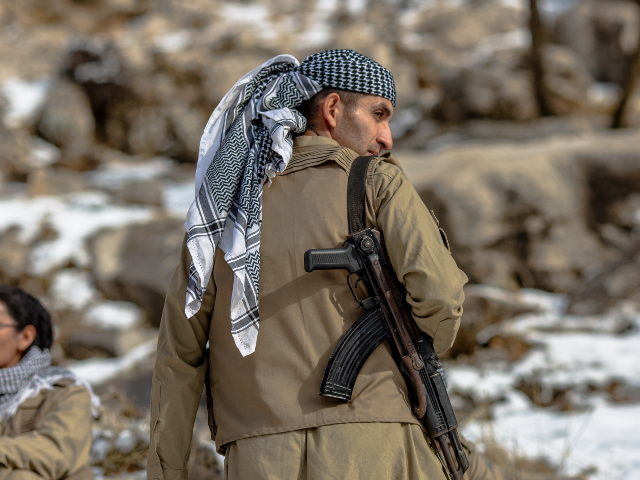

Several media outlets in the U.S. and Israel have reported that the U.S. has asked the Iranian Kurds to join the fight against the regime in Tehran, potentially neutralizing security forces in western Iran and paving the way for another popular uprising.
CNN on Tuesday cited “multiple people familiar with the plan” who said the Central Intelligence Agency (CIA) is “working to arm Kurdish forces with the aim of fomenting a popular uprising in Iran.”
A senior Iranian Kurdish official told CNN the plan is fairly advanced, and the Kurds could begin a ground operation “in the coming days,” emboldened by their belief that they have a “big chance” to topple a regime crippled by devastating U.S. and Israeli airstrikes.
The Times of Israel (TOI) also reported consultations between Iranian Kurdish militias and the United States. TOI said the Kurds have been training for battle with regime forces, and have asked the CIA to supply them with weapons, but “a final decision has not yet been made on the operation and its possible timing.”
“Three sources with knowledge of the matter” confirmed the report of U.S. consultation with the Iranian Kurds to Reuters on Tuesday. As with TOI’s report, Reuters said a “final decision has not yet been made on the operation and its possible timing.”
The U.S. has also been talking to Kurdish leaders in Iraq, although accounts of those discussions did not specifically mention military cooperation. As CNN pointed out, the Iraqi Kurds would have to cooperate with U.S. efforts to support the Iranian Kurds with weapons and logistics.
Several outlets in the U.S. and Middle East, including Kurdish news service Rudaw, quoted Patriotic Union of Kurdistan (PUK) leader Bafel Talabani saying that he spoke with President Donald Trump on Tuesday.
Talabani said Trump “clarified the objectives of the United States in the current war” during their conversation.
Rudaw also reported on a possible conversation between Trump and Kurdistan Democratic Party (KDP) President Masoud Barzani, but Barzani’s office has not confirmed the discussion took place. The report also claimed Trump has spoken with Mustafa Hijri, leader of the Democratic Party of Iranian Kurdistan (PDKI).
Fortune on Tuesday also claimed Trump “spoke directly” with Iranian Kurdish leader Mustafa Hijri, and asserted concrete steps have already been taken to bring the Kurds into the fight.
“Benjamin Netanyahu arrived at the White House with Kurdish uprising numbers already mapped. Weapons have reportedly been smuggled into western Iran since last year’s twelve-day war. Israeli strikes are targeting Iranian military outposts along the Iraq border to clear a path for ground operations,” Fortune reported.
While these reports suggest using the Kurds as a proxy ground force was always part of the U.S.-Israeli war plan, Foreign Policy Research Institute (FRPI) senior fellow Mohammed A. Salih speculated on Tuesday that the Kurds were more like a “plan B” after the tremendously successful decapitation strikes in the first days of the war did not bring the Iranian regime down.
The White House would not confirm any talks with either the Iraqi or Iranian Kurds, although White House spokeswoman Karoline Leavitt told reporters on Monday that “President Trump has been in contact with many allies and partners in the region throughout the past several days.”
Iran’s Kurds certainly have no love for the theocracy in Tehran. Militant Kurdish groups have been operating along the border between Iran and Iraq for many years, and the regime has long denounced them as terrorists and separatists.
Iranian Kurdistan held a general strike across 39 cities during January’s widespread uprising against the theocracy, and some Kurdish militant groups claim to have conducted attacks on Islamic Revolutionary Guard Corps (IRGC) units during that time.
The IRGC, which handles both foreign terrorist operations and internal repression, periodically attacks Kurdish “separatists,” creating a great deal of animosity. The previous major uprising in Iran, the “Women, Life, Freedom” movement of 2022, was sparked by the death of a young Kurdish woman named Mahsa Amini at the hands of Iran’s infamous “morality police.”
The regime in Tehran seems to believe the Kurds are an imminent threat. According to the Iranian resistance, the IRGC is already launching drone and missile strikes against Mustafa Hijri’s PDKI, apparently prompted by a meeting on Monday in which the five largest Iranian Kurdish political parties agreed to set aside their differences to oppose the regime.
The Jerusalem Post reported regime strikes against several of the other Kurdish parties. The Kurds, in turn, issued a statement urging security troops in western Iran to defect and abandon the dying regime.
Analysts generally believe the Kurds are capable, at the very least, of engaging the IRGC and pinning its forces down while a general popular uprising takes shape, especially if they receive weapons and logistical support from the United States. Airstrikes have already weakened regime forces considerably, creating an opportunity for the Kurds to win a fight they have long relished.
There are many potential drawbacks to the plan, however, beginning with the possibility that Iraqi Kurds might not get on board, and arming the Iranian Kurds would be impossible without their cooperation.
The Kurds are spread across Iran, Iraq, Syria, and Turkey, and all of those nations are perpetually worried about surges of Kurdish nationalism that could inspire separatist movements to create a “greater Kurdistan.”
Turkey, in particular, regards Kurdish separatism as the single greatest security threat it faces. These governments could be unnerved by the possibility of a U.S.-backed Kurdish insurgency helping to knock over the regime in Tehran and then potentially seeking autonomy from whatever government replaces the ayatollahs. The Kurds are politically fragmented, both across the Middle East and within each country’s Kurdish region, but a triumphant Iranian Kurdish resistance could send potent signals throughout the entire Kurdish political nervous system.
Other separatist forces could also be energized by a win for the Iranian Kurds, including the Baloch, another restless ethnic group that spreads across national borders. Pakistan is especially nervous that trouble in Iranian Balochistan could spill across the border into Pakistani Balochistan.
A good deal of the complex political relationship between Pakistan and Iran over the past half-century has been driven by mutual concern about the Baloch, who might be even more determined than the Kurds to put their common ancestral homeland back together as an independent nation.
One other complicating factor is that Kurds across the region were dismayed by U.S. support for the new Syrian government against the Kurdish-led Syrian Democratic Forces (SDF) during their recent internal conflict.
If the Iranian Kurds use American weapons to rise up against Tehran, and the regime survives, the Kurds will surely want some guarantee of protection against the utterly savage reprisals they would face — a grim slaughter the regime is already threatening to inflict against any “separatists” in Iran who think about turning against it.
COMMENTS
Please let us know if you're having issues with commenting.