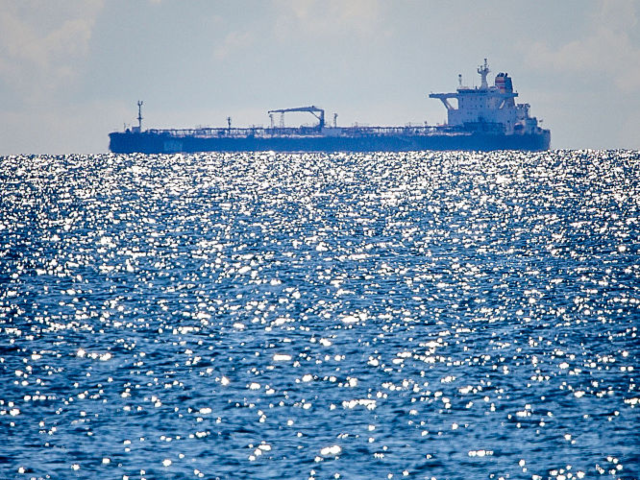

Wednesday’s seizure of a rogue Russian-flagged tanker in the North Atlantic marked a significant escalation of U.S. efforts to shut down the dangerous “shadow fleet” of sanctions-defying invisible ships created by Russia, China, Iran, and other hostile powers – a fleet that poses serious threats to the environment, maritime safety, legitimate global shipping, and the world’s economic security.
Homeland Security Secretary Kristi Noem announced “two predawn operations” on Wednesday, in which “the Coast Guard conducted back-to-back meticulously coordinated boarding of two ‘ghost fleet’ tanker ships – one in the North Atlantic Sea, and one in international waters near the Caribbean.”
Noem identified the ships as Motor Tanker Bella I and Motor Tanker Sophia, and said both were “either last docked in Venezuela or en route to it.” She noted that Bella I had been “trying to evade the Coast Guard for weeks, even changing its flag and painting a new name on the hull while being pursued, in a desperate and failed attempt to escape justice.”
In fact, the Bella I had changed its name to “Marinera” by the time U.S. Coast Guard helicopters dropped security forces on her deck. Like many ships in the “shadow fleet” or “ghost fleet,” it was an aging and poorly maintained rustbucket tanker – an environmental disaster just looking for a place to happen.
The Marinera changed its course to head for northern Russia shortly before it was boarded. The ship had already resisted one U.S. Coast Guard boarding attempt in the Caribbean last month. Shortly after that incident, it hastily painted a Russian flag on its hull and declared it was sailing under Russian registration.
The Russians have been using their flag to protect illegal shadow fleet vessels and they were evidently shocked when the U.S. disregarded that tactic to seize the Marinera. Shortly before the ship was seized for violating U.S. sanctions, the Wall Street Journal claimed that Russia “sent a submarine and other naval assets” to “escort” the ship.
The action in the North Atlantic was supported by the United Kingdom, which reportedly joined U.S. forces in maintaining surveillance on the ship, and provided “pre-planned operational support” for the Coast Guard boarding. The scale of the joint operation to capture the Marinera led some observers to suspect it was carrying more than oil.
“Why have the U.S. put all these assets into the UK just for some oil tanker? Could it be Russian arms going to Venezuela?” former British defense attache to Moscow John Foreman speculated to the UK Guardian.
Radio Free Europe (RFE) on Wednesday cited data from the Windward maritime intelligence company that showed at least 21 previously flagless ships have hoisted the Russian flag since December 10, when the U.S. seized a shadow fleet tanker named Skipper. The Skipper was broadcasting false navigational data to conceal its position, a common and reckless tactic employed by shadow tankers. The U.S. military was nevertheless able to track and locate it.
“There are hundreds of flagless, stateless tankers that have been a lifeline for revenues, sanctioned oil revenues, for regimes like Maduro’s, Iran and for the Kremlin. They can no longer operate unchallenged,” Windward analyst Michelle Weise Bockmann said in December, after the Skipper was captured.
RFE noted that flagless ships have effectively zero legal protection against boarding and seizure, since they are violating maritime law, but hoisting virtually any national flag gives the sanctions-busting smugglers some legal defense, because the country whose flag they are flying must grant permission for them to be boarded. Russia has been successfully abusing that custom to protect ghost ships – until now.
Tufts University Center for International Law and Governance senior fellow John Burgess told RFE that the Marinera was a fringe case, since its change of convenience to the Russian flag while at sea was such a transparently obvious ploy.
The White House dismissed perfunctory complaints from Moscow by declaring the ship was “stateless after flying a false flag.” Analysts expect Russia’s objections to grow louder if any Russian citizens aboard the ship are put on trial in the United States.
Windward analyst Bockmann said on Wednesday the Baltic Sea nations would be especially interested in the precedent set by the Marinera seizure, since ghost ships are a major threat to “maritime safety, maritime security, and the environment” in their relatively cramped waters.
“The U.S. has shown that it is possible to interdict and to seize and to deal with tankers,” she said.
COMMENTS
Please let us know if you're having issues with commenting.