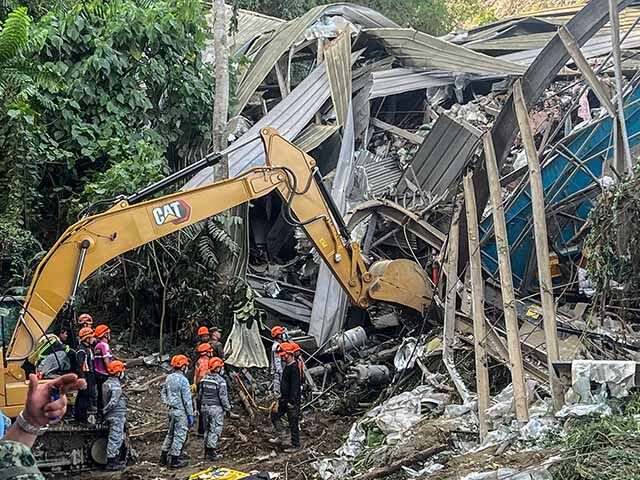
At least two people were killed on Thursday, 12 were injured, and 35 are still missing after a landfill in the central Philippines collapsed and buried a village beneath an avalanche of garbage.
The incident occurred at the Binaliw Landfill near Cebu City at roughly 4:00 p.m. local time on Thursday. Employees at the landfill told local media the collapse of the landfill was swift and sudden, apparently caused by the immense weight of the piled garbage pressing against metal retaining walls. An initial investigation by city officials suggested the landfill might also have been weakened by the magnitude 6.9 earthquake that struck Cebu in September.
Landfill employees said they have been warning about the dangers of the growing trash mountain for years. A Cebu City public information officer told AFP the garbage pile had grown to be “four stories high.”
The towering pile of trash quickly turned into a flood of refuse when the wall gave way, rolling downhill with such force that it buried and destroyed structures in its path. One of the buildings it struck was a warehouse where recyclables were being separated from piles of trash, adding more garbage to the avalanche.
A dozen of the injuries reported from the incident were landfill workers who got swept away with the tide of garbage. There were about 110 people working at the landfill when the catastrophe occurred.
City officials said the buildings crushed by the garbage flood included “company offices, HR, admin, and maintenance staff” for Prime Waste Solutions Cebu, the firm that operates the site. The company’s website said the landfill processed 1,000 tons of municipal solid waste every day. Local media reports said another 600 tons of trash are already “on standby for disposal.”
The mayor of Cebu, Nestor Archival, explained that rescuing the people trapped under the tidal wave of garbage is exceptionally difficult, because the footing is so unstable.
“This is not like other landslides that you can just excavate. If you pull from the top, the bottom is soft. Let’s say there is a person there, when you get the debris, it might get worse,” he said.
City councilor Joel Garganera, head of the Cebu City environmental committee, added there was “serious concern about toxic air, which could endanger anyone trapped for too long.” These toxic gases include methane, which is flammable, so rescue workers must be careful not to do anything that could throw sparks and start a fire.
Another challenge is that all of the trash being moved aside to access buried victims has to be moved somewhere, and rescue workers are concerned about triggering another garbage avalanche.
The sister of a trapped landfill engineer told reporters that people trapped under the garbage are “calling for help,” so there are still living victims to be rescued, possibly including her brother.
Mayor Archival said that about 500 workers are involved in the rescue effort, “with strict adherence to safety protocols.”
Remarkably, Thursday’s incident was not the first deadly garbage avalanche in the Philippines, nor was it the worst.
In July 2000, over 200 people were killed when a wall of garbage collapsed upon a shanty town in Manila, which was occupied by thousands of scavengers who spent their days picking through the trash. Tighter rules for landfills were passed amid public outrage after the incident.
COMMENTS
Please let us know if you're having issues with commenting.