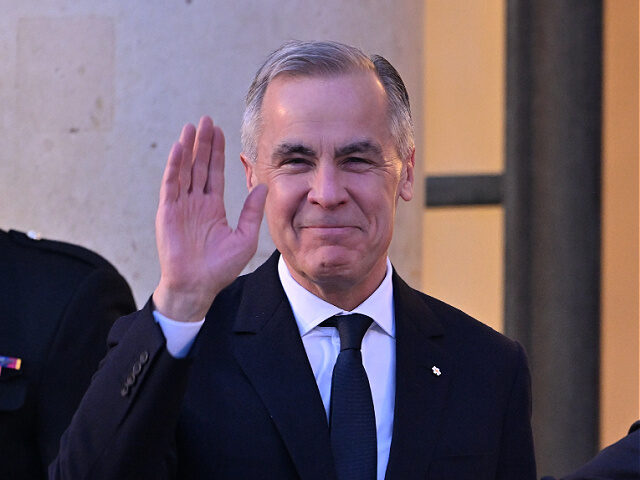

Canadian Prime Minister Mark Carney departed for a visit to China on Tuesday, fulfilling a promise he made to dictator Xi Jinping when they met in South Korea in October.
Carney, whose private financial career included extensive dealings with China, is seeking to mend relations with the Communist superpower after tariffs and jibes about annexing Canada from President Donald Trump soured relations between Ottawa and Washington.
Carney will become the first Canadian prime minister to visit Beijing since 2017. Relations between the two countries took a nosedive in 2018, when Canadian police arrested Huawei executive and Chinese Communist Party royalty Meng Wanzhou in Vancouver to face charges of fraud and evading U.S. sanctions against Iran.
China brought enormous pressure against Canada to release Meng, including taking some Canadians hostage with sketchy charges of espionage. The U.S. dropped its charges against Meng in September 2021, and China released its Canadian hostages shortly afterward.
China was angry enough about Meng’s arrest and continuing Canadian criticism of human rights violations in China to keep relations in the deep freeze until President Trump returned to office in 2025. Trump’s tariffs and taunts about annexing Canada as the 51st American state prodded Carney to mend fences with Beijing.
Carney and Xi had a friendly encounter at the Asia-Pacific Economic Cooperation (APEC) summit in South Korea in October. Observers saw the meeting as a shift in “tone” between China and Canada, but no substantial agreements were reached between the two leaders. Carney’s office said Xi invited him to visit China at a “mutually convenient time,” and Carney accepted.
China’s state-run Global Times on Tuesday saw Carney’s visit as an opportunity to peel Canada away from the United States, approvingly quoting Mark Ceolin of the Canadian Chamber of Commerce in Shanghai’s statements of enthusiasm for the prime minister’s trip to Beijing.
“From my perspective, the visit is an acknowledgement of Canada’s need to diversify its markets and a recognition that, to work successfully with China, a recalibration of relations has to take place which will allow our two countries to get beyond the challenges of old issues and bring us to a level where our natural synergies find fuller realization,” Ceolin said.
“We have an opportunity here to not only recalibrate our bilateral relationship but to find ways to forge into the future by bringing Canadian commodities such as oil, lumber, minerals, to the table, as well as our skilled workforce and excellent research facilities and technologies into new partnership with Chinese innovation and manufacturing systems,” he said.
“It is important to note that Canadian businesses have remained steadfast in their dedication to the Chinese market,” he added.
Other Chinese state media outlets advised Carney to develop greater “strategic autonomy” by building ties with China and showing America it cannot take the allegiance of its northern neighbor for granted. China Daily, for example, said most of China’s problems with Canada were caused by former Prime Minister Justin Trudeau’s eagerness to “contain China in lockstep with the United States.”
“If Ottawa still chooses to subject its China policy to the will of Washington again in the future, it will only render its previous efforts to mend ties with Beijing in vain,” the Chinese paper warned.
Carney took heavy fire for his business ties to China during his campaign for prime minister, including allegations that he could make Canada’s national interests secondary to his own private business connections to Chinese firms.
Carney insisted he had no such conflicts of interest, and he insisted he regarded China as the greatest threat to Canadian security. He is evidently hoping to secure Xi’s forgiveness for expressing that opinion and for keeping China from dumping its electric vehicles (EVs) into Canadian markets.
The Globe and Mail noted Carney appears to be treating his pilgrimage to Beijing as his most important foreign outing to date:
Mr. Carney’s entourage for the trip beginning Wednesday will include five cabinet members, the biggest ministerial delegation that has accompanied Mr. Carney on a foreign trip so far. That group is made up of Foreign Affairs Minister Anita Anand, Industry Minister Mélanie Joly, Energy and Natural Resources Minister Tim Hodgson, Agriculture Minister Heath MacDonald and International Trade Minister Maninder Sidhu. The Prime Minister will meet President Xi Jinping on Friday.
Mr. Carney’s short-term imperative in Beijing is a breakthrough in a punishing trade war triggered by 2024 Canadian tariffs on Chinese electric vehicles that prompted retaliation on Canadian agricultural products from canola to seafood. China’s ambassador has made it clear Beijing would remove levies if Canada scraps the EV tariff.
Saskatchewan Premier Scott Moe is joining Mr. Carney for a portion of his trip to China, the provincial government announced Monday, raising expectations of a deal involving canola or other agricultural exports to China.
A “senior government official” told the Globe and Mail that Carney does not intend to lift protective tariffs against Chinese EVs unless China makes him a very good offer, probably involving a lot more than canola oil. Ontario Premier Doug Ford suggested Carney’s price for letting China sell EVs in Canada should require the Chinese to build them at a factory in his province.
Other Canadian officials who spoke to Reuters lowered expectations by saying they did not even expect China to fully relent on canola, and Carney will probably stay away from hot-button trade topics like artificial intelligence and critical minerals — in part because he wants to send a calibrated signal to Trump without enraging the American president and scuttling ongoing negotiations to reduce tariffs on Canada.
Canada can make some diplomatic concessions to break the ice with Beijing, and it appears to already be doing so. Two Canadian lawmakers have already terminated a visit to Taiwan ahead of schedule, and Reuters listed some topics irksome to China that Carney could promise to stop talking about, including “the jailing of pro-democracy media mogul Jimmy Lai, the secret execution of four Canadians in China last year and past interference in Canadian elections.”
Canadian Conservative Michael Chong blasted the Liberal MPs for cutting their trip to Taiwan, calling it “nothing short of kowtowing to Beijing’s authoritarianism.”
“The Chinese might make a case during bilateral meetings with Canada about how unreliable the U.S. is as a partner and how dangerous they are. Whereas China is willing to help Canada expand its trade relationships outside of its hemisphere if the Canadians are willing to play ball,” suggested Chinese expert Joseph Torigian of American University.
Zhu Feng, dean of international studies at Nanjing University in China, reduced expectations by telling the Associated Press (AP) that Carney’s visit to Beijing “does reflect the new space for further development in China-Canadian relations under the current U.S. trade protectionism,” but it would probably not produce any world-shaking realignment, “because Canada is not only a neighbor of the United States but also an ally.”
Foreign policy expert Cui Shoujun of China’s Renmin University wondered if Canada’s “current state of considerable unease towards the U.S.” might be exacerbated by Trump’s interest in taking control of Greenland,” or by Trump’s surprising arrest of Venezuelan narco-terrorist dictator Nicolas Maduro, but other observers doubted those concerns would be enough to completely outweigh Carney’s reasons for viewing China as a major trade, security, and cyber threat.
“The whole crux of this visit is how can [Carney] keep Canadians safe while increasing trade with China, given that it is such a great security threat?” mused Michael Kovrig — one of the Canadians taken hostage by China to secure the release of Meng Wanzhou — in a Tuesday interview with Toronto’s CityNews.
Kovrig’s advice was for Carney, and all Canadians, to remember exactly what regime they are dealing with when they consider shifting some of their trade from the “increasingly difficult to deal with United States” to China.
“Canadians should not be looking for a reset. We shouldn’t look for that or expect it or want that. This is a recalibration in relations and success here should be modest, concrete and reversible, not focused on atmospherics,” he said.
Kovrig also thought that while Carney appears to be visiting Beijing with hat in hand, it is actually China’s economic weakness that made Xi eager to exploit the opening to Canada created by Trump’s trade war.
“What changed is that Xi Jinping decided because China’s economy is suffering and struggling with rivalry with the United States that it’s in China’s interest to start talking to Canada again. The Canadian government has been trying to talk to China all along,” he said.
COMMENTS
Please let us know if you're having issues with commenting.