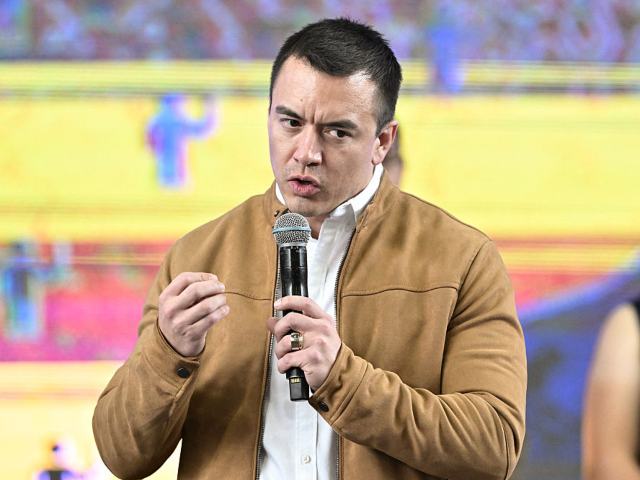
The administration of Ecuadorian President Daniel Noboa on Monday announced a 900 percent increase in tariffs on Colombian oil transiting through its pipeline system, the latest move in an escalating trade dispute.
Ecuadorian Energy Minister Inés Manzano reportedly confirmed the measure in an interview with a local radio station, where she detailed that Ecuador will now charge $30 for every barrel of Colombian oil that transits through its Trans-Ecuadorian Pipeline System (SOTE) oil pipeline — a 900-percent increase from the $3 per barrel it had been charging up to that point.
“From paying around $3 to pass through the SOTE, it went up to $30. I think it’s a fee that, for foreign users, is also subject to availability and opportunity… We have done this because, when [Hydrocarbons Regulation and Control Agency] Arch’s resolutions are issued, they are based on technical decisions, legal decisions, responsible decisions, and also carry an important message for Colombia,” Manzano said. Around 12,000 barrels of oil per day from Colombia’s majorly state-owned Ecopetrol pass through the SOTE pipeline.
Colombian Energy Minister Edwin Palma rejected Ecuador’s tariff hike in remarks given to reporters on Tuesday morning. Palma said that the new measure was “adopted unilaterally and disproportionately,” does not meet technical or economic criteria, and affects oil production feasibility in southern Colombia.
“This decision by the Ecuadorian government is a new attack on the people. Now they are unilaterally and arbitrarily raising the price of crude oil transportation through one of their pipelines, once again violating previously made commitments, such as the agreement of February 13, 2011. This mainly affects small crude oil producers,” Palma said.
Ecuador and Colombia have been embroiled in ongoing trade and diplomatic tensions after President Noboa announced that, starting on February 1, Ecuador will apply a 30-percent “security tariff” to Colombian imports, citing a trade deficit with the neighboring nation and a lack of cooperation from the administration of far-left President Gustavo Petro in the fight against drug trafficking and illegal mining.
“This measure will remain in place until there is a genuine commitment to jointly tackle drug trafficking and illegal mining on the border with the same seriousness and determination that Ecuador is currently demonstrating,” Noboa wrote on social media.
Colombia immediately condemned the tariff and refuted Noboa’s claims regarding lack of cooperation against drug trafficking. In an official statement, the Colombian government urged Ecuador to desist on implementing the tariff raise and claimed that cocaine seizures have increased during the years of Petro’s administration. Bogotá also alleged that it has documented a 36.7 percent increase in cocaine seizures in municipalities bordering Ecuador.
Moments later, the Colombian Commerce Minister Diana Morales announced that the country would impose reciprocal tariffs on an unspecified group of 20 Ecuadorian products. At the same time, the Colombian Energy Ministry announced the suspension of electricity sales to the neighboring nation. Ecuador reportedly covers up to nine percent of its energy demand with purchases of Colombian-generated electricity.
Ecuadorian Energy Minister Manzano reportedly explained in her Monday interview with Radio Sucesos that the measures being taken by her country, including the tariff increase on oil transports, are in response to security issues facing Colombia which affect Ecuador. Manzano stressed that attacks have been carried out by criminal groups in various areas where the oil pipelines operate and that Ecuador tried to help Colombia so that it could extract and market its crude oil.
“We have to make them see that I am also providing you with a service, and that it is a very important service for Ecopetrol and for Colombian companies,” Manzano said. “They don’t have the crude oil because that sector of Colombia is a sector where there are illegal activities.”
Colombia, the world’s top cocaine producer, has seen a record-breaking surge in the drug’s production following the implementation of lenient drug-fighting policies by the administration of Gustavo Petro — a notorious advocate for the legalization of cocaine and Colombia’s first ever leftist president. In October, President Donald Trump accused Petro of being an “illegal drug dealer” after the United States imposed sanctions on Petro and some members of his family for having engaged in, or attempted to engage in, “activities or transactions that have materially contributed to, or pose a significant risk of materially contributing to, the international proliferation of illicit drugs or their means of production.”
In early January, shortly after the United States carried out a law enforcement operation in Caracas to arrest socialist dictator Nicolás Maduro, President Trump put Petro on notice and told reporters that the Colombian President should “watch his ass.”
Days later, President Trump and Petro spoke over the phone moments before the Colombian president was slated to deliver an anti-Trump speech in Bogotá. Petro admited that he reformulated his speech and lowered its original intended belligerent tone after speaking with Trump. Petro is expected to meet with President Trump at the White House on February 3.
Christian K. Caruzo is a Venezuelan writer and documents life under socialism. You can follow him on Twitter here.
COMMENTS
Please let us know if you're having issues with commenting.