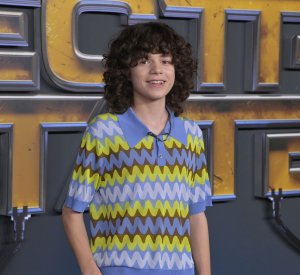

NEW YORK, Nov. 3 (UPI) — The Electric State and Poldark alum Woody Norman says he tried to humanize Richard II, but that doesn’t mean people should like the king he plays in the epic medieval film, The Uprising.
Set in the 14th century after the bubonic plague left the peasants of England grief-stricken and starving, the film follows the hero Ploughman (Andrew Garfield) as he leads an uprising against Richard and his corrupt counsel.
“Through the peasant’s uprising, he knew that they were coming after him and that his men were good to blame for it. So, he did. But I think it’s all just him looking for a way to deal with his own power and to find his own ego,” the 17-year-old actor said in a recent virtual press conference. “At the time, the king was second to God and he believed that.”
Written and directed by Paul Greengrass, the film co-stars Jamie Bell, Stephen Dillane, Tom Hollander, Cosmo Jarvis, Thomasin McKenzie, Jonny Lee Miller, Katherine Waterston and Sky Yang. It was released on DVD and Blu-ray Tuesday.
“As someone who is going through my teenage years, I feel that need for finding my own power in my life,” Woody said. “[Richard] was in a very different situation because he was incredibly mentally ill and he was the King of England. So, his way of power was murder.”
The actor noted his character was very young when he inherited the throne from his dead father and he learned how to rule from greedy aristocrats who did not have his — or England’s — best interests at heart.
“He was used and he was, not to rhyme, but abused, as well, and he realized that,” Woody said, agreeing that the young monarch chose to dominate his people instead of giving them reasons to love and defend him.
“This is one of the most insane characters in the whole of English royal history,” he added. “They invested all of their hopes in a single leader who turned out to be psychologically not the right person to do that to and becomes a monster.”
Woody insisted the “weird character” was still a joy to play.
“He was so over the top,” the actor added. “I tried my best to humanize him. But he was such a bad and evil person that it was hard to do that, even when I was playing him. I hate him and I think you should.”
Greengrass praised Woody for the vulnerability he brought to the character.
“You felt this boy who’d been brought in as a child and told you are the messiah,” the filmmaker said. “Literally, that’s what they said to him. He was brought up to be the messiah. I mean, what does that do to your head?”
The end of The Uprising echoes Shakespeare’s dramatic version of the historic figure’s life.
“The monster who reverts in the end to self-pity. For God’s sake, let us sit upon the ground and tell sad stories of the death of kings,” Greengrass said.
“This guy who’s crested the absolute height of absolute power and this moment in the peasant’s revolt is the first time he tastes it. He’s a child, he’s the king, he’s told: ‘You’re everything. You’re next to God.’ And then this sight of the whole country is out before you, clamoring for you,” he added. “What you end up with is the monstrous Richard, who has this tragic end.”
Although the film has been billed in the United States as the true story that inspired the legend of Robin Hood because the Ploughman challenges Richard take care of the poorest of his charges, Greengrass downplays that connection.
“There was no person called ‘Robin Hood.’ Robin Hood was a moniker. Prior to the peasantry, it basically meant criminal or outlaw. You called someone Robber the Hood, or Rob Hood, or something like that,” the filmmaker said, explaining this archetype has become symbols of justice and fairness.
“After the peasants’ revolt, one of the ways in which the spirit of the revolution stayed alive was that people told stories about outlaws, in particular, the character we now know of as Robin Hood. He became the most prominent legend in the medieval world.”
COMMENTS
Please let us know if you're having issues with commenting.