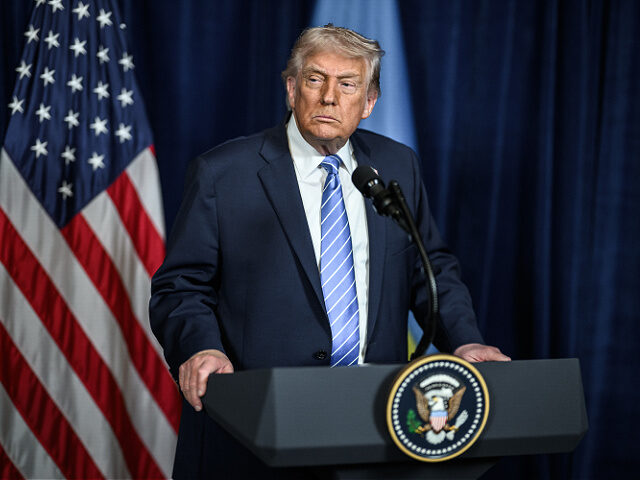
President Donald Trump used the veto for the first two times of his second term on two bills, one called the Finish the Arkansas Valley Conduit Act and the other called the Miccosukee Reserved Area Amendments Act.
In a press release from the White House regarding Trump’s veto of the Finish the Arkansas Valley Conduit (AVC) Act, it was explained that the AVC “is a water pipeline currently being built to provide municipal and industrial water to communities in southeastern Colorado.”
The press release went on to explain that the project for the pipeline — which was “originally authorized as part of the Fryingpan-Arkansas Project in a bill,” signed by former President John F. Kennedy — was supposed to be “initially funded by the Federal Government, but repaid by local users, with interest, over a 50-year period.”
The press release added that “the current bill would not have the Federal Government extend the repayment period”:
The Arkansas Valley Conduit (AVC) is a water pipeline currently being built to provide municipal and industrial water to communities in southeastern Colorado. It was originally authorized as part of the Fryingpan-Arkansas Project in a bill signed by President Kennedy in 1962. For decades it was unbuilt, largely because the AVC was economically unviable. Under the original plan, the costs of the project were to be initially funded by the Federal Government, but repaid by local users, with interest, over a 50-year period following completion of construction. But participants were unable to comply with that repayment obligation.
In 2009, President Obama signed the Omnibus Public Land Management Act of 2009, which not only reduced the payment obligation from 100 percent to 35 percent but also provided that miscellaneous revenues from the Fryingpan-Arkansas Project at large would count towards the AVC cost share. Even then, however, construction did not begin until 14 years later, after the State of Colorado authorized $100 million in loans and grants for the project.
The current bill would not have the Federal Government extend the repayment period (on the already-reduced repayment requirement) for an additional 25 years, creating a 75-year repayment period. The bill would also cut the interest rate in half.
“Enough is enough,” the press release from the White House added. “My Administration is committed to preventing American taxpayers from funding expensive and unreliable policies. Ending the massive cost of taxpayer handouts and restoring fiscal sanity is vital to economic growth and the fiscal health of the Nation.”
In a press release regarding the Miccosukee Reservee Area Amendments Act, it was explained that “the subject of this bill is a specific area in the Everglades National Park known as the ‘Osceola Camp'”:
The subject of this bill is a specific area in the Everglades National Park known as the “Osceola Camp.” In 1998, the Congress passed the Miccosukee Reserved Area Act, which authorized the Miccosukee Tribe of Indians of Florida (Tribe) to permanently occupy a certain area within Everglades National Park. The reserved area did not include the Osceola Camp. Nonetheless, the Tribe has a residential community in that area, including infrastructure for wastewater treatment and water supply, and is experiencing periodic flooding. H.R. 504 would require the Secretary of the Interior, in consultation with the Tribe, to take appropriate actions to safeguard structures within the Osceola Camp from flooding events.
The Osceola Camp was constructed in 1925, without authorization, in a low area that was raised with fill material. It served as a family residence and gift shop initially, and then later a site for air-boat rides. None of the current structures in the Osceola Camp are over 50 years old, nor do they meet the other criteria to be considered for listing in the National Register of Historic Places.
The previous administration developed a plan to protect and replace unauthorized infrastructure at the Osceola Camp, which could cost up to $14 million. But despite seeking funding and special treatment from the Federal Government, the Miccosukee Tribe has actively sought to obstruct reasonable immigration policies that the American people decisively voted for when I was elected.
“My Administration is committed to preventing American taxpayers from funding projects for special interests, especially those that are unaligned with my Administration’s policy of removing violent criminal illegal aliens from the country,” the press release added.
COMMENTS
Please let us know if you're having issues with commenting.