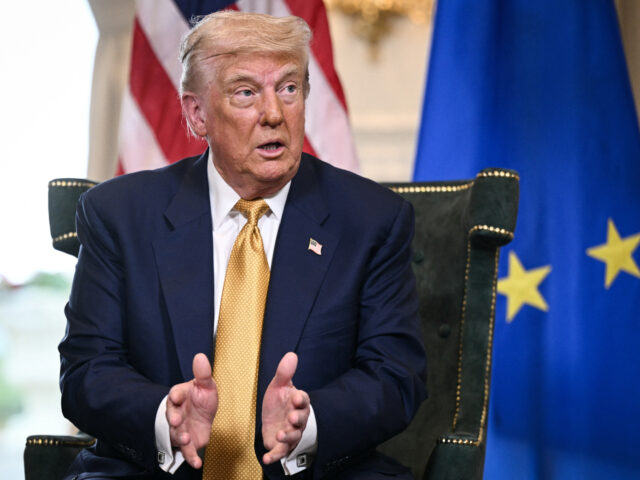
Neo-liberal politicos have frequently mischaracterised the ‘American First’ foreign policy of President Donald Trump as a return to the isolationism of the 19th century; however, the past year has seen the American administration actively intervene to break the globalist chokehold on Europe and to revive the spirit of the West.
Perhaps no president since Harry S. Truman, who helped rebuild Europe in the wake of two World Wars with the Marshall Plan, has been as involved in shaping the old continent according to his will as President Donald Trump. Building off the success of using the White House bully pulpit during his first term to force NATO allies to finally invest in their defence rather than solely relying on American military might, in the first year of his second term, President Trump has rebalanced the Transatlantic trade relationship, and has put heavy pressure on European allies to reject the dominant ethos of mass migration and political censorship.
Opening Volley From Vance

US Vice President JD Vance delivers his speech during the 61st Munich Security Conference (MSC) in Munich, southern Germany on February 14, 2025. (Photo by THOMAS KIENZLE/AFP /AFP via Getty Images)
Three weeks after taking the oath of office, U.S. Vice President JD Vance was dispatched to the Hotel Bayerischer Hof to represent the Trump administration at the Munich Security Conference, one of the highlights of the globalist conference circuit.
Tensions were high in the German city, with dozens of people being injured the day before the conference after an alleged asylum seeker from Afghanistan ploughed a car into a trade union rally. However, inside the luxury hotel, bigwigs from across Europe and the world waited, filled with anticipation to see the new American government’s stance on the international landscape, particularly on Russia’s war in Ukraine.
Yet the 41-year-old Vice President had other thoughts in mind and, in a landmark speech delivered from the main stage of the conference, proceeded to excoriate the leadership of Europe for their increasingly censorious approach to their own citizens, proclaiming: “In Britain and across Europe, free speech, I fear, is in retreat.”
Much to the chagrin of those in the room who have attempted to cast themselves as the champions of democracy in the face of Russian aggression in Ukraine and Moscow’s alleged election “interference”, Vance noted that the Cold War was fought against the Soviet Union in defence of the very liberties being trampled on today across supposedly democratic Europe.
The Vice President further declared that the greatest threat facing the West is not Vladimir Putin’s Russia or Xi Jinping’s China but rather from “within”, from the forces that seek to censor the public, use lawfare against political opponents, and even cancel elections as occurred in Romania just months prior, following a surprise victory for a Trump-aligned candidate.
While demands that European nations uphold the foundational values that bind the new world to the old may seem to many Americans as the least one would ask in return for the blood and treasure spent protecting allies, Vance’s speech was met with gasps of horror.
Indeed, the head of the conference, German diplomat Christoph Heusgen, literally broke down in tears, a stark contrast to his open laughter during President Trump’s 2018 United Nations speech, which prophetically warned that Germany had become over-reliant on Russian energy.
In the days and weeks following the address, shockwaves reverberated throughout the continent, with many without irony accusing the Trump administration of interfering in their democracies by advocating for free speech rights and for free and fair elections. Yet despite the performative outrage over the speech, the message from Vance rang out clearly: “There’s a new sheriff in town”.
Turning the Screw

US President Donald Trump (R) and European Commission President Ursula von der Leyen (2nd R) speak to the press after agreeing on a trade deal between the two economies following their meeting, in Turnberry south west Scotland on July 27, 2025. (Photo by BRENDAN SMIALOWSKI/AFP via Getty Images)
Just days after his deputy’s speech in Munich, President Trump delivered perhaps his most blunt remarks on the globalist European Union to that point, likening the bloc to other international interlocutors like China in terms of how they have “taken advantage” of the United States on trade since the end of the Second World War as America sought to help the continent recover financially.
“We have about a $300 billion deficit with the European Union. Now I love the countries of Europe, I guess I’m from there at some point a long time ago… but I love the countries of Europe. I love all countries, all different. The European Union, it was formed to screw to United States. Let’s be honest… that’s the purpose of it. And they’ve done a good job, but now I’m President,” Mr Trump said from the White House.
What followed were months of hardball negotiations from Trump and his team, imposing fresh tariffs on the bloc on key industries, including on automobiles, as well as on commodities like aluminium and steel, while threatening steep 200 per cent rate hikes on European wine and other spirits if the bloc carried through with threats to impose duties on American whiskey.
Then in a reversal of the infamous warning from former President Barack Obama that the UK would go to the “back of the queue” on U.S. trade should the British people vote to leave the European Union, President Trump struck a deal with London that will allow for greater market access for American goods and agriculture while taxing British imports at a baseline of 10 per cent.
After racking up deals across Asia and with the UK, pressure mounted on EU negotiators. Trump raised the stakes further by threatening a 50 per cent tariff on all European imports. As the clock ticked down on the deadline, Brussels caved in spectacular fashion. EU chief Ursula von der Leyen not only travelled to meet with Trump, but adding insult to injury, she had to do so at the president’s Turnberry golf resort in Scotland, which, as a part of the UK, had left the EU just five years prior.
With little leverage, the EU capitulated to nearly all of the Trump administration’s trade demands, dropping all of its tariffs on American goods, lowering other trade barriers, while accepting a 15 per cent duty to import into the United States, and committing to invest $600 billion in the U.S. and purchase $750 billion in American energy. The deal was instantly hailed on both sides of the Atlantic as a significant success for the Trump administration, and Breitbart News Economics Editor John Carney described the deal as the “birth of a new era in global trade“.
Allies Not Protectorates

WASHINGTON, DC – OCTOBER 22: NATO Secretary General Mark Rutte (L) shakes hands with U.S. President Donald Trump during a meeting in the Oval Office of the White House on October 22, 2025 in Washington, DC. (Photo by Alex Wong/Getty Images)
The rebalancing of the transatlantic trading relationship coincided with efforts to further reduce European dependence on America for protection. Since his first term in office, President Trump has been a frequent critic of wealthy European allies who neglect their own defence in favour of generous welfare states and socialised healthcare systems, while relying on the American taxpayer and soldier to fund and carry out their protection.
During his first term in office, Trump often pointed to chronically negligent NATO partner Germany, which had consistently failed to meet its 2 per cent of GDP defence spending requirement. At the same time that Berlin sought U.S. protection from Russia, Germany was one of the largest purchasers of oil and gas from Moscow.
While, as noted above, German diplomats openly laughed at Trump’s warnings about over-reliance on Russian energy, the American president was later proven prophetic, with Germany and much of Western Europe being caught completely flat-footed by the invasion of Ukraine. Indeed, the cutoff of much of Russian pipeline energy to Europe plunged the continent into economic turmoil, with many being forced to purchase Russian energy on the international market at inflated prices through go-betweens such as India.
Nevertheless, the nearly four-year war in Eastern Europe has apparently forced the bloc to come towards Trump’s position on defence and at the NATO Summit held in The Hague in late June, the Western military alliance partners agreed to increase defence spending requirements from two per cent of GDP to five per cent by 2035. President Trump hailed the agreement as a “monumental win” for America, Europe, and “Western civilisation” as a whole.
NATO Secretary General Mark Rutte remarked: “I think when somebody deserves praise, that praise should be given. And President Trump deserves all the praise, because without his leadership, without him being re-elected president of the United States, the [spending boost] would never, ever, ever have been [achieved].”
The revival of Europe as a military power is widely seen as critical to the broader American foreign policy goal of shifting U.S. focus away from Europe and the Middle East to Asia to counter the rising power of Communist China.
The successful pressure on Europe to pay for its own defence also undercut the longstanding narrative that President Trump was alienating Western allies with his America First agenda. Vice President JD Vance has argued that the demilitarisation of Europe was in fact a failure of past American administrations, pointing to the Suez Canal crisis in 1956 as a key turning point. In April, Vance said that ultimately the world would be better served with a confident and self-reliant Europe, saying: “It’s not good for Europe to be the permanent security vassal of the United States”.
Make Europe Great Again

06 March 2019, Bavaria, Dingolfing: A man is wearing a baseball cap with the inscription “Make Europe Great Again” at the FDP Political Ash Wednesday. Photo: Sina Schuldt/dpa (Photo by Sina Schuldt/picture alliance via Getty Images)
The issue of Europe’s lack of confidence and self-belief is perhaps best typified by its disastrous pursuit of an open-borders mass-migration agenda and the censorship apparatus imposed to quell dissent against it. A terrible cocktail of collective guilt over the sins of the Second World War, a desperate desire to prove anti-racist bona fides, and a devotion to GDP growth at all costs has seen the bloc open the floodgates of mass migration from Africa and the Middle East over the past decade.
Rather than the economic panacea promised by liberal elites, the influx of millions of often low-skilled migrants has placed a heavy strain on healthcare, welfare, and asylum systems across the bloc while coinciding with rising crime, frequent race riots, and terrorism. The scale of immigration has also led to social instability as native populations face the prospect of being demographically displaced in their homelands.
While President Trump has often erred on the side of leaving foreign nations to deal with their own internal social issues, the American leader has been one of the most vocal critics of the open borders agenda in Europe.
During a visit to Scotland, just days before coming to the landmark trade deal with Brussels, President Trump publicly warned that “immigration is killing Europe”.
“You better get your act together or you’re not going to have a Europe any more. You’ve got to get your act together… you’re allowing it to happen to your countries, and you’ve got to stop this horrible invasion that’s happening to Europe,” he said.
Doubling down on this point, the White House’s National Security Strategy memo, released last month, warned that Europe faces “civilizational erasure” if it continues globalist policies of mass migration. The memo further said that the Trump administration will seek to partner with “patriotic” parties and groups across Europe to reverse the damage of mass migration.
Meanwhile, the U.S. government has also begun a major pushback against the “industrial” censorship complex throughout the UK and Europe, which often seeks to silence populist and conservative critics of mass migration and the neo-liberal order.
In December, the U.S. State Department imposed visa sanctions on five British and European figures accused of censoring Americans and American companies. This included the CEO of the Center for Countering Digital Hate (CCDH), Imran Ahmed, a UK citizen with close ties to the left-wing Labour Party government who has engaged in attempts to “Kill Musk’s Twitter” and to blacklist conservative sites such as Breitbart News.
Also sanctioned was former European Commissioner for Internal Market Thierry Breton, the French businessman who served as the bloc’s unelected censorship czar until last year and who was the chief architect of the EU’s Digital Services Act (DSA) censorship legislation, which recently fined Elon Musk’s X platform €120 million ($140 million).
Secretary of State Marco Rubio said last week: “For far too long, ideologues in Europe have led organized efforts to coerce American platforms to punish American viewpoints they oppose. The Trump Administration will no longer tolerate these egregious acts of extraterritorial censorship.”
However, the pushback against censorship in the UK and Europe from the White House is not merely a function of protecting direct American interests, but instead of reviving belief in the bedrock values of the West.
The case for the paramount importance of reinstating freedom of speech in European democracies was perhaps most clearly defined by Vice President Vance in his remarks at the Munich Security Conference, when he said: “You can embrace what your people tell you, even when it’s surprising, even when you don’t agree. And if you do so, you can face the future with certainty and with confidence, knowing that the nation stands behind each of you.
“And that, to me, is the great magic of democracy. It’s not in these stone buildings or beautiful hotels. It’s not even in the great institutions that we have built together as a shared society. To believe in democracy is to understand that each of our citizens has wisdom and has a voice. And if we refuse to listen to that voice, even our most successful fights will secure very little.”
COMMENTS
Please let us know if you're having issues with commenting.