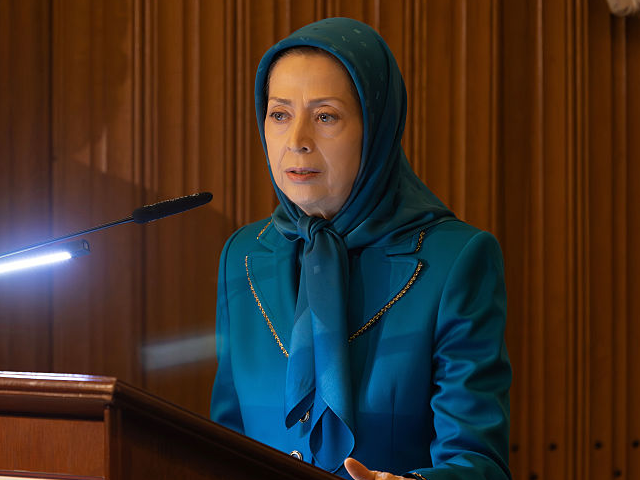

Iranian opposition leader Maryam Rajavi warned that the Islamic Republic’s escalating violence against protesters has exposed a regime under strain — but not one on the verge of collapse — arguing that Tehran will not fall through foreign military intervention or external pressure alone, but only through an organized, nationwide resistance capable of dismantling its repressive core.
Speaking in an exclusive interview with Breitbart News, Rajavi — the president-elect of the National Council of Resistance of Iran (NCRI) — said recent developments have made clear that while Iran’s clerical rulers are increasingly vulnerable, their weakening alone will not bring about the regime’s downfall.
‘This Regime Will Not Fall Through External Pressure’
Rajavi framed the issue as a strategic reality confronting Iran’s opposition rather than a question of outside force.
“Genuine transformation in Iran can be achieved only by the Iranian people themselves,” Rajavi said, through “an organized, nationwide resistance rooted in active, combat-ready forces inside Iran’s cities — a resistance capable of confronting and defeating one of the most brutal apparatuses of repression in the world today, the Islamic Revolutionary Guard Corps (IRGC).”
Such a resistance, she added, must also possess “the capacities, requirements, and concrete plans necessary for a peaceful transition after the overthrow.”
‘No Spontaneous Collapse — The IRGC Must Be Dismantled’
Rajavi rejected the notion that the regime could simply implode under pressure, arguing instead that its survival hinges on the IRGC — and that dismantling it is the prerequisite for change.
“There will therefore be no spontaneous collapse,” she said. “The prerequisite for toppling the regime is the dismantling of the IRGC through an uprising and an organized resistance.”
She said the NCRI has spent years preparing for precisely such a moment, describing the opposition coalition as uniquely positioned to prevent chaos after the fall of the regime.
Rajavi said the NCRI has the “practical readiness” to manage the post-overthrow period, citing the existence of an organized, deeply rooted nationwide network inside Iran, paired with a recognized democratic alternative and a broad pool of specialists inside and outside the country.
That combination, she explained, makes it possible for sovereignty to be transferred from dictatorship to the Iranian people “in an orderly, calm, law-based manner, without chaos or anarchy.”
What makes such a transition feasible, she added, is the presence of a ready political and executive framework for “the day after” — one the NCRI has been preparing for many years.
Under those plans, she said, a provisional government would be formed immediately after the overthrow, tasked with organizing free and fair elections for a Constituent Assembly within six months. That body would then appoint a transitional government and draft a constitution for a new Iranian republic to be submitted to a public vote.
‘Not Symbolic. Not Propaganda.’
Asked about the scale and organization of resistance inside Iran, Rajavi rejected claims that the movement exists only abroad.
“The MEK’s presence inside Iran is not symbolic nor merely propaganda,” she said, describing it as a movement forged through six decades of struggle against both the Shah’s dictatorship and the clerical regime, “through fire, blood, and sacrifice.”
She underscored the toll paid by the movement, noting that more than 100,000 of its members and supporters have been executed or killed under torture — including 30,000 political prisoners hanged in the 1988 massacre for maintaining their support for the MEK.
Turning to the current uprising, Rajavi said resistance units were active in at least 220 cities, providing on-the-ground reporting and detailed information about those killed and arrested.
She said a significant number of resistance members have been killed during the unrest, with some of their names made public.
Despite relentless repression by the IRGC, the Basij, and the security apparatus, Rajavi said the nationwide resistance network has endured due to its professional structure and culture of sacrifice.
The network, she explained, disseminates calls to action, links localized protests into nationwide waves, sustains morale, and raises the cost of repression for the regime — a capacity that has endowed it with formidable strength in social mobilization.
Why Tehran Is Targeting the Resistance
Rajavi argued that the regime’s own actions demonstrate how seriously it views the resistance.
“The clearest indicator of the Resistance’s active and impactful presence inside Iran is the regime’s own reaction to it,” she said, pointing to a sustained campaign of demonization and disinformation.
As an example, she cited an ongoing in-absentia proceeding in Tehran targeting 104 resistance members — most of them refugees in Europe — a process that has stretched over two years and involved more than 50 court sessions.
She said the presiding judge has called for their extradition, describing the case as a staged effort aimed at deterring young Iranians from joining the resistance.
A Transition Built to Prevent a Power Vacuum
Addressing divisions among opposition groups, Rajavi said the NCRI was formed precisely to avoid monopolization and institutional collapse.
She said the coalition has paid a heavy price for its commitment to democratic principles and has consistently rejected marginalizing other democratic forces.
Founded 44 years ago, she described the NCRI as the longest-standing coalition in Iran’s contemporary history — created with the explicit goal of enabling unity during the overthrow of the regime and the transition that follows.
She said the NCRI is grounded in a democratic structure, a clear political program, and a concrete governing roadmap with foundational principles articulated more than two decades ago in the Ten-Point Plan for a Free Iran.
Those principles include gender equality, separation of religion and state, minority rights including autonomy for Iranian Kurdistan, an independent judiciary, freedom of parties and media, abolition of the death penalty, and a non-nuclear Iran living in peace with its neighbors.
Rajavi said these plans are not theoretical, but are underpinned by thousands of experts, academics, and administrators inside and outside Iran who have spent years working on implementation across the economy, law, education, healthcare, energy, environmental policy, security, and transitional justice.
For that reason, she said, the NCRI — working alongside other democratic forces — can guarantee a transition without a power vacuum, without the collapse of state institutions, and without dangerous instability.
‘Neither Appeasement Nor War — A Third Option’
Rajavi’s comments come as Iran enters its most volatile moment in years, with protests that erupted in late December met by mass arrests, executions, and an ongoing nationwide internet blackout. President Donald Trump warned on Saturday that it is “time to look for new leadership in Iran,” prompting Tehran’s president to threaten “all-out war” if Supreme Leader Ayatollah Ali Khamenei were targeted.
As the rhetoric escalates, the United States has begun repositioning major military assets toward the region, underscoring the rapidly intensifying standoff as the Islamic Republic struggles to contain unrest at home.
Against that backdrop, Rajavi defended the NCRI’s long-standing insistence that regime change must be achieved by Iranians themselves — even amid reports of widespread killings.
“The massacre of thousands at the height of the January uprising is a deep and searing wound,” she said, noting that the killings, carried out across more than 200 cities, have only reinforced the strategy of change from within.
“The outpouring of this blood will draw ever more young people into the struggle and bring down the monster of religious despotism,” she said.
Rajavi said she articulated this approach more than two decades ago in a speech to the European Parliament, arguing that Iran’s crisis would be resolved neither through appeasement nor war, but through a “third option” — regime change led by the Iranian people and organized resistance.
She said recent events have only validated that view.
Without an organized resistance force on the ground, she warned, “the prospects for real change are extremely slim” — a reality underscored by both the recent 12-day war and the uprising that followed.
Rejecting passivity by the international community, Rajavi outlined steps she said could meaningfully support the Iranian people without military intervention: raising the cost of repression, pursuing legal accountability for regime crimes, cutting off financial and logistical lifelines of repressive forces, and guaranteeing access to the internet and open communications.
She emphasized that a truly effective step would be international recognition of the resistance and of rebellious youth confronting the regime.
External Pressure — Only When It Reinforces Internal Change
Rajavi said the NCRI has long called for sanctions, sustained pressure, and severing diplomatic relations — but only as tools that reinforce internal resistance.
External pressure, she said, is effective only when it serves that internal process.
She pointed to targeted sanctions — particularly blocking oil exports — political isolation, credible diplomatic pressure, and expelling regime operatives from Western countries, which she described as rear bases for the IRGC.
Such measures, she said, can raise the cost of repression and deepen fissures within the ruling apparatus — but none can replace the Iranian people themselves.
“We are neither seeking power nor a share of power,” Rajavi said. “We struggle and make sacrifices so that the people of Iran may reclaim their freedom, and so that sovereignty is returned to its rightful owners: the Iranian people.”
Over the years, the NCRI’s Ten-Point Plan has drawn support from thousands of lawmakers worldwide, including bipartisan members of the U.S. Congress, as well as international figures who have cited its framework for a future Iranian republic.
In 2002, the group was the first to publicly reveal Iran’s clandestine nuclear program, including the Natanz enrichment facility — disclosures that later became central to international scrutiny and sanctions targeting Tehran’s nuclear activities.
Joshua Klein is a reporter for Breitbart News. Email him at jklein@breitbart.com. Follow him on Twitter @JoshuaKlein.
COMMENTS
Please let us know if you're having issues with commenting.