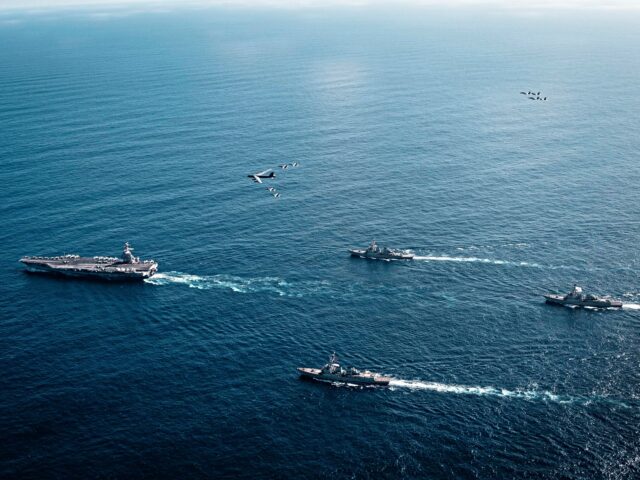
The United States has assembled the largest concentration of airpower in the Middle East since the 2003 Iraq invasion — deploying two aircraft carriers, advanced stealth fighters, refueling tankers, and layered missile defenses into theater — as multiple U.S. and Israeli reports warn President Donald Trump could authorize strikes on Iran “as soon as Saturday,” with talks described by American officials as “very far apart” and even a “near nothing-burger.”
Senior U.S. officials told CBS News that the military is prepared to launch strikes this weekend if ordered, with one official describing planning conversations as “fluid” but indicating forces are in place.
Separate reporting by CNN and the New York Times likewise confirmed strike options have been presented and that readiness timelines now point to the coming days.
Behind the scenes, Trump convened top national security advisers in the Situation Room on Wednesday, according to Reuters, as the Pentagon finalized positioning across the region.
Air Campaign Assets Flow Into Theater
The scale of the buildup represents the most formidable U.S. military posture in the Middle East in over twenty years.
The Wall Street Journal reported Wednesday night that Washington is assembling “the greatest amount of air power in the region since the 2003 invasion of Iraq,” including additional F-35 and F-22 stealth fighters, F-15s and F-16s, airborne command-and-control aircraft, and dozens of refueling tankers essential for a sustained campaign.
A second carrier strike group led by the USS Gerald R. Ford is moving toward the Mediterranean to join the USS Abraham Lincoln, which is already operating in the broader region. Destroyers capable of intercepting ballistic missiles are accompanying both groups.
According to flight-tracking data and defense reporting from The War Zone, additional fighter squadrons have flowed into bases in Jordan and Saudi Arabia, while aerial refueling “bridges” have been established through Europe to sustain operations.
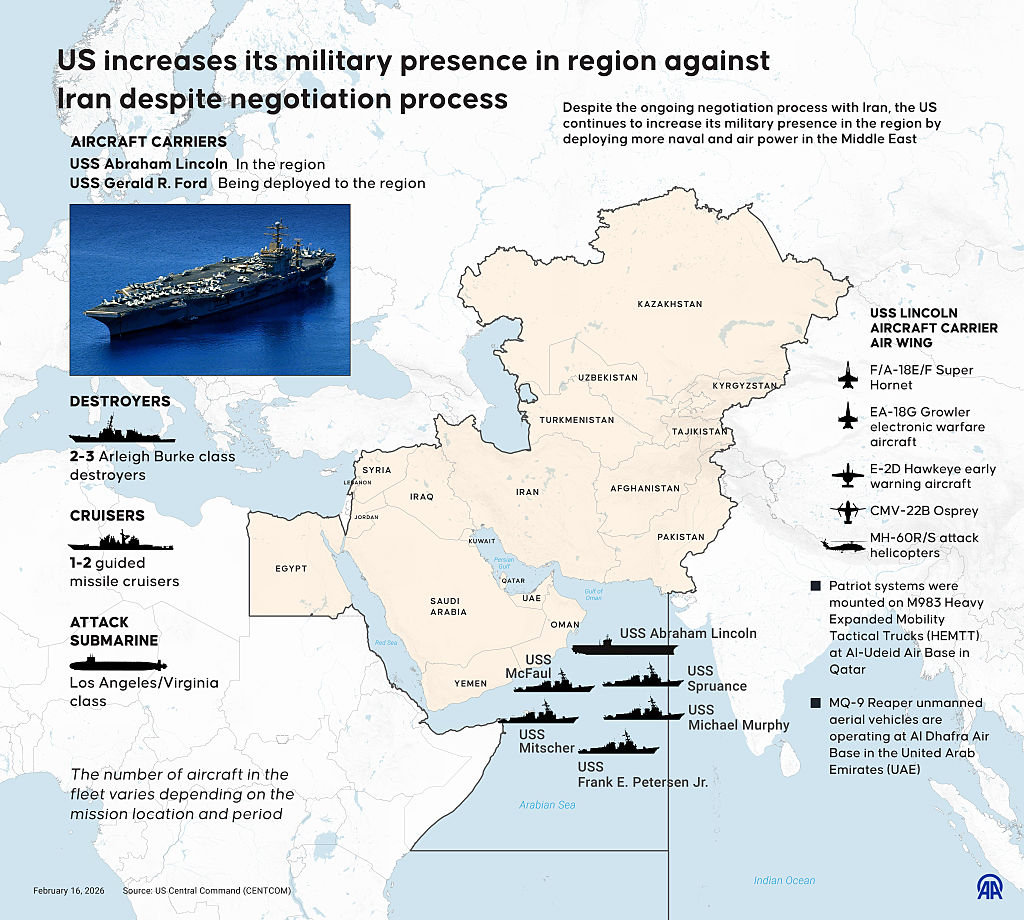
Despite the ongoing negotiation process with Iran, the US continues to increase its military presence in the region by deploying more naval and air power in the Middle East. (Omar Zaghloul/Anadolu via Getty Images)
The New York Times noted that Patriot and THAAD missile defense systems — previously thin in theater — have now been reinforced to protect the roughly 30,000–40,000 U.S. troops stationed across the region.
Officials told the Times the force package gives Trump the option of a sustained, multi-day or even multi-week campaign — not merely a limited strike like last year’s “Midnight Hammer” operation against three Iranian nuclear sites.
Talks Fracture as Red Lines Collide
The military surge is unfolding as diplomacy sputters.
Iranian Foreign Minister Abbas Araghchi described Tuesday’s indirect Geneva talks as producing agreement on a “set of guiding principles,” but a senior U.S. official told Israeli media the session was “a nothing burger,” while another U.S. official said the sides remain “very far apart.”
White House press secretary Karoline Leavitt confirmed that “a little bit of progress” was made, but stressed, “We’re still very far apart on some issues,” a fact Trump has also affirmed.
Vice President J.D. Vance said Tuesday evening that “the president has set very clear red lines,” adding that Iran has not yet shown willingness “to actually acknowledge and work through them.”
At issue is more than uranium enrichment.
U.S. officials are pressing for constraints not only on Iran’s nuclear activities but also on its ballistic missile arsenal and regional proxy network — demands Tehran has signaled it will not entertain.
Energy Secretary Chris Wright warned Wednesday that Iran acquiring nuclear weapons is “entirely unacceptable,” underscoring that Washington is prepared to act “one way or another.”
Meanwhile, Reuters reported that while Washington awaits a written Iranian proposal, military planning appears to be moving on its own clock. Leavitt declined to say whether Trump would wait for that proposal before acting.
Weekend Window Emerges
Multiple outlets now point to a compressed timeline.
CBS reported that military strikes could begin “as soon as Saturday.” CNN cited sources saying readiness could be achieved by the weekend. The New York Times likewise noted that Trump now has the option to act within days.
On Thursday, Iran has issued a NOTAM — a notice to airmen — for planned rocket launches across southern Iran, according to the U.S. Federal Aviation Administration website. Tehran is also conducting joint naval drills with Russia near the Strait of Hormuz.
Earlier this week, Iran fired live missiles during exercises in the Strait of Hormuz, through which roughly 20 percent of the world’s oil supply passes.
Iranian Supreme Leader Ali Khamenei escalated rhetoric Tuesday, warning that while an American warship is dangerous, “more dangerous than that warship is the weapon that can send that warship to the bottom of the sea.” He later posted an AI-generated image depicting the USS Ford submerged beneath the ocean.
Israel Moves to War Footing
Israeli officials are preparing for the possibility of U.S. action.
Two defense officials told the New York Times that significant preparations are underway for a potential joint strike. Israel’s security cabinet reportedly moved a meeting from Thursday to Sunday amid rising tensions.
An Israeli official cited in local reporting said there is a “high level of preparedness” for an American strike.
The Knesset’s Foreign Affairs and Defense Committee heard a confidential briefing from Home Front Command Chief Major General Shai Klapper on Wednesday, focusing on multi-theater readiness and civilian protection systems.
RELATED: President Trump — Iran Has Bad Negotiators Because We Had to Send the B-2’s
Committee chairman MK Boaz Bismuth said, “We are in challenging times. There is no one who doesn’t ask multiple times a day when there will be a conflict with Iran.”
Former IDF military intelligence chief Amos Yadlin warned publicly that he would “think twice” about flying this weekend — a comment widely interpreted as signaling elevated risk.
Israeli officials have also warned Hezbollah that intervention would bring a “very painful” response, while contingency planning includes possible Houthi involvement from Yemen.
Iran Hardens Sites, Prepares Continuity
Satellite imagery analyzed this week shows Iran burying tunnel entrances at Isfahan, fortifying sites near Natanz, and encasing a new structure at the Parchin military complex in what analysts described as a concrete “sarcophagus.”
Experts say such steps are consistent with preparing for renewed U.S. or joint U.S.–Israeli strikes.
The Wall Street Journal reported that Tehran is dispersing command authority and reviving the IRGC’s so-called “mosaic defense” doctrine — designed to preserve regime continuity in the event of decapitation strikes against senior leadership.
In other words, both sides are preparing for more than symbolic blows.
Strategic Bombers and Diego Garcia
Trump added another layer of signaling Wednesday, writing that it “may be necessary” to use Diego Garcia — the joint U.S.–U.K. base in the Indian Ocean used in prior long-range strike operations — if Iran refuses a deal.
B-2 stealth bombers used in last year’s strike on Iranian nuclear facilities are reportedly on heightened alert.
Unlike last year’s limited attack, current options reportedly include broader target sets — missile depots, nuclear facilities, command nodes, and potentially senior military figures — depending on presidential direction.
The Window Narrows
Diplomacy and war planning are now running in parallel — and converging.
Iran is hardening nuclear sites, issuing rocket launch notices, and conducting naval drills with Russia.
Israel has shifted to elevated readiness.
And the United States has surged more air power into the Middle East than at any time in over two decades.
Trump has repeatedly warned that if Tehran refuses his terms, “it’s going to be a bad day for Iran — very bad.”
Multiple U.S. outlets now suggest that day could come within days — possibly as soon as this weekend.
Joshua Klein is a reporter for Breitbart News. Email him at jklein@breitbart.com. Follow him on Twitter @JoshuaKlein.
COMMENTS
Please let us know if you're having issues with commenting.