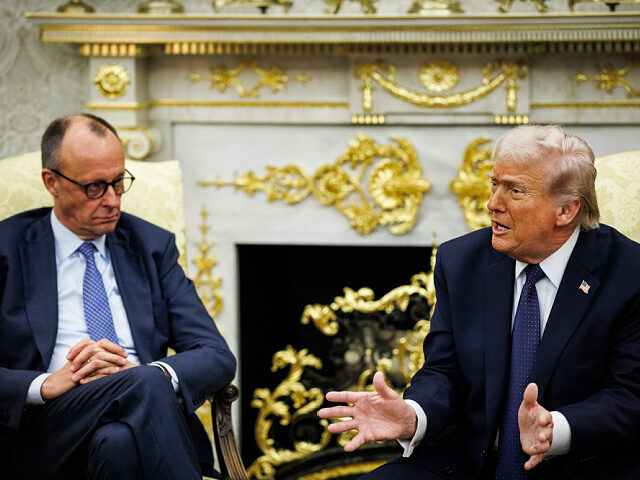

President Donald Trump on Tuesday blasted German Chancellor Friedrich Merz, warning that “the whole World would be held hostage” if Iran obtained a nuclear weapon as he pushed back on the German leader’s criticism of the U.S. approach to the conflict.
Writing on Truth Social, Trump rebuked Merz directly, stating that “the Chancellor of Germany, Friedrich Merz, thinks it’s OK for Iran to have a Nuclear Weapon,” adding, “He doesn’t know what he’s talking about!”
Trump cast the stakes in blunt global terms, warning that “if Iran had a Nuclear Weapon, the whole World would be held hostage,” while stressing that his administration is taking action against Tehran that “other Nations, or Presidents, should have done long ago.”
He then broadened the criticism to Germany itself, adding, “No wonder Germany is doing so poorly, both Economically, and otherwise!”
The remarks came a day after Merz, speaking to students at a school event in Marsberg, claimed Iran’s leadership was “humiliating” the United States, arguing that American officials were being sent to negotiations only to return “empty-handed.”
“An entire nation is being humiliated by the Iranian leadership, especially by these so-called Revolutionary Guards,” Merz said, while also questioning Washington’s strategy and suggesting the United States lacked a “clear” path to ending the conflict.
Trump’s response follows a series of moves by his administration signaling a harder line toward Iran, including rejecting proposals that would delay addressing Tehran’s nuclear program and emphasizing that any agreement must directly confront its ability to advance toward a weapon.
Over the weekend, Trump canceled a planned U.S. delegation trip to Islamabad, Pakistan, dismissing further talks as unproductive amid what he described as “tremendous infighting and confusion within their ‘leadership,’” adding that “nobody knows who is in charge.”
“If they want to talk, all they have to do is call!!!” Trump wrote at the time.
He reiterated that position in a Sunday interview, saying Iran could reach out directly if it sought negotiations, rather than continuing indirect talks that have failed to produce results.
Senior administration officials have pointed to divisions inside Iran as a key obstacle. Secretary of State Marco Rubio said Monday that Iran’s leadership is “deeply fractured internally,” with competing factions limiting the scope of any agreement.
Rubio added that Iranian officials often must “negotiate with other Iranians” before determining what they can offer, complicating efforts to reach a deal, and said that hardline elements driven by what he described as an “apocalyptic vision” ultimately control the regime’s decision-making — further constraining what any negotiator can deliver.
Recent reporting has similarly indicated that authority in Iran has shifted heavily toward the Islamic Revolutionary Guard Corps, leaving no single, decisive leadership structure clearly directing negotiations or strategy.
Against that backdrop, Trump has rejected proposals that would delay addressing Iran’s nuclear program, insisting any agreement must confront Tehran’s ability to advance toward a weapon from the outset.
“Iran has just informed us that they are in a ‘State of Collapse,’” Trump also wrote on Tuesday, adding that Iranian officials were seeking relief while “trying to figure out their leadership situation.”
Trump has also taken aim at European allies, including Germany, for hesitating to fully back U.S.-led efforts to pressure Iran, particularly around measures tied to securing the Strait of Hormuz, arguing that sustained economic and military pressure — not prolonged negotiations — is necessary to force meaningful concessions from Tehran.
Joshua Klein is a reporter for Breitbart News. Email him at jklein@breitbart.com. Follow him on Twitter @JoshuaKlein.
COMMENTS
Please let us know if you're having issues with commenting.