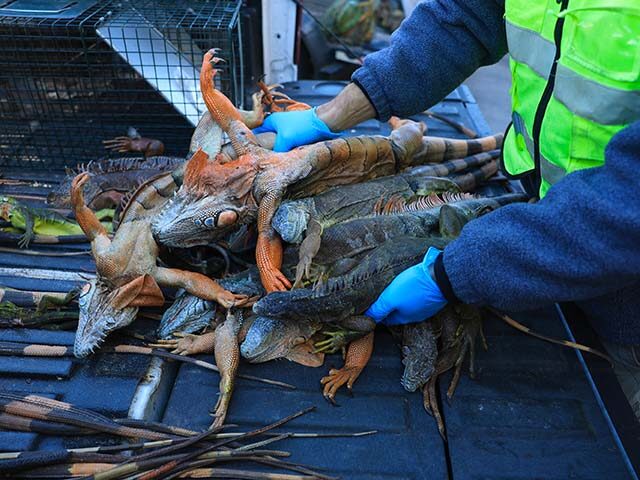
Some 5,000 scaly green iguanas were removed from southern Florida during the state’s recent frigid temperatures under a two-day exemption that allowed people to capture the cold-stunned reptiles without a permit.
The tally was reported this week by the Florida Fish and Wildlife Conservation Commission (FWC). The reptiles in cold temperatures can go into a “state of torpor, where they temporarily lose muscle control and appear ‘frozen’ — sometimes even falling out of trees.”
“Low temperatures in Miami reached 35 degrees on Feb. 1, while lows in West Palm Beach hit 30 degrees — breaking records for that date, set in 1909,” according to Fox News’s reporting of National Weather Service data.
The removal exemption covered February 1 and 2.
One YouTuber who goes by the name “Iguana Man” posted nearly 30 minutes of the reptile roundup:
At a meeting of the commission this week, FWC Executive Director Roger Young explained the exemption and its results:
The special regulations under EO 26-03 provided a unique opportunity for members of the public to remove cold-stunned green iguanas from their property during the recent unusual cold weather and bring them to the FWC, no permit required. As an invasive species, green iguanas have negative impacts on Florida’s environment and economy. The removal of over 5,000 of these nonnative lizards in such a short time span was only possible thanks to the coordinated efforts of many staff members in multiple FWC divisions and offices, our partners, and of course the many residents that took the time to collect and turn in cold-stunned iguanas from their properties.
Out of the 5,195 green iguanas, 3,882 of the invasive reptiles were collected at the FWC’s Sunrise drop-off location near Fort Lauderdale, the FWC reported.
The remainder came from Tequesta north of West Palm Beach as well as one of the Florida Keys and Fort Meyers on the Gulf Coast.
FWC staff coordinated the transfer of iguanas collected to permit holders, including for sale outside the state, while the remainder were “humanely killed by trained staff,” according to the FWS.
Iguanas are native to Mexico, Central and South America, and the Caribbean. They are not native to Florida and first showed up in the state in the 1960s, apparently as a consequence of the exotic pet trade.
“Because they’re an invasive species in Florida, iguanas can be humanely killed on a person’s property and are not protected except by the state’s anti-cruelty laws,” Fox News reported.
The FWC cautions residents who encounter the reptile during a cold snap to “never bring it into your home.”
“The FWC reminds the public that if you encounter a cold-stunned green iguana, you should never bring it into your home or building to warm up,” according to the release. “Iguanas can recover from cold-stunning more quickly than you may expect and, once recovered, can act defensively, with long tails that whip and sharp teeth and claws.”
Contributor Lowell Cauffiel is the author of the New York Times true crime best seller House of Secrets and nine other crime novels and nonfiction titles. See lowellcauffiel.com for more.
COMMENTS
Please let us know if you're having issues with commenting.