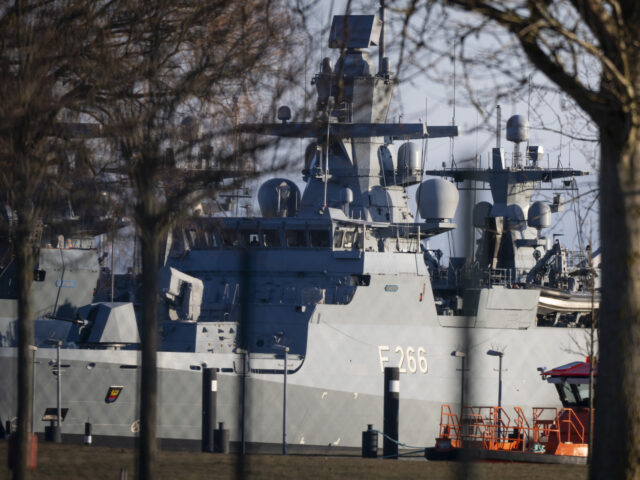
A joint European police operation has led to the arrest of two men over the alleged sabotage of German warships by dockyard workers, which could have “led to significant damage to the ships” had it not been detected.
Two men, a 37-year-old Romanian citizen and a 54-year-old Greek, were arrested on Tuesday in a joint operation between German, Romanian, Greek, and European Union police agencies. Their apartments were searched, and digital devices were recovered.
German prosecutors say the men, who were both contractors employed at the Blohm und Voss shipyard in Hamburg, a subsidiary of the German defence giant Rheinmetall, where “several” warships were sabotaged last year. It is alleged the Romanian man, who was employed as a painter, had poured 20 kilograms (45lbs) of abrasive steel shot blasting media into the main engine of the brand-new German navy corvette Emden.
It is further alleged that other acts of sabotage include “punctured fresh water supply lines, removed fuel tank caps, and deactivated safety switches in the ship’s electronics”. At least one other ship is said to have been sabotaged, but exactly how remains unclear.
While it was revealed last year that incidents had occurred at the naval shipyard, it was only after the arrests that it was confirmed that the government had concluded they were acts of sabotage. Remarkably, German newspaper Bild reports that at least one of the alleged saboteurs remained employed at the shipyard until this week and had access to the secure facility for over a year after the attempted sabotage was first discovered.
Tagesschau reports that the prosecutor said the attack could have “led to significant damage to the ships or at least to their delayed departure, thereby endangering the security of the Federal Republic of Germany” had the introduction of granular steel into the engine’s lubrication oil not been detected in time.
The names of the arrested men were restricted in line with German privacy law, but Greek newspaper Protothema states the arrested Greek male is a member of the country’s “Muslim minority” and that he was arrested in the village of Koptero, in the Rhodope region close to the Turkish border.
While reporting in the German media around the alleged sabotage has unfailingly noted the threat to Europe from Russia, and in parallel, hard-left activists have stepped up their campaign of sabotage against Germany, prosecutors have so far made no indication of whether they know why the men allegedly attacked the ships. Earlier in 2024, a German minehunter ship was sabotaged in a separate shipyard at Rostock.
Nevertheless, the method allegedly used against the German warship is a long-established and well-practised form of sabotage. The Second World War-era CIA forerunner, the Office of Strategic Services, trained saboteurs to put fine metal dust into engines to destroy them without making sabotage obvious and the saboteur vulnerable to detection. In 1944, it was stated in now-declassified documents:
Put metal dust or filings, fine sand, ground glass, emery dust (get it by pounding up an emery knife sharpener) and similar hard, gritty substances directly into lubrication systems. They will scour smooth surfaces, ruining pistons, cylinder walls, shafts, and bearings. They will overheat and stop motors which will need overhauling, new parts, and extensive repairs… Put any clogging substance into lubrication systems or, it it will, float, into stored oil. Twisted combings of human hair, pieces of string, dead insects, and many other common objects will be effective in stopping or hindering the flow of oil through feed lines and filters.
There are records of incidents in which just this sort of sabotage was suspected against warships in the past. Metal dust deliberately placed inside the engine was thought a possible cause of damage to submarine HMS Usk in 1941, it is claimed. British aircraft carrier HMS Terrible was thought to have been sabotaged in 1948 by having bolts thrown into the main engine gearbox, with potential communists working in the dockyards suspected. More recently new frigate HMS Glasgow had cables cut aboard, with a dispute over pay thought possibly responsible.
The British government was so aware of these issues during the Cold War, its domestic spy agency MI5 kept lists of known communists to round up in event of war to minimise the chances they would have to launch sabotage campaigns against the defence industry and key national infrastructure as the country transitioned to a wartime economy or, worse, prepared to weather an atom bomb strike.
In the Second World War, Germany’s navy was also sabotaged by French dockworkers, who were forced to work on the equipment of their occupiers. Famous submarine U-505, which now resides in the Museum of Science and Industry in Chicago, missed missions because of dockyard sabotage. It is said that: “One often-used trick was to undermine the integrity of the hull by packing ropes into welding seams. Another ingenious trick involved drilling a small, pencil-sized hole in the fuel tank that caused U-505 to trail a line of diesel oil, which could be spotted miles away by Allied aircraft”.
COMMENTS
Please let us know if you're having issues with commenting.