
The World Health Organization (W.H.O.) confirmed on Wednesday morning that the Hantavirus outbreak onboard a Dutch cruise ship Hondius is the rare Andes strain of the virus, which is endemic in Argentina and known to be transmissible between humans.
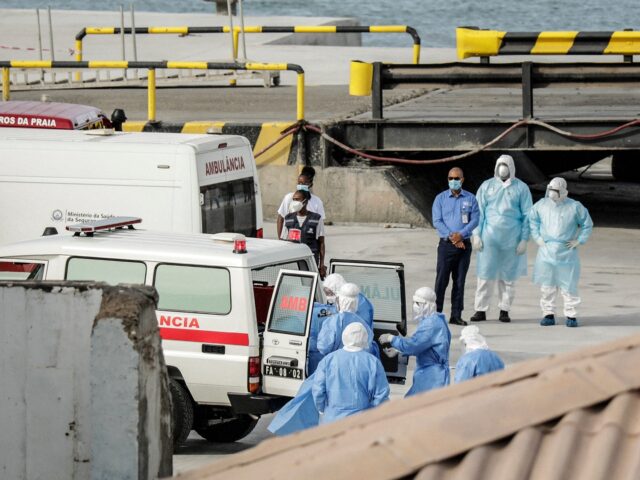
The Hondius – a luxury cruise ship that departed from Argentina en route to the Canary Islands, Spain – is currently isolated after documenting a hantavirus outbreak. As of Wednesday morning, the ship is reportedly marooned off the coast of Cape Verde after being denied permission to land.
The W.H.O. stated on Wednesday that there are eight cases aboard, three of which have been confirmed by laboratory testing. Three people have already been confirmed to have died.
The BBC reports that a 56-year-old Briton, a 41-year-old Dutch man, and a 65-year-old German national have been evacuated from the ship via helicopter to receive treatment in the Netherlands.
A Swiss man who travelled on the ship is also being treated for the virus at the Zurich University Hospital. Swiss authorities emphasized that the local population is not currently in danger.
On Tuesday, the government of Spanish socialist Prime Minister Pedro Sánchez announced that, in collaboration with the W.H.O. and the European Union, Spain will receive the Hondius and its crew and passengers on the Canary Islands after Cape Verde said it was unable to carry out the required health protocols. The Canary Islands, off the coast of Africa, are the next closest location for the ship to port in. It is expected to arrive in the next few days. The report did not specify which of the seven islands would accept the ship.
The Spanish government’s decision has drawn fierce opposition from the president of the Canary Islands’ local government. President Fernando Clavijo has rejected the ship’s planned arrival and accused Prime Minister Sánchez of responding to the urgent situation with “disloyalty” and lacking the necessary technical capability.
Clavijo spoke on Wednesday morning with local radio stations and outlets and affirmed that he opposes the ship’s arrival on the grounds that the Sánchez administration has neither consulted with him nor provided him with sufficient information on the developing situation — something that, he stressed, has left him “bewildered.” According to Clavijo, the actions of the Spanish government are “leaving much to be desired,” and publicly called for an urgent personal meeting with Sánchez and his team to address the situation.
“This [Wednesday] morning, in light of the news we’ve seen, I reached out to President Sánchez via WhatsApp and asked to speak with him urgently,” Clavijo told the Spanish radio network Cope, and added, “We walked out of a technical meeting where a decision was made without any technical report to back it up.”
The president emphatically told Cope that he will not “blindly jeopardize” the Canarian population due to Madrid not acting “in good faith.”
“Why subject those passengers to a three-day voyage to the Canary Islands just to do here what they could do in Cape Verde?” he asked, questioning the arguments espoused by the Spanish government, and added, “And if they aren’t infected and there isn’t a health emergency, why not let them continue on to the Netherlands? […] Why take them to the Canary Islands?”
Later, speaking to the radio station Onda Cero, Clavijo reiterated that the Spanish government has not provided him with medical or epidemiological reports that can justify the ship’s planned docking at the Canary Islands and stressed that he was only sent a WhatsApp message notifying him of the need to evacuate an infected patient from the ship.
He made similar remarks to the Spanish public broadcaster RTVE, during which he argued that the decision to have the cruise ship dock in the Canary Islands was not based on any “technical” criteria, but rather on “political” reasons he claimed he did not understand.
COMMENTS
Please let us know if you're having issues with commenting.