
The Spanish government has disclosed details of its response plan it intends to deploy for the Dutch cruise ship Hondius, facing a hantavirus outbreak, once it arrives at the Canary Islands this coming weekend.
The Hondius and its 147 passengers are expected to arrive at the Port of Granadilla in Tenerife over the weekend after the World Health Organization (W.H.O.) deemed it the nearest safest location to arrive.
Per the Spanish Health Ministry, the outbreak aboard the ship has resulted in eight confirmed and suspected cases. Three of those people have died, one is hospitalized in Switzerland, one hospitalized in South Africa, and three symptomatic patients that were evacuated from the ship to Amsterdam.
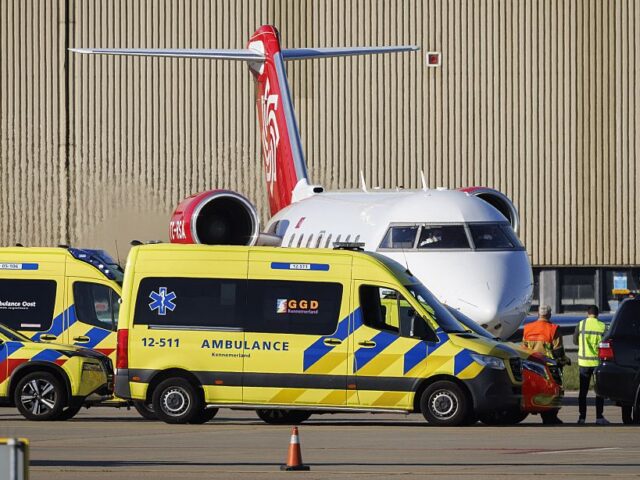
Of the passengers and crew, Spanish Health Minister Mónica García explained that those with active or symptomatic cases are being directly evacuated by air from the ship’s last location at Cape Verde to high-security isolation units in hospitals to receive specialized care.
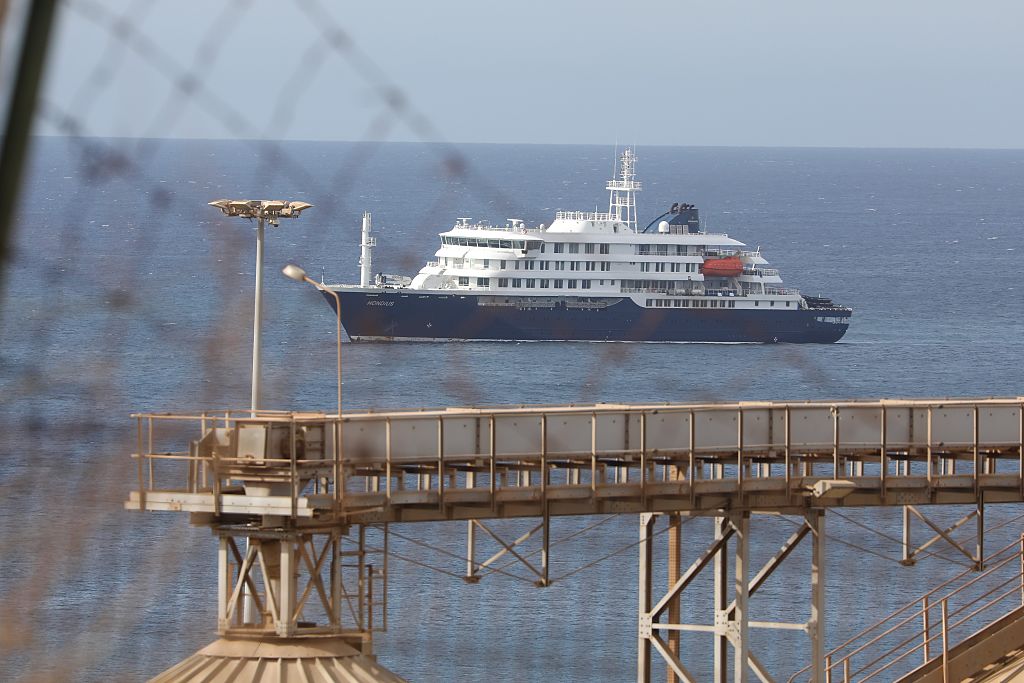
The Dutch cruise ship MV Hondius is anchored off Praia, Cabo Verde, May 6, 2026. Cabo Verde on Wednesday carried out an air evacuation of three passengers suspected of hantavirus infection from the Dutch cruise ship MV Hondius, which had been anchored off the capital, Praia. The evacuation was conducted under strict security and health protocols, with personnel from the national police and public health services deployed from the Port of Praia to Nelson Mandela International Airport on Santiago Island. The three passengers were transferred by air ambulance, with the two aircraft departing at 10:55 a.m. local time 1155 GMT in quick succession. According to the World Health Organization, the patients would be transported to the Netherlands for specialized treatment. (Photo by Elton Monteiro/Xinhua via Getty Images)
Asymptomatic passengers and crew, and those deemed to have been in close contact with the outbreak, will make the journey aboard the ship to the Canary Islands. Controlled health protocols for disembarking, García further detailed, will see passengers directly transported from the port to an airport and sent to their respective countries, avoiding at all times any transit through areas open to the general public.
As for the Spanish passengers if their primary residence is in Spain, they will be transferred to the Gómez Ulla Military Hospital in Madrid by the Defence Ministry, where they will undergo quarantine protocols under medical supervision.
The newspaper El País reports that Defence Minister Margarita Robles affirmed that the quarantine will be “voluntary,” and individuals will be requested to sign a consent form for their admission under grounds that asymptomatic individuals cannot be subjected to a “regime of deprivation of liberty.”
The Health Ministry, on the other hand said they intend to use all “legal measures” to ensure high-risk individuals comply with the quarantine protocols. “I am convinced that both families and passengers are responsible enough and have enough common sense,” Health Minister García said on Thursday morning per the public broadcaster RTVE.
García emphasized to the Spanish population that the risk continues to be “very low,” and stressed that although some clinical forms of hantavirus can have a high fatality rate, the specific context of the outbreak aboard the ship is “much more conducive to potential person-to-person transmission.”
The W.H.O. identified the hantavirus outbreak aboard the Hondius to be the Andes strain, a rare variant of the virus known in Argentina and transmissible between humans. The Hundius had departed from Argentina towards the Canary Islands on its cruise when the outbreak started.
The Spanish government accepted W.H.O.’s request to let the ship dock in its territory on “international law” and “moral obligation” grounds despite the fierce opposition from the president of the Canary Islands government, Fernando Clavijo, who challenged the decision and slammed the Spanish government for allegedly not providing his office with adequate information on the developing situation. He said his regional government had been left out of the decision-making process.
COMMENTS
Please let us know if you're having issues with commenting.