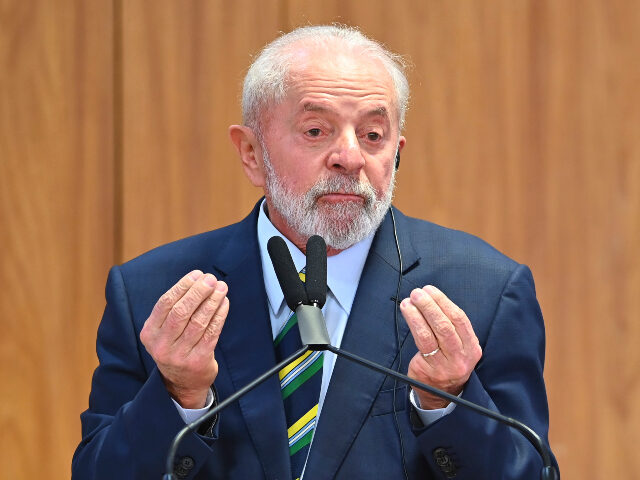
Socialist President of Brazil Luiz Inácio Lula da Silva said on Thursday that freedom for Venezuela’s deposed dictator Nicolás Maduro is “not a main concern” of his regarding the neighboring country.
The Brazilian president claimed that strengthening Venezuela’s democracy, the return of the more than eight million Venezuelans who fled from their country, and restoring the Venezuelan state-owned oil company PDVSA’s lost oil output are more important than a hypothetical scenario of Maduro returning to Venezuela from his detainment in Brooklyn, New York, where he is presently awaiting trial on multiple narco-terrorism charges.
Lula spoke with UOL journalist Daniela Lima in Brasília regarding his upcoming trip to Washington and his scheduled encounter with President Donald Trump in the White House during the first week of March. Lula said that he plans to hold a face-to-face conversation with Trump and not “keep talking on Twitter,” asserting that he is open to discussing with Trump industry partnerships, mining, and rare earths, but that the sovereignty of his country is “sacred.”
During the interview, he touched upon the subject of the developing situation in Venezuela following the January 3 U.S. law enforcement operation in Caracas that resulted in the arrest of Nicolás Maduro and his wife, “First Combatant” Cilia Flores. Lima asked Lula if he thought there was “anything that can be done” to ensure the return of Maduro and Flores to Venezuela. Lula interrupted the journalist and stressed, “That is not the main concern.”
“The main concern is the following. Is there a possibility that we can strengthen democracy in Venezuela and that the Venezuelan people, 8.4 million people who are outside the country, can return to Venezuela? Are there conditions in place to ensure that democracy is effectively respected in Venezuela and that the people can actively participate?” Lula asked.
“What is at stake is whether it will improve people’s lives or not. Whether it will generate jobs or not,” he continued. “What is at stake is whether PDVSA [Venezuela’s state-owned oil company] will return to producing 3.7 million barrels of oil per day instead of the 700 [thousand] it produces today.”
The Brazilian president’s apparent dismissal and abandonment of Maduro marks a notably different stance towards the now-deposed socialist dictator, with whom Lula held years-long friendly ties. Lula stood among the group of regional leftist heads of state that fiercely condemned the United States’ military operation in Caracas to arrest Maduro, condemning the “bombing” of Venezuela as “unacceptable.”
The Venezuelan socialist regime has ruled over Venezuela for 27 years and was first led by Hugo Chávez from 1999 until his death in 2013, then by Maduro, his chosen successor, from 2013 to January 3, 2026. Presently the regime is led by “acting President” Delcy Rodríguez following Maduro’s arrest.
Lula harbored deep friendly ties with Chávez, especially throughout the years that both were the respective heads of state of their countries during Lula’s first two presidential terms (2003-2011). The Brazilian president continued to maintain friendly ties with the Venezuelan regime under Maduro and had his country restore ties with Venezuela on the first day of his third term in 2023 after his predecessor, conservative former President Jair Bolsonaro, had Brazil cut all relations with Venezuela in response to Maduro no longer being the legitimate president of the country following the sham 2018 presidential election. At the invitation of Lula, Maduro visited Brazil on May 2023.
The Brazilian president’s relationship with the now-deposed dictator became strained in the aftermath of Maduro’s sham July 2024 presidential election and Maduro’s refusal to show any evidence or documentation of his alleged “victory.”
Lula da Silva’s top foreign policy adviser, Celso Amorim, told reporters at the time that Maduro had personally promised him he would present evidence of his electoral “victory,” however, no such thing ever occurred and at press time, no Venezuelan regime authority has presented any evidence of the claimed results.
The Brazilian president responded by blocking Maduro from securing a long-coveted membership seat at the BRICS anti-U.S. bloc during the group’s Summit in October 2024, hosted by Russian strongman Vladimir Putin. Amorim cited a “breach of trust” and not a problem with the regime itself as justification for vetoing Venezuela out of BRICS.
Although Lula did not recognize Maduro as the winner of the sham 2024 election, he also did not recognize opposition candidate Edmundo González as Venezuela’s legitimate president-elect despite several teams under the leadership of Nobel Peace Prize laureate María Corina Machado securing vote tallies from the day of the election that demonstrated González’s landslide victory against Maduro.
Lula reportedly affirmed during the interview that the governments of Venezuela and the United States “need to understand each other,” and recounted having advised Hugo Chávez on the importance of reaching an understanding with former president George W. Bush. Chávez held a notoriously antagonistic stance towards Bush, accusing him of being “the devil himself” during a speech at the United Nations and repeatedly branding him “Mister Danger” during his lengthy television broadcasts.
The Brazilian president compared the situation between the U.S. and Venezuela to a ‘compadre’ fight, or a fight among friends, noting that Venezuela sold oil to the United States in the past.
Christian K. Caruzo is a Venezuelan writer and documents life under socialism. You can follow him on Twitter here.
COMMENTS
Please let us know if you're having issues with commenting.