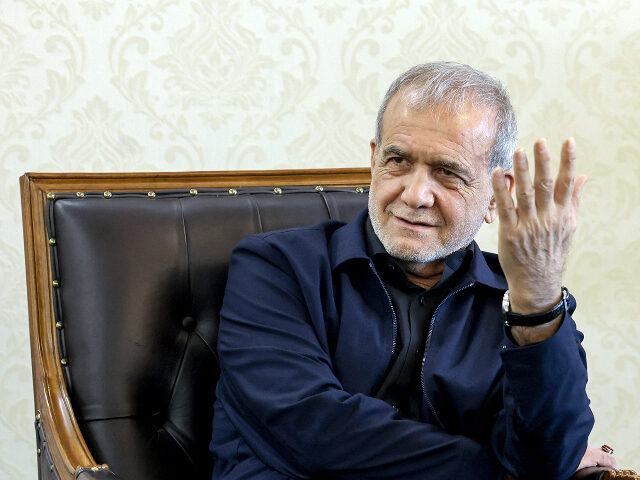

Iran reportedly aired a broadcast on state television this week in which President Masoud Pezeshkian claimed to have met “supreme leader” Mojtaba Khamenei, multiple news outlets reported on Thursday, suggesting that the civilian government head is seeking some support from the theocratic wing of what is left of the regime.
Mojtaba Khamenei was proclaimed the successor to his father, late dictator Ali Khamenei, following his death on February 28 as a result of America’s “Operation Epic Fury.” The younger Khamenei has not been seen in public since being decreed the next dictator, nor has he broadcast any video or audio messages that would prove that he is alive and capable of running a government. Iranian state media have published written statements alleged to have come from Khamenei, but these have been read off a piece of paper by propagandists on television, leaving the health status of the “supreme leader” unclear.
As a result of Tehran’s secrecy surrounding the Khamenei son, a variety of rumors have erupted suggesting that he was severely injured in the airstrike that killed his father or otherwise physically unable to take the actions necessary for the day-to-day administration of Iran. Some of those reports claimed that Khamenei was hospitalized and unconscious, while others suggested that he had lost one of his legs and been otherwise severely disfigured. Other, more outlandish rumors also began circulating accusing Mojtaba Khamenei of homosexuality.
The individuals who remain in charge of the Iranian regime – after American and Israeli military actions killed dozens of the most senior administrators in the dictatorship – have insisted that Mojtaba Khamenei is in good health, failing to explain his public absence but dismissing rumors of alleged health struggles.
While the people have yet to see Mojtaba Khamenei in public, Pezeshkian claimed on television that he had enjoyed an extended visit with the “supreme leader.” According to the U.K. Times, Pezeshkian described his purported meeting with Khamenei positively, calling their conversation “direct” and “frank” and celebrating the “humble” atmosphere he said existed between them. The president claimed he “attended this meeting with a spirit based on simplicity, humility, warmth and mutual respect, which made the atmosphere of the conversation completely direct, frank and filled with a sense of closeness and trust.”
“What stood out to me more than any other topic in this meeting was the humble and deeply cordial manner, perspective and approach of the supreme leader,” the Times quoted Pezeshkian as saying on television.
The reports claimed that the two met for nearly two and a half hours. The report did not indicate where this meeting took place and it is not clear whether Khamenei is in Tehran. Pezeshkian does appear to be in Tehran. In April, he and Foreign Minister Abbas Araghchi walked the streets of the capital, taking selfies with passersby and shaking hands in an apparent show – to the Iranian terrorist armed forces and clerics as much as to the United States and Israel – that they remain popular with the Iranian people.
The reports did not specify when, exactly, the purported Pezeshkian-Khamenei meeting took place. The Islamic Republic News Agency (IRNA), a state outlet, reported on Thursday that Pezeshkian had visited the Ministry of Industry, Mine, and Trade, that day, so if his meeting with Khamenei was recent – if it occurred at all – it would have had to take place reasonably near Tehran.
Pezeshkian’s tone in his comments during the Industry Ministry meeting was strident, despite his reputation for being the more “moderate” official in the current regime.
“The president warned that raising unrealistic expectations and neglecting the importance of dignity and independence could lead to renewed dependency and weakness for nations,” IRNA paraphrased him as saying. He described the regime’s intransigence in refusing a peace agreement with the United States as a “difficult yet honorable path ahead for the Iranian nation.”
Mojtaba Khamenei’s most recent written statement surfaced in late April and also discouraged negotiation with the United States, particularly on Iran’s terror policy in the Strait of Hormuz. He announced, without details, the beginning of a “new legal framework and management system” for the Strait, and a future “free of America” for the region.
“We, the peoples and neighbors of the Persian Gulf and the Sea of Oman, share a common destiny, and the foreigners who covetously meddle here from thousands of kilometers away have no rightful place, except at the depths of its waters,” the statement declared.
President Donald Trump has repeatedly complained to reporters that negotiating with the Iranian regime is challenging in part because it is unclear to the White House’s diplomatic team who exactly is running the country.
“Iran is having a very hard time figuring out who their leader is! They just don’t know!” Trump wrote bluntly in late April. “The infighting is between the ‘Hardliners,’ who have been losing BADLY on the battlefield, and the ‘Moderates,’ who are not very moderate at all (but gaining respect!), is CRAZY!”
“There’s tremendous discord — they’re having a tremendous problem getting along with each other,” Trump said on May 1. “The leadership is very disjointed. It’s got two, three, maybe four groups … they all want to make a deal, but they’re all messed up.”
Khamenei’s inability to enforce his leadership is a main factor in the discord. Under Ali Khamenei, all arms of the Iranian terror regime were subordinate to him, and the “supreme leader” regularly mediated disputes between the civilian and military wings of the government. Even then, conflict often arose, such as when reports revealed former Foreign Minister Mohammad Javad Zarif complaining that late terror mastermind Qasem Soleimani, the head of the notorious Islamic Revolutionary Guard Corps (IRGC) Quds Force, was usurping his diplomatic power. When Zarif’s grievances leaked, Ali Khamenei personally intervened to condemn the foreign minister in public.
COMMENTS
Please let us know if you're having issues with commenting.