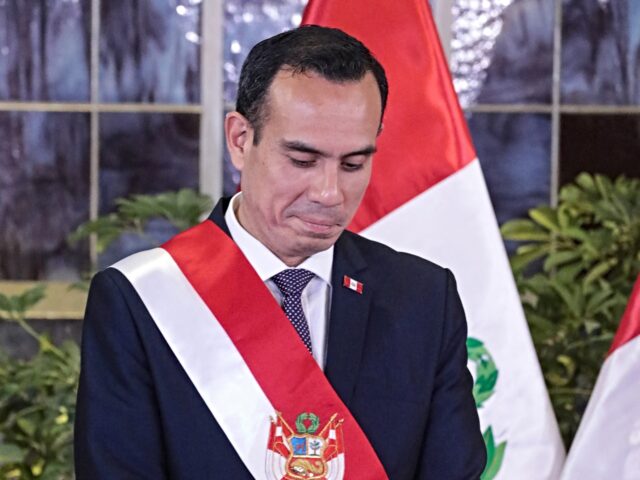

A court in Peru on Monday ruled that President José Jerí must comply with a psychological treatment for “psychosexual pathology” that he failed to submit himself to after he was accused of alleged rape in 2025.
Jerí is the eighth President Peru has had in the past ten years and, like his recent predecessors, has found himself embroiled in scandals before and after taking office as head of state. Jerí succeeded Dina Boluarte in October 2025 after the Peruvian Congress impeached her due to “permanent moral incapacity.” At the time, Jerí served as the head of the Peruvian parliament and succeeded Boluarte following the presidential line of succession, as Boluarte had not appointed a vice president.
At press time, Jerí is hours away from potentially facing an impeachment process by members of Congress. Peruvian lawmakers are expected to hold a multi-hour session on Tuesday, February 27, to assess seven different censure motions against Jerí.
Some of the motions stem from allegations of presumptive influence peddling stemming from a local scandal known as “Chifagate” that erupted over the Peruvian president’s undisclosed meetings with a Chinese businessman. Other censure motions stem from an ongoing probe by Peruvian prosecutors against Jerí over the alleged irregular hiring of five women into his government — all of whom have conducted nightly visits to Jerí at the Peruvian Presidential Palace after they were hired.
In late December 2024, months before he took office as president, an unidentified woman filed a complaint against Jerí at a civil court in the town of Canta, accusing him of raping her while she was unconscious during a New Year celebration. In addition to issuing protective measures against the alleged victim, the Canta civil court ordered Jerí to undergo psychological treatment for “impulsive and pathological sexual behavior.” Jerí did not comply with the court-mandated therapy sessions. The case against Jerí was ultimately archived on August 2025 after prosecutors determined that there was insufficient evidence to proceed against Jerí.
The Peruvian president referred to the mandated psychological therapy sessions he did not attended while speaking in an interview with Peruvian journalist Milagros Leiva on Sunday. According to Jerí, he did not attend the therapy sessions because he did not receive a “valid” notification from the judiciary regarding the sessions. Jerí asserted that the measures came from a court that had “no jurisdiction” to hear his case and, because of his position as a lawmaker, it was for another judicial instance to decide on the actions against him.
“If, from the outset, in the most complicated part of the complaint, I agreed to cooperate and participate, it would be illogical and inconsistent not to accept another recommendation, provided that I had been duly notified,” he said. “You can’t cooperate in one thing and not cooperate in another. It’s inconsistent, and I’m not inconsistent. If it had arrived validly, I would have complied with what had been recommended to me.”
Peruvian and international outlets reported on Monday that Judge Sonia Tello of the Civil Court of Canta ruled that Jerí must undergo the specialized “psychosexual disorder” therapy as part of the 2025 rape complaint. Judge Tello reportedly argued that, although one of the previous notifications was “annulled due to formal errors,” the protective measures and the order for psychological treatment remain in force and, as such, Jerí is obliged to comply with the court.
The court ruling reportedly stated that the therapies include “psychological support sessions for managing impulsivity, anger control, and pathological sexual behavior” as per the terms of the original January 2025 measures. Judge Tello referred to Jerí’s past attempts to invoke parliamentary immunity to avoid undergoing therapy and argued that it is not applicable to civil or rights protection proceedings, such as those involving the January ruling.
The judge also indicated that, while Jerí also filed an appeal against the court-mandated therapy sessions, it was admitted without suspensive effect. As a result, the obligation to begin the psychological therapy sessions is not postponed while the appeal is being resolved at a higher court.
“The defendant[Jerí] must comply with the psychological therapy ordered by Resolution No. 1 dated January 15, 2025, and if he is not satisfied with the decision, he may file the appeals permitted by current procedural regulations,” the court order reads, according to Infobae.
“The court also specified that the notification was delivered formally—although one of the previous methods was not considered valid—and that the 15-business-day period to begin treatment began to run from the confirmation of the ruling by the judiciary,” The Peruvian newspaper La Razón reported.
The February 17 Congress session to assess the possible impeachment of José Jerí occurs roughly two months before Peru is slated to hold a new presidential election. At press time, there are 36 different candidates running on the ballot. Jerí is not running in the election and, if he is not impeached before, he will leave office on July 28, 2026.
Christian K. Caruzo is a Venezuelan writer and documents life under socialism. You can follow him on Twitter here.
COMMENTS
Please let us know if you're having issues with commenting.